Esther
You Should Have LeftEsther is the four-year-old daughter of the unnamed narrator and Susanna, and the child through whom the novel’s family drama remains concrete while the rented mountain house becomes increasingly impossible. At first she represents a more manageable stage of family life: having recently turned four, she can do much more by herself, and the parents no longer argue constantly over who will get her up, put her to bed, or play blocks, trains, and Legos with her. As the house’s geometry and reflections begin to disobey ordinary rules, however, Esther becomes both the family’s most vulnerable member and the narrator’s decisive responsibility. Her safety determines his choices even when the marriage, the house, and his own identity are coming apart.
Identity and Everyday Life
Esther is introduced through the routines of care that define the family’s temporary stay. She plays on the carpet while the unnamed narrator tries to write, making noise with Susanna and interrupting his concentration; his apparent productivity becomes partly a performance designed to prevent Susanna from accusing him of not working. Yet the domestic irritation never cancels affection. The narrator insists that he loves Susanna and wants no other life, and Esther’s presence helps explain both the tenderness and the strain embedded in that claim.
Her age is important to the family’s changing rhythm. Having turned four the previous week, she is no longer wholly dependent, and the narrator observes that life is already becoming easier because the parents have fewer repeated disputes about childcare. The observation gives her development a practical meaning: growing independence should have allowed the adults to recover time and intimacy. Instead, the mountain house redirects their remaining energy toward concealment, suspicion, and escape. Esther’s ordinary maturation therefore stands in sharp contrast to the environment’s regression into confusion.
She responds vividly to small objects and stories. When she brings the unnamed narrator a commonplace rock found outside, he enthusiastically praises it and kisses her while her skin is still cold from the evening air. Esther imagines that the stone looks like a diamond, and he accepts her interpretation rather than correcting it. At breakfast she laughs and claps while Susanna reads yet again from a book about a mouse and the cheese moon. These moments establish Esther’s imaginative attention and the parents’ habitual language of encouragement, even as the adults’ own exchanges become evasive and hostile.
Fear Inside the House
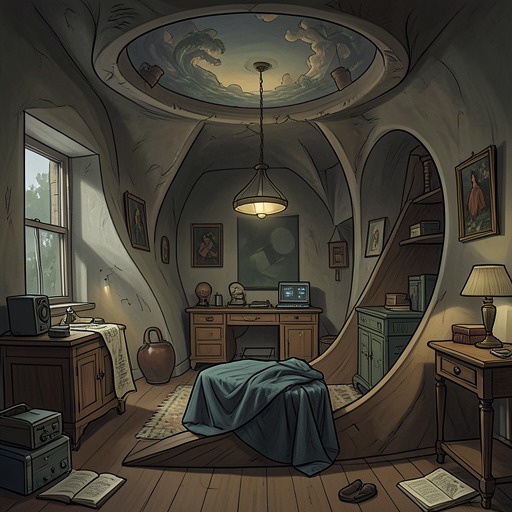
The house gradually ceases to be a reassuring setting for Esther. After her bath, the unnamed narrator dresses her in her favorite colorful pajamas, decorated with dinosaurs, and carries her to a room whose walls are marked with green and violet circles. A new teddy bear sits on the shelf, perhaps forgotten by another renter or placed there by Steller. Esther had previously found the room wonderful, but that evening she no longer accepts it as safe. When asked what is wrong, she says that she does not want to be alone there. Her fear gives the house’s spatial anomalies an intimate measure: the threat is not only an abstract violation of geometry but a child’s refusal to remain in a room that had seemed attractive and new.
The parents’ conflict is repeatedly filtered through Esther’s presence. During dinner, Susanna and the unnamed narrator accuse each other of acting strangely while Esther attempts to tell a confused story about a preschool friend, whose name and actions neither adult can quite reconstruct. They respond with exaggerated approval until she stops speaking, and the relief at the end of her story briefly brings them closer. Her speech thus functions as both a source of interruption and a temporary emotional buffer within the marriage. When the confrontation over Susanna’s messages to David erupts, Esther is looking up at the adults as the narrator shouts or croaks. Susanna tells him to pull himself together and think of his daughter, then lifts Esther from the floor and takes her upstairs, preserving a calm maternal routine amid the marital rupture.
Esther is also exposed to the house’s impossible duplication. The baby monitor shows her sitting up and looking into the camera with gleaming white eyes. Later, the unnamed narrator sees her on the monitor while she is undeniably lying beside him on the living-room sofa, apparently sleeping peacefully as a strange voice sings to her. He pulls the plug after carrying her downstairs and locking the living room door. The contradiction transforms the monitor from a household instrument of reassurance into evidence that the house can produce more than one version of the child, or more than one place in which she exists.
The Child as the Narrator’s Responsibility
The unnamed narrator’s decisions become most decisive when Esther is involved. After seeing the impossible image on the monitor and finding her asleep in her bed, he cannot leave her alone upstairs. He lifts her gently, feels her warm breath against his neck, carries her down the stairs, and lays her on the sofa. Her snoring softly in his arms and curling up with a sigh on the sofa are among the last recognizable gestures of domestic peace. He locks the door and declares, in effect, that Esther’s presence is the only fact that matters; he does not want to know what may be upstairs.
When the family decides that it cannot spend another night in the house, Esther accompanies the unnamed narrator through an attempted escape. He turns the journey into a game, telling her that they must not turn around, and they walk backward into the hall. This strategy allows him to resist the house’s spatial trap while translating terror into a rule a four-year-old can follow. On the way, he glimpses an empty room with a naked lightbulb and a wooden chair missing a leg, a room that seems not to have been there before. Esther says that she needs to use the toilet, but he tells her not now and continues pulling her onward. The child’s immediate bodily needs collide with the impossible demands of escape, revealing how little room the anomaly leaves for ordinary care.
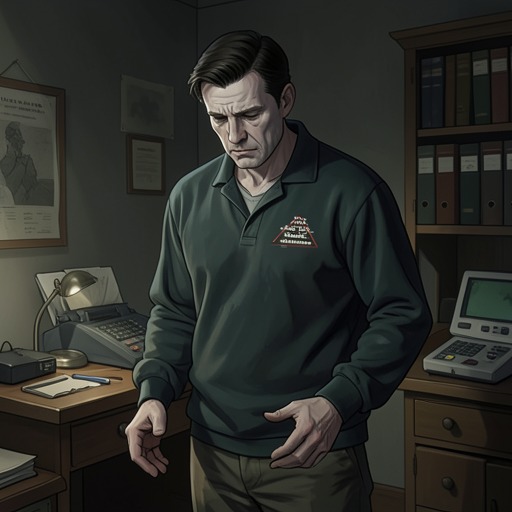
Outside, the unnamed narrator carries Esther through darkness with only the small flashlight on his phone, which still has no reception. She is no longer crying when they reach the bends in the road, but a large four-legged body suddenly rushes past them. He steps protectively in front of her, then picks her up and kisses her; he identifies the animal uncertainly as an ibex or something like one. The scene combines parental protection with epistemic failure. Even in the open air, he cannot reliably name what surrounds them, but he can still place his body between Esther and danger.
The apparent escape ends in a reversal. The woods thin, a bright window appears, and the narrator initially tells Esther that they have made it. Then he recognizes the pointed roof, wide front door, empty parking area, large illuminated window, long table, kitchen, and open hall door. The house has returned before them, making the road an apparent route that leads back into the same enclosed reality. Esther does not respond. Later she lies completely relaxed, breathing deeply and evenly, as if freed, while the unnamed narrator says there is absolutely nothing he can do. Her stillness can no longer be understood simply as sleep or recovery; it marks the narrator’s helplessness before the house’s power.
Separation and Ending
Esther remains the practical reason the unnamed narrator continues to act after his marriage has fractured. When Susanna returns in the car, she is pale and distressed, and the narrator places Esther in the back seat. Esther looks at him wide-eyed, but her cheek is hot because she has a fever. He opens his mouth to speak and finds nothing appropriate to say. The fever adds a bodily consequence to the night’s ordeal and makes the child’s condition more urgent even as the adults struggle to communicate.
Susanna’s return creates a possible restoration of the family unit, but the narrator has crossed into a condition from which he cannot return. He embraces Susanna while feeling divided from himself, and the knowledge that he will never see her and Esther again is unbearable. At the same time, they seem so distant that he no longer knows whether he would have wanted to return to the place from which he cannot return. He finally tells Susanna to go. She drives away with Esther, and he sees the child’s pale face in the rear window before the car disappears around the bend.
Esther’s departure is therefore both rescue and severance. Susanna and Esther leave the mountain house and the narrator behind, but the separation does not restore the family’s earlier life. The narrator remains with the altered house, while Esther becomes visible only in retrospect as the person he was trying to protect and the person whose removal confirms his exclusion. Her final image in the rear window concentrates the novel’s central reversal: the child is carried toward ordinary human connection, while the father is left on the side of an impossible space that has appropriated his reality.
Narrative and Thematic Role
Esther anchors the novel’s supernatural unease in the ethics of care. The unnamed narrator can doubt his perceptions, question the measurements of angles, distrust the monitor, and lose confidence in the continuity of rooms, but he cannot treat Esther’s dependence as theoretical. Her fear of being alone, her need to be washed and dressed, her request to use the toilet, her tears after the rushing animal, and her fever in the car continually return the narrative to a body that requires protection.
Within the family system, Esther also becomes the point around which adult emotion circulates. The parents’ arguments about work and their mutual accusations are softened when they attend to her preschool story; the marital confrontation is interrupted by Susanna’s command that the narrator think of his daughter; and the narrator’s decision to carry her downstairs converts private terror into protective action. Yet she cannot ultimately stabilize the family. The house’s impossible doubling turns even the child’s image into a source of dread, and the failed escape makes her the witness and object of a separation that no parental effort can prevent.
Esther’s arc moves from increasing independence in a familiar family routine to dependence within an uninhabitable space, then toward removal with Susanna. She does not solve the mystery or explain the house. Her importance lies elsewhere: she makes the stakes legible, exposes the difference between adult explanation and lived fear, and gives the narrator one remaining obligation when every other structure of identity has become uncertain. Through Esther, the novel’s spatial horror becomes a crisis of parenthood, and the final image of her pale face in the departing car gives the narrator’s loss its most concrete form.