Get away
You Should Have Left“Get away” is the book’s recurring warning, a phrase that links an apparently ordinary trip to the mountain house with nightmares, infidelity, impossible space, and the narrator’s final entrapment. Its force lies in its instability: it may be spoken by another person, generated by panic, written by an unknown hand, or transmitted across time by the narrator himself. The phrase therefore functions not merely as advice to flee, but as the verbal symptom of a reality in which the same danger keeps returning after every apparent attempt to escape.
First Warning in the Village
The phrase first enters the narrative during the narrator’s drive down from the mountain house. Driving is already associated with vulnerability: he describes himself as clumsy, absentminded, and slow to react, and experiences the car as a fuel-filled capsule in which an ordinary error could instantly become catastrophe. On the narrow road of hairpin bends, the car slides toward the edge, forcing him repeatedly to brake, reverse, and begin again. The descent is therefore a concrete ordeal before the warning is spoken; the road has made escape itself frightening.
After thirty minutes he reaches the village, where there is one street and one shop, Gruntner's General Store, opposite the church. He remains in the car until his trembling hands settle and his heartbeat slows, then enters the small store. The woman behind the counter tells him to get away quickly. When he asks what she means, she repeats the instruction, urging him to get away quickly. Yet the narrator immediately becomes uncertain about what he heard. Her dialect makes the words doubtful, and he wonders whether she said something entirely different or merely cleared her throat. Her glasses contain his reflection, turning the warning into a scene of unstable recognition: the message is delivered by another person, but its meaning is returned to him through an image of himself.
The ambiguity does not prevent him from acting. He leaves the store, starts the car, and drives back toward the house. The return journey is calmer than the descent: the winter sun has moved behind the rocky ridge, the valley is in shadow, and details previously missed become visible, including stones beside a ruined barn, a rusted tractor, the car’s long shadow, birds bursting from a bush, and an orange-glowing cloud. This apparent recovery gives the warning an especially ominous structure. The narrator receives an explicit command to leave, but the ordinary route carries him back to the place from which he has been told to flee.
Phrase of Panic and Dream
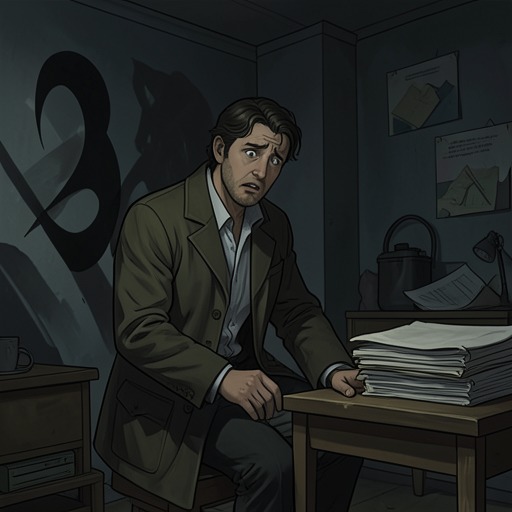
“Get away” next becomes internal and compulsive. In a nightmare, the narrator finds himself in an empty room containing a ceiling bulb, an uncertain barred window, a chair with a broken-off leg, and the terrifying woman with narrow eyes. The woman briefly becomes Susanna and then becomes the terrifying woman again, so that identity itself changes within the scene. The narrator runs through a corridor, cannot find the light switch, and reasons that a dream has no need for light. His desire to escape condenses into the repeated command to himself: get away, get away, get away.
The dream does not end cleanly when he reaches the front door. He finds himself outside in the cold, feeling grass beneath his bare feet and wind against his face, then wakes beside Susanna while the baby monitor shows Esther sitting up and looking into the camera with gleaming white eyes. At the same time, however, the grass and wind remain physically present to him. He is in bed and outside the house simultaneously, groping for a door handle that has clicked shut. The phrase belongs to this collapse of boundaries: it is the mind’s direct response to danger, but the danger has crossed from dream into waking experience.
The attempt to return indoors produces another contradiction. He leaves the bed, runs past Esther’s room, searches for a light switch, and struggles through the cold while believing that he is awake and can hurt himself. When he reaches the door, he understands that he is not permitted to open it, because it cannot happen that he should look himself in the face from both sides of the door. He backs away, and the world shifts back into place: he is again lying in bed, Susanna murmuring, Esther apparently asleep on the monitor. The warning thus accompanies a failed escape from a doubled self. It urges movement, but the spatial order continually converts movement into return.
Warning Against Domestic Normality
The phrase also appears against the background of the narrator’s damaged domestic life. In the notebook, he rereads the recent days and finds the familiar scenes of a marriage: arguments in the living room, standing by the window at night, breakfast, and Susanna’s turquoise eyes flecked with black. The domestic record then exposes her ongoing exchange of messages with David. While the narrator writes about the family’s visible routines, Susanna writes to David and David writes to her, making the phrase an alarm attached to the discovery of her infidelity.
The narrator is startled to find “Get away” in his own account. He insists that he did not write it and that it was not his handwriting, then suspects that Susanna forged it because he knows she can imitate his hand. Turning another page, he reads about his drive into the valley to buy groceries while Susanna remained at the house with time to speak to David. The warning appears again. Its placement troubles his attempt to explain it away: if Susanna had added the words to the notebook, he reasons, they could not have fitted naturally into the line and would have had to appear in the margin. The phrase therefore becomes evidence that cannot be contained by either marital suspicion or ordinary writing practice.
The same warning is connected to movement through the mountain setting. After a fight, Ella turns off the speakerphone, brakes, pulls over, and turns around while the words repeat in a broken stream: get away before it is too late. Elsewhere, the narrator and Susanna return from spending the day outdoors as the sun goes down and the short winter days close around the mountain house. The ordinary activities of driving, shopping, arguing, and hiking are repeatedly placed beside the command to flee. The phrase transforms these daily routes into warning signs, suggesting that danger is not confined to the supernatural house but is embedded in the routes through which people try to maintain ordinary life.
Reversed Escape and Temporal Message
The narrator later attempts a deliberate escape with Esther. He takes the phone from her, grasps her hand, tells her that turning around is forbidden because it is a game, and makes her walk backward. They reach the hall, passing the washing-machine room and a half-open door that seems not to have existed earlier. Inside is the same empty room, naked bulb, and broken-legged chair associated with the nightmare. The narrator feels a powerful desire to enter but resists and pulls Esther onward. Even in this calculated retreat, the warning is present as an implicit rule: survival depends on recognizing the space’s signs and refusing the direction that it demands.
The phrase’s final significance emerges when the narrator reflects on impossible geometry and the possibility that different universes may coexist under different laws. He imagines warning an earlier version of himself through undulating time, calling to the man he was before the entrapment: get away before it is too late; stop worrying about the movie and open his eyes. The phrase is now no longer only a warning received from the village or repeated by a frightened consciousness. It is an attempted transmission from the future to the past, a message from the trapped self to the self who still appears capable of choosing.
That attempt fails. The later narrator says that he tried to reach the earlier one, but the message did not work; he remains where he is because the earlier self did not get away when he still could. The phrase consequently becomes a self-fulfilling and self-defeating warning. It identifies the possibility of escape while also proving that recognition may arrive too late. Its repetition across speech, dream, notebook, movement, and temporal speculation gives the book a structure of recursive alarm: each warning promises an exit, yet each return confirms that the warning has not been obeyed or cannot be obeyed.
Narrative Function and Meaning
As a verbal motif, “Get away” binds together several kinds of uncertainty. The village woman may have said it, but the narrator doubts his hearing. The sleeping mind repeats it, but the dream’s physical effects continue after waking. The notebook contains it, but the narrator denies authorship. A future self tries to send it backward, but the earlier self fails to receive it. The phrase’s source is therefore as unstable as the spaces through which it travels.
Its repetition also turns escape into a structural problem rather than a simple physical objective. The narrator can drive down the mountain, return up it, leave a room, approach a door, walk backward with Esther, or attempt to communicate across time, yet none of these movements guarantees departure. The warning is strongest precisely because it remains unresolved. It is at once an external command, an expression of fear, a trace of marital crisis, a sign of spatial distortion, and the last testimony of a consciousness that understands its own failure only after the possibility of escape has closed.