Impossible Geometry
You Should Have LeftImpossible Geometry is not presented as an abstract mathematical theory detached from the plot. It emerges through ordinary acts of measuring, writing, looking, telephoning, locking a door, and trying to leave a room, until those acts become evidence that the world itself has ceased to remain consistent. The concept gives material form to the narrator’s loss of certainty: geometry is first a tool for verifying reality, then a record of contradiction, and finally the nearest available language for a spatial condition that exceeds the narrator’s vocabulary.
The Triangle Ruler and the First Contradiction
The concept first enters through a small transparent triangle ruler given to the unnamed narrator at Gruntner's General Store. The shopkeeper calls it a gift and points to its right angle, adding that it is suitable for a four-year-old, a detail that links the object to Esther’s age and to the ordinary domestic world the narrator is trying to protect. At this stage, the ruler appears harmless and familiar: it resembles the school instruments the narrator once used, carries an apparently normal degree scale, and promises the simple authority of ninety degrees.
The ruler later becomes a testing device after the narrator has copied troubling messages into a notebook and hears Susanna singing a lullaby upstairs. To occupy himself, he draws a straight line, rotates the ruler, draws a second line at a right angle, and then uses the ruler to bisect that angle. The result looks peculiar before the narrator can explain why. Measurement makes the contradiction explicit: the lower angle reads forty degrees and the upper reads forty-two, although together they form a right angle that measures ninety degrees. Several degrees seem to be missing, yet nothing is missing from the whole. The ruler therefore does not merely give a wrong answer; it produces mutually incompatible answers that remain simultaneously present.
The narrator responds by repeating the experiment rather than abandoning measurement. A newly constructed right angle still measures ninety degrees. Two more right angles complete a rectangle, and a diagonal appears to bisect two of its angles. Yet the lines look blurred rather than properly oblique, and the measurements again divide the right angles impossibly, this time into forty-nine and fifty-one degrees. The ordinary figure survives as a recognizable rectangle, but its internal relations no longer behave according to the rules that make the figure intelligible. The object’s transparency and normal scale cannot restore trust, because the defect lies not visibly in the ruler but in the relation between ruler, drawing, and space.
Measurement as an External Support for Thought
The triangle ruler matters because the narrator repeatedly tries to move cognition outside the mind. The notebook preserves observations that might otherwise dissolve into uncertainty, while the ruler supplies a supposedly objective standard against which perception can be checked. In the reflection episode, the narrator even writes down what happened because the event already seems remote despite having just occurred, and because the act of recording may prevent a later denial that it was imagination. The notebook and the ruler thus form a practical system of memory and verification: one stores the experience, the other measures the world.
That system fails in stages. The narrator’s attention cannot remain fixed on the drawings; when the gaze relaxes, it glides over them on its own. The ruler is held up to the light with one eye closed, as though a visual inspection might expose a trick, but the right angle still looks ordinary and no numbers are absent from the scale. The contradiction is consequently resistant to the usual distinction between a faulty instrument and a faulty observer. It is neither simply a damaged tool nor simply a confused mind. The familiar apparatus of checking reality has become part of the anomaly.
The failure also echoes the narrator’s earlier attempt to document the impossible reflection in a windowpane. After looking away to find the phone and take a picture, the narrator turns back and finds himself in the room, with the reflection sitting down in the same way. The written account insists on simultaneous actions while admitting dizziness and the fear that the event will soon seem unreal. The geometry of the ruler and the doubled space of the reflection belong to the same crisis: external objects continue to look ordinary while their relations contradict ordinary explanation.
From Angles to the House
The ruler’s most alarming recurrence comes after the narrator has taken Esther from upstairs and placed her on the living-room sofa. The narrator has seen Esther sleeping beside him while the screen shows her sleeping elsewhere beside a strange singing voice, and pulls the plug on the device. With the living room secured, the narrator measures the drawing again. One angle remains unchanged, while the other shifts to thirty-nine degrees and its counterpart to forty-one. The page is torn from the notebook, crumpled, and thrown away. The act is significant because measurement no longer records a stable anomaly; the anomaly changes while being measured, making the page itself unusable as evidence.
The same instability appears in the architecture. The narrator notices that the living-room door, previously locked, is open in the window reflection. Later, after leaving the living room with Esther through a locked door whose key remains in the lock, the pair arrive back in the living room. They have gone out, but the door has led them into the room they were trying to leave. The house has converted a basic spatial relation—an exit leads elsewhere—into a loop. Door, key, room, and movement remain materially recognizable, yet their arrangement no longer produces a reliable path.
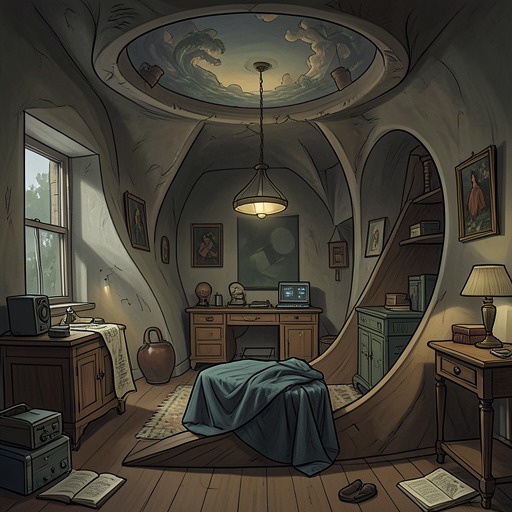
The narrator eventually understands the angle as a sign of a larger spatial structure. The explanation cannot be expressed easily in the available words; it would require imagining, in addition to the familiar three dimensions, another three from the other side or from within. This is not offered as a completed scientific account. It is a desperate conceptual approximation, an attempt to give language to spaces that overlap without behaving as a single Euclidean world. The impossible division of a right angle becomes the small, repeatable version of the house’s larger impossibility.
Cognitive Collapse and Partial Understanding
Impossible Geometry marks the point at which the narrator’s methods of self-correction become indistinguishable from the forces disorienting him. At first, he can blame confusion or the feeling that the world is ending. He can test the ruler, reconstruct the right angle, and repeat the measurement. But every repetition produces a new conflict: the total remains correct while its parts do not, and later readings alter the earlier result. The concept therefore destroys the comforting idea that truth can always be recovered through more careful observation.
The narrator’s uncertainty is not merely emotional. He worries about having gone crazy, yet recognizes that self-questioning proves nothing. The question cannot settle whether perception is reliable, because the capacity to doubt has itself become another unstable mental instrument. The ruler, notebook, phone, screen, door lock, and house layout all function as external supports for orientation, but each becomes contradictory or ineffective. The phone rings repeatedly before contact is made, later shows no network, and cannot secure help; the notebook preserves observations but also contains a page the narrator destroys; the door is locked but returns the travelers to their starting point; the screen shows Esther in a location where Esther is also physically present.
This distributed failure makes the concept more than a metaphor for private confusion. The narrator’s mind is not confronting an anomaly in isolation; it is embedded in a network of objects and spaces that should stabilize judgment. When those supports disagree, perception cannot be repaired simply by concentrating harder. Impossible Geometry names the breakdown of the whole arrangement through which a person ordinarily distinguishes memory from imagination, image from body, inside from outside, and departure from return.
Final Spatial Meaning and Narrative Significance
Near the end, the narrator’s partial explanation becomes inseparable from entrapment. Esther lies completely still, breathing deeply and evenly, as if freed, while the narrator understands that others have been here forever and already know more about the additional dimensions. The thought transforms the ruler’s strange angles from an isolated optical curiosity into a trace of a permanent condition. The geometry is impossible only from the standpoint of the ordinary world; within the house, it may be the rule governing the existence of those who cannot escape it.
The narrator’s response is to attempt communication across time and space, warning an earlier version of himself to get away before it is too late. The warning is not a solution. It is another sign that the story’s sequence has folded back on itself, allowing the trapped narrator to address the man he was shortly before. The concept thus links spatial contradiction to temporal recurrence: if the house contains overlapping dimensions, it may also contain overlapping moments of consciousness, observation, and warning.
The final image refuses to make the explanation secure. In the rain, the narrator can see the room clearly in the window reflection—table, cabinet, kitchen, and door—but no one is present there. A notebook remains on the table. The scene returns to the original instruments of verification: reflection and writing. Yet the empty reflection and surviving notebook no longer clarify what happened. They preserve the possibility of observation without guaranteeing an observer, just as the ruler preserved a right angle without guaranteeing coherent parts. Impossible Geometry therefore becomes the governing principle of a reality in which tools retain their shapes and functions while the relations they are meant to establish have come undone.