Infidelity
You Should Have LeftInfidelity is the hidden sexual relationship between Susanna and David, revealed when the narrator finds intimate messages on Susanna’s phone. It is decisive not only because it exposes a breach in the narrator’s marriage to Susanna, but because the discovery reorganizes every preceding domestic tension: her impatience with his writing, his anxious scrutiny, their habitual quarrels, and the family’s apparent togetherness acquire the pressure of concealment. Once the messages are read, the marriage cannot return to its earlier form, even when Susanna later calls the affair a mistake and insists that David means nothing to her.
Domestic Strain Before the Discovery
The affair enters a household already marked by emotional friction rather than open separation. While the narrator tries to write, Susanna and Esther play loudly on the carpet, and he continues scribbling so they will believe he is working. He describes himself as genuinely busy because the entire production is waiting for him, yet the performance of productivity also becomes part of the household’s conflict: Susanna can accuse him of complaining without working, while he experiences her presence and the child’s noise as barriers to concentration. His declaration that he loves Susanna and wants no other life stands beside his bewilderment that they fight all the time, establishing attachment and conflict as simultaneous conditions.
The strain is also visible in the evening conversation after the narrator has begun acting strangely. Susanna asks twice what is wrong; he answers that nothing is wrong, then reverses the accusation and says that she is acting strangely. Their exchange does not disclose the affair, but it shows how suspicion and defensiveness circulate before either partner names its cause. Esther’s disjointed preschool story briefly gives the adults a shared task. They respond with enthusiastic exclamations and feel relief when she stops speaking, a moment in which childcare temporarily buffers the marital tension rather than resolving it.
The household’s apparent stability is further complicated by the setting. The family is staying in a new, minimalist, architect-designed two-story house with a narrow upper balcony and a large living-room window, a place that looks better in reality than in its Internet pictures. Its polished modernity contrasts with the increasingly unreliable domestic world inside it. Even before the affair is exposed, the house is not entirely stable: when the narrator reaches for the bathtub faucet, it seems farther away than its visible position permits, and he can reach it only after closing and reopening his eyes. The anomaly gives physical form to a more ordinary estrangement, in which familiar objects and familiar intimacy no longer occupy dependable positions.
The Messages and the Exposure
Susanna’s phone lies beside the narrator on the table. He takes it because he believes it may contain Steller’s number, but a message flashes on the screen before he can continue with that purpose. It reads, "I want to touch you again." The sender is identified only as David, a man the narrator does not know. He initially searches for an innocent explanation—a joke, an out-of-context message, or a message sent to the wrong number—but the phone supplies a pattern rather than an isolated accident.
The messages contain explicit and reciprocal longing. David asks how much longer Susanna will be away and says that the time before having her in his arms feels endless. He writes, "I want to be inside you and," asks whether she is thinking about him and what they might do, and says, "I miss you so much." Another message says, "I miss you it’s driving me crazy I want to feel how" before breaking off. The incomplete lines intensify rather than soften the evidence: the narrator cannot transcribe them fully, but their sexual and emotional direction is unmistakable. By the time he reaches the conclusion, "It’s enough. There’s no harmless," the possibility of coincidence has collapsed.
The discovery is mediated through the narrator’s professional habits. He tries to copy the messages into his notebook, the same notebook associated with his screenplay and his attempts to preserve working concentration. Recording the evidence becomes an act of possession and verification: he wants to convert the unstable phone screen into a fixed account before Susanna can erase or deny it. At the same time, he recognizes that the scene resembles one of his films. In fiction, he thinks, a life falling apart can be made entertaining by clever dialogue; in reality, the collapse is merely dismal and repugnant. The contrast exposes the limits of his professional imagination: narrative control cannot make betrayal intelligible or bearable when he is its participant.
Confrontation and Marital Rupture
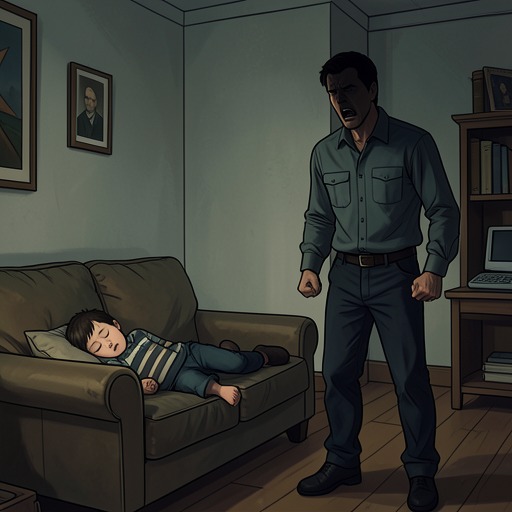
When Susanna returns to the room, the narrator confronts her about David. He believes he is shouting, though he gradually suspects that his voice has become only a croak. His physical failure to produce the force he intends reflects the larger breakdown of mastery: he has evidence, but he cannot control its meaning, his voice, or Susanna’s response. He asks whether she wants to deny the affair, while privately realizing how strongly he had hoped she would deny it. Susanna does not deny it.
Susanna tells him to pull himself together and think of Esther before picking up their daughter and taking her upstairs. Her maternal composure sharply contrasts with the narrator’s disintegration. Esther’s bedtime interrupts the confrontation without repairing it; Susanna continues speaking to the child calmly and maternally while the narrator remains motionless, unable to think or summon strength. The child therefore functions as both the immediate moral stake of the argument and a temporary barrier against its full escalation.
When Susanna returns, she reframes the discovery around the phone and the narrator’s conduct. She says that people who are caught are often exposed because they cannot bring themselves to delete their messages. She describes the saved messages as the result of an absurd attachment and says that a jealous husband may be persistent enough to take a phone from a bag. Her account treats the affair as an already familiar pattern of concealment and detection, while also shifting attention toward the narrator’s alleged intrusion. He insists that he did not steal the phone from her bag; it had been lying on the table, and he had wanted to find Steller’s number. Susanna answers that she would never have left it there and accuses him of going through her bag.
The accusation does not erase the messages, but it changes the conflict from a one-sided exposure into a mutual struggle over violation, evidence, and legitimacy. The narrator feels that he is the injured spouse, yet his act of taking the phone and reading it becomes part of the moral battlefield. His jealousy is not baseless, but the discovery does not leave him innocent of every boundary crossing. The couple’s competing claims prevent the scene from settling into a simple confession followed by explanation.
The ensuing argument survives only in fragments in the narrator’s memory. He remembers shouting, throwing something onto the table, pounding his fist, crying, calming down, asking questions, and watching Susanna walk back and forth. At different moments she sits at the table crying, he stands silently by the window, and both eventually shout across the table at the same time. He wants to go to her, place his hands on her cheeks, and say that they should forget everything because he loves her, but he knows that forgetting is impossible. When he touches her cheeks, Susanna tells him to leave her alone and says that he does not understand. The repeated escalation ends with the front door slamming and an engine starting. The narrator writes everything down and still does not understand it, a failure that links the affair to the book’s wider crisis of unreliable perception and incomplete memory.
Aftermath for Esther and the Family
The affair immediately alters the family’s practical structure. After Susanna leaves, the narrator remains with Esther, who is crying and asks where her mother is. He says that he has already told her, then realizes with horror that he cannot remember which white lie he used. His inability to recall even the protective explanation given to the child shows how quickly the marital rupture undermines his parental confidence. He kneels to kiss and hug Esther while her shoulders jerk with sobs, but physical consolation cannot supply the absent mother or restore a coherent account of what has happened.
The narrator later tries to leave the mountain house with Esther. He takes the phone from her, grasps her hand, and turns the escape into a game in which they are not allowed to turn around. Walking backward, they reach the hall, where a half-open door seems not to have existed before. Inside is an empty room with a naked lightbulb and a wooden chair missing a leg. The narrator feels a powerful desire to enter but resists and pulls Esther onward. The backward movement makes the family’s attempt to retreat from the affair literal: they seek to undo the discovery and return to an earlier state, but the house converts that wish into an impossible spatial rule.
The attempted escape fails. In the woods, the narrator carries Esther while her arm muscles tremble, then sees a house ahead and hopes that it is only a resemblance. It is not. The pointed roof, wide front door, empty parking area, illuminated large window, long table, kitchen, and open hall door reproduce the mountain house. He tells Esther that they are back. The infidelity has therefore become entangled with a space that refuses ordinary departure, turning the consequences of betrayal into a recursive captivity rather than a clean separation.
Esther’s condition makes the family crisis more severe. She eventually lies completely relaxed, breathing deeply and evenly, as if freed, while the narrator says there is absolutely nothing he can do. His attempt to protect her has led not to safety but to helplessness. The language of release is especially disturbing because it leaves open whether Esther has escaped some immediate distress, surrendered to the house’s altered conditions, or crossed into a state the narrator can no longer interpret. In each case, the child has become the point at which marital conflict, parental responsibility, and the house’s spatial danger converge.
Susanna’s Return and the Affair’s Ambiguous Meaning
Susanna eventually drives back. She gets out without turning off the engine, pale and furrowed, and says that she has been deeply worried and has called a hundred times. Her anger focuses on the narrator’s failure to answer, which she presents as unacceptable behavior toward a parent sharing responsibility for a child. The return does not begin with a reconciliation over the affair; it begins with an accusation about disappearance and the obligations of co-parenting.
The narrator places Esther in the back seat and notices that she is wide-eyed, hot-cheeked, and feverish. He wants to speak to her but cannot think of anything appropriate, so he closes the car door. Susanna then tries to minimize David’s importance, saying that he means nothing to her and that she never wants to see him again. The narrator needs a moment to understand whom she means, as if the supernatural events and the domestic revelation have made ordinary reference unstable. Susanna calls the relationship "a mistake" and "a horrible mistake." These words are an admission that the affair occurred, but they offer no detailed account of its duration, cause, or emotional substance.
The narrator responds by ordering Susanna to start driving. Her departure is not a renewed family journey shared by all three in the mountain house; it is a separation in which Susanna and Esther leave while he remains behind. He embraces Susanna for several seconds, though the embrace already feels too long, and experiences himself as divided between knowledge that he will never see Susanna and Esther again and a simultaneous sense that they have become impossibly distant. He pushes Susanna away and tells her to go. She nods, gets into the car, and drives around him and away; Esther’s pale face is visible for a moment in the rear window before the car disappears around the bend.
The aftermath preserves neither the marriage nor a stable moral resolution. Susanna’s claim that David means nothing and that the affair was a terrible mistake may express remorse, expedience, or an attempt to close the subject under impossible circumstances; the evidence confirms the betrayal but does not provide a final interpretation of her motives. The narrator’s own behavior is equally unstable: he loves Susanna, investigates her, confronts her, tries to protect Esther, lies to the child, attempts an impossible escape, and finally sends his wife and daughter away. Infidelity thus operates less as an isolated act than as the hinge between domestic suspicion and ontological dislocation. It breaks trust, reorganizes the family, and leaves the narrator alone with a house that looks different from before and a life to which neither confession nor departure can restore the old shape.