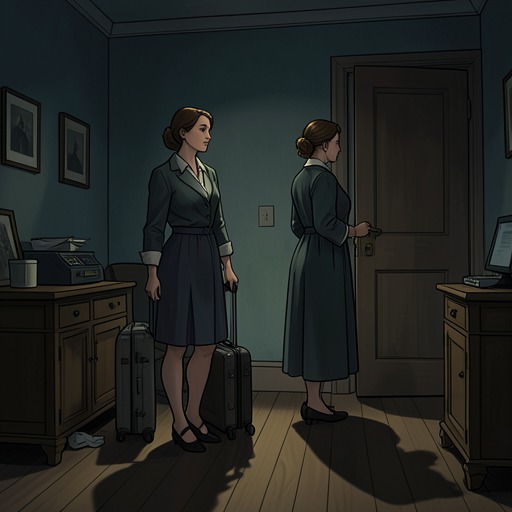
Jana was driven out of the apartment by Ella
You Should Have LeftJana being expelled from Ella’s apartment is the first-act rupture around which the sequel’s domestic and narrative tensions gather. Ella asks Jana to leave the apartment where Jana had lived in the previous movie so that Ella’s new boyfriend, Martin, can move in. Because Martin is Jana’s former boyfriend, the practical change of residence carries the force of betrayal, displacement, and the reordering of a friendship. Yet the scene refuses the obvious dramatic payoff: Jana does not erupt. Her calmness unsettles Ella more than anger would have done, turning a seemingly ordinary eviction into a revealing reversal of expectation.
Background and Dramatic Premise
The event belongs to a sequel whose main characters have already been established by the first movie. Its problem is therefore not introduction but backstory: the new film must explain how familiar relationships have changed without relying on information the writer does not possess. The narrator considers using a childhood flashback for Jana and Ella, calls that device conventional and reliable, and admits that he knows nothing about either woman’s childhood and is not interested in inventing it. Instead, the sequel gives their history a concrete present-day pressure point: Ella’s request that Jana surrender the apartment to make room for Martin.
Martin’s identity makes the request especially charged. He is not simply Ella’s new partner but Jana’s ex-boyfriend, the man from whom Jana separated because he was a senior tax official. Jana had regarded his profession as incompatible with romance, even though he is described as good-looking, sensitive, well-read, and multilingual. The apartment thus becomes the site where an old relationship, a new relationship, and an intimate friendship collide. Ella’s decision is spatially practical but emotionally loaded: Jana is displaced so that the former lover she rejected can enter the life of her closest friend.
What Happens in the Scene
The narrator expects Jana to respond impulsively. In the first movie she had been capable of an abrupt, verbally aggressive outburst, and the sequel seems to require another recognizable display of her lack of self-control. The writer’s difficulty is that repeating the earlier fit of rage would merely satisfy an audience waiting for a familiar beat. The event becomes dramatically useful only when Jana does something else.
Jana remains calm. Her composure is so unexpected that Ella feels provoked by it, as though the absence of resistance were itself an accusation. Ella insists that Jana had not wanted to live there anymore, while Jana asks where Ella got that idea. The exchange places the burden of emotional interpretation back onto Ella: the eviction is presented as if it were the fulfillment of Jana’s own wish, but Jana’s response refuses to confirm that explanation. Her calmness neither resolves the conflict nor openly escalates it. It leaves the motives and injuries suspended.
Jana then stands expressionlessly, with no visible sign of whether she deliberately started a fight between Ella and Martin or genuinely meant everything she had said. That ambiguity is central to the event. The scene does not provide a clean psychological explanation for Jana’s behavior, and the narrator’s concern with whether someone should enter at that moment exposes the pressure of conventional sitcom construction. A conspicuous interruption would make the scene feel cheap; the narrative instead allows the uncomfortable uncertainty to remain.
The eviction is also placed within a larger three-act design. In the first act, Jana moves out of Ella’s apartment and must manage on her own, while Ella lives with a man for the first time. The event therefore changes more than an address. It separates the friends’ daily lives, gives Ella a new domestic arrangement, and forces Jana into an independent position that the sequel can develop. The move is both an action in the story and the structural hinge that begins the first act’s new configuration.
Immediate Consequences and Parallel Conflicts
The apartment rupture is echoed by Martin’s reaction after the fight. At his office, he becomes dissatisfied with himself and recognizes in his colleagues what other people see in him: tax officials. Looking through photographs from school and university, he watches his own transformation into the man Jana once rejected. The office sequence turns his profession into an existential condition rather than a neutral fact. He loosens his tie, feels insecure, tightens it again, and then responds to a photograph of a casually dressed pop singer by ordering a tax audit of the singer before slowly loosening the tie once more.
This parallel matters because Jana’s expulsion does not simply establish Ella’s happiness with Martin. It exposes Martin’s unease about the identity that made him unacceptable to Jana. His decision to audit the singer converts private insecurity into institutional power. The domestic conflict therefore extends into the workplace: Jana’s judgment of Martin’s profession is answered not by self-knowledge but by an official act against someone who appears to embody the freedom and casualness Martin lacks.
The event also belongs to a broader pattern in which work and family life interfere with one another. Elsewhere, the narrator keeps writing while Ella and Martin are present because he cannot concentrate when other people occupy the room; he pretends to be working so that Susanna will not accuse him of complaining without producing anything, even as the production waits for him. That scene clarifies the social pressure surrounding the embedded film project: the characters’ relationships are repeatedly treated as material for writing, while their actual demands prevent the writer from controlling the work. Jana’s eviction becomes one of the moments where the screenplay’s planned emotional machinery visibly fails to behave as expected.
Later Echoes of Expulsion
The first-act separation is followed by recurring images of departure and flight. After another fight, Ella turns off the speakerphone, brakes, pulls over, and turns the car around while the words associated with escape repeat insistently. Jana is then shown in her new apartment, sitting on the couch and looking up from her laptop when Ella storms in. The new apartment confirms that the earlier eviction has materially occurred, but Ella’s return shows that separation has not produced emotional independence. Jana has been removed from the shared space, yet the conflict continues to draw Ella back to her.
The same movement from domestic rupture toward attempted escape later appears in the narrator’s relationship with Susanna. In the rain, Susanna embraces him and agrees that they will not spend one more night in the mountain house. The promise of departure gives the earlier apartment event a wider resonance: across the story, intimate relationships are tested through decisions about who may remain in a place and who must leave it. Jana’s removal from Ella’s apartment is the first clear instance of this pattern, while the later vow to leave the mountain house shows the pattern becoming a matter of survival rather than social rearrangement.
Narrative and Thematic Significance
Jana’s expulsion is significant because it is simultaneously a plot event, a relationship reversal, and a critique of predictable storytelling. The narrator knows that the audience expects Jana’s anger, but the expected performance does not arrive. Her expressionless composure makes the scene more troubling, not less, because it prevents the conflict from being contained by a recognizable comic outburst. The event reveals the limits of character templates: Jana has been defined by impulsiveness, yet she can surprise the narrative without ceasing to be herself.
The scene also establishes a movement from comedy toward darker uncertainty. What might have been a sitcom-like quarrel instead becomes entangled with suspicion, displaced desire, and the question of whether Jana engineered the conflict between Ella and Martin. Later, the narrator repeatedly asks who David is while confronting Susanna’s messages, and the domestic world becomes similarly resistant to explanation. In both cases, intimate bonds are threatened by information that cannot be safely interpreted. The apartment eviction is an early version of that larger instability: a familiar home remains physically ordinary while its emotional meaning changes underneath the characters.
Finally, the event anticipates the story’s later spatial and perceptual disturbances. The mountain house initially appears better in reality than in its Internet pictures: a new, minimalist, architect-designed two-story house with a narrow upper balcony and a large living-room window. Yet ordinary objects and spaces later become unreliable, from a faucet that seems unreachable to a child who lies utterly relaxed while the narrator can do nothing. The house is eventually understood as a trap, a place in which movement meant to lead upward instead carries a person deeper. Jana’s eviction does not cause that supernatural crisis, but it introduces the same governing logic in social form: an apparently reasonable movement out of one space does not restore freedom; it reorganizes the conditions of entrapment. As the first major separation in the sequel’s three-act plan, the event makes displacement the story’s durable grammar.