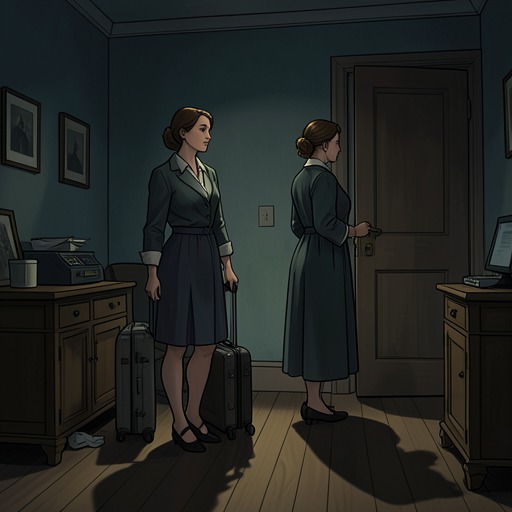
Jana was expelled from the apartment by Ella
You Should Have LeftJana being expelled from Ella’s apartment is the action in which Ella asks her closest friend and former housemate to leave so that Ella’s new boyfriend, Martin, can move in. Its decisive force lies in the reversal of expectation: Jana is known for impulsive verbal explosions, yet when Ella removes her from the apartment, she remains calm. The absence of the anticipated outburst provokes Ella and turns an apparently ordinary domestic rearrangement into a destabilizing confrontation.
Background and Domestic Stakes
The dispute belongs to the sequel’s effort to provide backstory for characters already established in the first film. The narrative openly acknowledges that it knows little about Jana’s or Ella’s childhood and is uninterested in inventing conventional formative explanations for them. Instead, it locates their history in a present-tense social rupture: Jana had been living in Ella’s apartment, and Ella now wants her to move out so that her new boyfriend can move in.
The arrangement is especially charged because Martin is not an unknown newcomer. He is Jana’s former boyfriend, and their relationship ended because he is a senior tax official. Martin is described as good-looking, sensitive, well-read, and multilingual, but Jana’s earlier objection to dating a tax official has made his profession the defining comic stigma of the breakup. Ella’s request therefore combines housing, friendship, romantic replacement, and the return of a relationship Jana had already rejected.
The Expected Outburst That Does Not Occur
Jana’s established identity makes the scene seem to demand another fit of rage. The narrative recalls her earlier, sudden insult to a gym teacher, in which she said that people like him lent the word stupidity new majesty. That precedent creates an expectation that being politely expelled from her best friend’s apartment will produce another uncontrolled verbal attack, even if the new version must differ from the first.
Instead, Jana remains calm. The calm is not treated as a neutral absence of action; it becomes the scene’s surprising event. Ella is so unsettled by Jana’s composure that she feels provoked by it. Her request has presumably been framed as a practical or courteous decision, but Jana’s refusal to supply the emotional response that would confirm Ella’s power over the situation leaves the exchange exposed and unstable.
The available dialogue emphasizes this inversion. Ella protests that Jana had not even wanted to live in the apartment anymore, while Jana asks where Ella got that idea. The exchange does not resolve the disagreement. It shows that the conflict is not simply about whether Jana wished to remain there. Ella’s statement attempts to recast the eviction as the fulfillment of Jana’s own preference; Jana’s reply rejects that convenient interpretation without replacing it with an explosive confession.
Relations Reordered by the Move
The action rearranges three interconnected relationships. Jana and Ella’s best-friend bond is placed under pressure because Ella chooses her new romantic relationship over the living arrangement that had supported their friendship. Jana and Martin’s former relationship is reactivated indirectly: Martin’s arrival is the reason Jana must leave, so the old breakup becomes materially present in Jana’s home life rather than remaining a completed romantic history.
Ella and Martin’s relationship also acquires a practical consequence. Martin is not merely Ella’s boyfriend in the abstract; his relationship with Ella requires space, and that space is obtained by displacing Jana. The apartment becomes a concrete map of changing loyalties. Jana’s removal gives Ella and Martin a shared domestic future while making Jana bear the cost of that future.
The action is therefore a conflict over dignity as much as residence. Jana is not described as physically forced out, and Ella makes the request in the nicest possible way, but politeness does not remove the underlying hierarchy. Ella controls the apartment’s future, Martin benefits from the decision, and Jana must absorb the loss without the dramatic release that everyone expects from her.
Consequences and Narrative Reversal
The move-out action has effects beyond the apartment. Jana later appears in a new apartment, where Ella storms in while Jana is looking at her laptop. The relocation thus does not end their contact; it changes its setting and intensifies its volatility. Ella’s continued arrival at Jana’s new home suggests that physical separation has not produced emotional separation. The former shared apartment has become a lost point of stability, while the new apartment becomes another site of confrontation.
The narrative also places the apartment dispute beside other scenes in which ordinary social forms fail to contain hidden pressure. Martin, dissatisfied in his office after the fight, looks at photographs tracing his transformation from a student into a tax official. He loosens his tie, feels insecure, tightens it again, and then orders a tax audit of a casually dressed pop singer before deliberately loosening the tie once more. His action converts the identity that Jana mocked into an instrument of authority and retaliation, making the domestic conflict reverberate through his professional power.
The same pattern of unstable expectations extends beyond Jana’s storyline. On the mountain, the narrator sees the room’s interior and his own reflection in the glass, then decides that the apparent disturbance was imagination. Elsewhere, a shopkeeper named Fehringer immediately asks Jana whether she is from the area, and Ella hears a repeated warning to get away before it is too late. These surrounding moments make Jana’s calm eviction part of a broader movement in which familiar situations retain their surfaces while their underlying rules shift.
The Action’s Thematic Role
Jana’s expulsion functions as a compact demonstration of the story’s method. It begins with a recognizable sequel problem—how to give established characters more history—and refuses the easiest solution of childhood flashback or explanatory psychology. It then substitutes a present conflict whose meaning is generated by relationships, expectation, and reaction. Jana’s character is defined not only by what she has done before but by her sudden failure to repeat herself.
That failure of repetition is crucial. Everyone expects Jana’s lack of self-control to produce another spectacle, but her composure becomes more disturbing than the spectacle would have been. The scene makes emotional behavior itself uncertain: anger is expected, calm is interpreted as provocation, and a courteous request becomes an act capable of reorganizing friendship, romance, and home. In that sense, Jana’s move is the first clear sign that the story’s domestic comedy is being redirected toward a reality in which people, spaces, and identities no longer remain as stable as their familiar patterns suggest.