Martin
You Should Have LeftMartin is Ella’s new boyfriend and Jana’s former partner, and his arrival reorganizes the relationships at the center of the film-within-the-narrative. Jana once ended their relationship because he was a senior tax official, even though she also recognized him as good-looking, sensitive, well-read, and multilingual. When Ella asks Jana to leave the apartment so Martin can move in, Martin becomes more than a romantic rival: his occupation turns him into the practical instrument of Jana’s expulsion and the embodiment of the ordinary, respectable life she has rejected.
Identity and Introduction
Martin is introduced through the history supplied by Jana and through the social meaning attached to his job. He is not presented as an unknown outsider but as Jana’s ex-boyfriend, now chosen by Ella. Jana’s objection is not that he lacks attractive or admirable qualities. Instead, she treats his employment at the tax office as disqualifying, a judgment that makes occupation stand for an entire personality and way of life. The film’s sequel needs to give its established characters new complications, but it openly admits that it knows little about Jana’s or Ella’s childhood. Martin’s backstory is likewise compressed into a decisive adult fact: he is the former lover whose bureaucratic profession has become the reason for a breakup and the trigger for a new domestic arrangement.
His professional identity is clarified later. Martin is not personally responsible for conducting every audit. He runs the appeals department, where taxpayers can lodge appeals, and he distinguishes that administrative role from the direct examination of accounts. The clarification makes him more specific than the stereotype that surrounds him, but it does not dissolve the stereotype. To Jana, and to the film’s comic logic, “tax official” remains a charged category before Martin’s actual duties can be considered.
Relationship with Jana and Ella
Martin’s relationship with Jana is defined by a reversal. He was once Jana’s boyfriend, but she broke up with him because he worked for the tax office. His personal virtues could not overcome the symbolic force of his occupation. Now the same man is entering the life of Ella, Jana’s best friend, and his presence requires Jana to move out of the apartment where she lived in the previous film. The arrangement turns an old romantic decision into a present material loss: Jana has not merely lost Martin; she is displaced so that he can occupy the domestic space she shared with Ella.
The confrontation exposes how unstable the arrangement is. Ella struggles to direct her anger and begins screaming at Martin under a pretext when he enters wearing a suit and carrying a briefcase. Jana stands there without smiling, then sadly. Martin’s formal clothing makes his role visible at the exact moment when private relationships are breaking down. The suit and briefcase mark him as the official figure Jana once rejected, while Ella’s rage suggests that the new romance has not produced the ease everyone might expect.
The same tension reappears in a telephone conversation. Ella is cheerful and relaxed in the car, whistling to herself, but Martin repeatedly asks when she is coming. When she challenges the way he speaks, he explains that his manner would be different while dealing with people whose accounts were under audit, adding that he does not conduct audits himself because he runs the appeals department. His attempt at professional precision does not settle the emotional question. Instead, the bureaucratic vocabulary follows the couple into their private conversation, making intimacy sound like procedure and turning Martin’s work into a continuing source of friction.
Office Scene and Self-Recognition
After the fight, Martin goes to the office dissatisfied with himself. The scene gives him an interior dimension that the earlier domestic conflict withholds. He looks around and suddenly recognizes in his colleagues what other people see in him: tax officials. The recognition is both comic and unsettling. Martin is not simply mocked from outside; he sees the category from within and understands that he belongs to it.
He then searches through photographs on the computer. In school, he was not yet a tax official. University photographs show him wearing a tie and solving crossword puzzles with a serious, almost devoted expression. The sequence presents his professional identity as a gradual transformation rather than an immutable essence. The tie becomes a visible sign of that process. Martin loosens it and immediately feels insecure, so he tightens it again, revealing that the appearance he might wish to escape has also become a source of stability.
The office scene ends with a small but consequential act of performance. Martin flips distractedly through a magazine and stops at a photograph of a pop singer posed casually, with tousled hair, an open shirt, and metal rings on his fingers. After hesitating, Martin reaches for the telephone and orders a tax audit of the singer. He then slowly and deliberately loosens his tie. The audit is an exercise of bureaucratic authority, but it is also an awkward response to the singer’s apparent freedom from the identity Martin feels trapped inside. By loosening the tie only after ordering the audit, Martin converts rebellion into a controlled gesture performed within the institution he has just recognized as his own.
Domestic Performance and Narrative Role
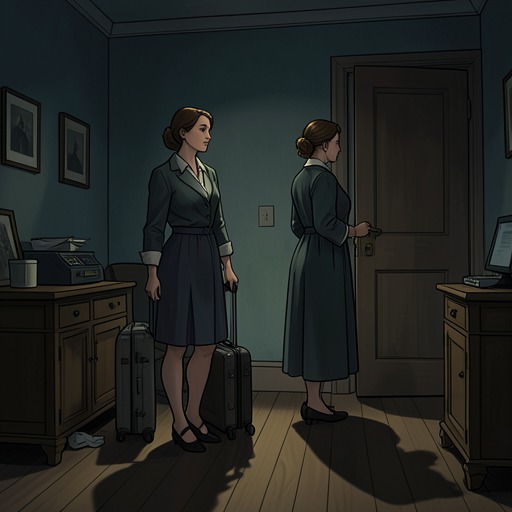
Martin’s relationship with Ella is also shown through mutual observation rather than uncomplicated closeness. Early in the morning, Ella sleeps while Martin watches her. When she moves, he quickly closes his eyes; she opens hers, looks at him, and surveys the room. Her clothes lie untidily on the floor, while his clothes are neatly folded on a chair, with his tie folded on top. Martin eventually acts as if he is waking, but Ella has closed her eyes again, so he uneasily closes his eyes too. They lie side by side pretending to sleep, and the scene fades out.
The arrangement turns ordinary bedroom behavior into a tableau of concealment. Martin’s folded clothes and carefully placed tie contrast with Ella’s disorder, but the sharper contrast lies between what each character sees and what each pretends not to see. Martin’s professional neatness has entered the bedroom, yet it cannot produce emotional transparency. Both partners perform sleep, and the relationship is therefore presented as a shared pattern of watchfulness, evasion, and uncertainty rather than as a secure romantic resolution.
Martin also functions as a pressure point in the outer narrator’s unfinished screenplay. When the narrator speaks with Schmidt and tries to recover the plot, he identifies the problem in direct causal terms: Jana must move out because Ella throws her out so Martin can move in. Martin is thus the hinge connecting the screenplay’s comic domestic premise to its escalating complications. The question of who he is even becomes a recurring interruption in the narrator’s attempt to write, while the possibility that he might be connected with someone named David is raised only as speculation and explicitly treated as beside the point. Martin’s narrative importance comes less from an expanded biography than from the consequences produced by his position between the two women.
Character Arc and Significance
Martin begins as a recognizable social type: the attractive, cultivated man rendered unacceptable by the institutional label attached to his work. Jana’s judgment flattens him into “the tax official,” but the plot gradually complicates that image. He has a specialized role in the appeals department, notices the transformation by which he became what others see, and experiences enough insecurity to loosen and retighten his tie in the privacy of his office. These details make him capable of surprise without turning him into a fully explained psychological portrait.
His most revealing action is not a declaration of love or a decisive escape from bureaucracy. It is the petty, deliberate ordering of an audit against a pop singer, followed by the controlled loosening of his tie. The gesture contains the character’s contradiction: he envies casual self-presentation, yet he expresses that envy through institutional power and returns to the familiar sign of his profession when uncertainty appears. Martin’s arc therefore remains unresolved. He does not cease to be a tax official, and the evidence does not show whether his relationship with Ella survives the strain surrounding Jana’s removal. What changes is the reader’s understanding of the role. Martin is no longer only the man whose occupation makes him undesirable; he becomes someone who recognizes the absurdity of that identity while still relying on it, a figure through whom the narrative turns professional conformity into an intimate and unstable form of performance.