Multiverse
You Should Have LeftMultiverse names the narrator’s attempt to understand the spatial and perceptual anomalies surrounding the Vacation House. It begins as an abstract thought about the stars and becomes, by the end, a concrete hypothesis: reality may consist of infinitely many separate universes, and the house may stand at a place where their substance has become dangerously thin.
Definition and Cosmological Premise
The narrator first connects the multiverse to the apparently endless universe visible in the night sky. He recalls that some astronomers believe the universe may be infinite, filled with stars and galaxies extending forever. He then extends that possibility: the infinite universe might be only one among an infinite number of infinite universes, each operating under different laws. These universes are normally unreachable from one another and remain strictly separate, so the multiverse is not presented as a network of routinely accessible parallel worlds but as an overwhelming totality divided by ordinarily impassable boundaries.
The scale of this speculation is deliberately disproportionate to the domestic crisis in which it arises. The narrator is caring for Esther, carrying his four-year-old daughter after an exhausting march, while his thoughts expand toward galaxies, galaxy clusters, and clusters of galaxy clusters without end in either direction. The contrast makes the multiverse less a detached scientific theory than a mental response to an experience that has exceeded the categories of ordinary household life. The stars, once soothing to him, have become disturbing because infinity now seems physically relevant to the room in which he is trapped.
The Vacation House and Thin Places
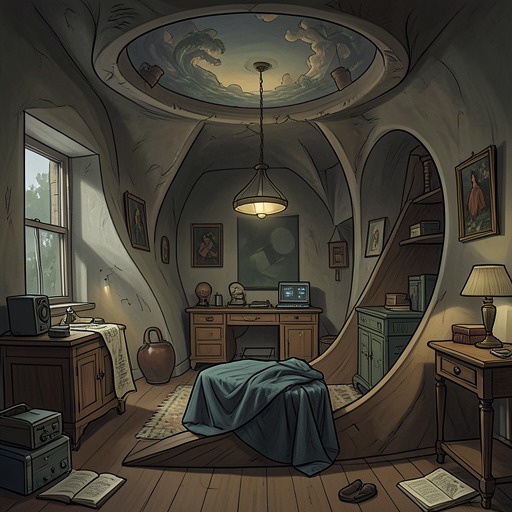
The narrator’s hypothesis becomes necessary after a direct contradiction of ordinary geometry. When he takes Esther through a door, they do not enter the expected adjoining space but return to the living room. He recognizes that they truly left the living room, yet the door led back into the same room. This is not merely a confusing floor plan or a locked exit; it is an alteration of the relation between movement, direction, and destination.
The house’s setting intensifies the contradiction. From the rented house, the narrator can see the valley far below, with its small houses, road, river, and railroad, while the meadow descends toward woods and the mountain landscape opens toward glaciers and granite. The scene supplies a stable, measurable world against which the house’s impossible interior can be judged. The building is also described as relatively new, standing on a site where an earlier vacation house had been demolished and replaced. That history gives the location a material continuity while leaving open the possibility that the anomaly belongs not to the visible structure but to the site itself.
The narrator eventually distinguishes the building from the place. In his formulation, the house is harmless; it is simply standing where nothing should stand. The danger lies in the location, where the boundary between otherwise separate realities may have become thin. He imagines that other such places could exist in unreachable regions, such as the bottom of the sea or mountain caves no one has entered, or that the next one might be light-years away. The multiverse therefore explains both the local distortion and its terrifying isolation: the Vacation House is an accidental point of contact, not necessarily a gateway that can be deliberately navigated.
Evidence, Doubt, and Perception
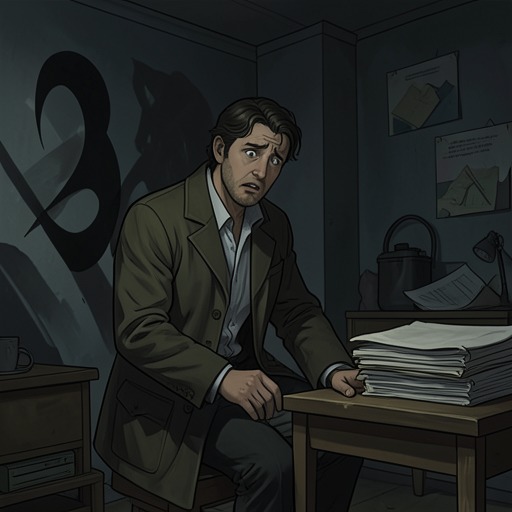
The multiverse does not eliminate uncertainty. The narrator continues to question whether he has witnessed real events or produced them through exhaustion, fear, and imagination. A framed photograph appears on a wall where he remembers having written that there were no pictures anywhere in the house. He cannot decide whether he overlooked it, whether his earlier record was wrong, or whether the room itself has changed. The discrepancy makes memory another unstable boundary, parallel to the spatial boundaries he is trying to theorize.
The same hesitation surrounds the figures and rooms he sees later. A tired man appears briefly in a room, apparently standing on the ceiling, and resembles the woman with the narrow eyes without being identical to the bearded man in the photograph. Behind an apparently empty room, the narrator glimpses further rooms, each with a lightbulb and an open door, and perhaps movement on the floor of the third. He admits that exhaustion may have made him imagine these things. Yet the multiverse hypothesis gives such perceptions a coherent, if horrifying, structure: the figures may belong to other configurations of the place, and the repeated rooms may be glimpses through overlapping spatial orders.
This uncertainty is reinforced by mundane details that fail to protect him. The phone shows no network, the door must be opened with a key, and after he and Esther leave the room they are returned to it. The failure is not only technological or architectural. Ordinary instruments and habits still function locally, but they no longer guarantee that the world will connect one action to its expected result. The multiverse remains an explanation rather than a confirmed fact, suspended between supernatural revelation and a mind struggling to describe what language cannot contain.
Geometry, Time, and the Final Warning
The narrator later says that he understands the matter of the angle better. He imagines that reality may include not only the familiar three dimensions but another three approached from the other side, or from within. The formulation is deliberately inadequate: he knows that the available words cannot express the structure accurately, and he doubts that explanation would help those who are already trapped there and know more than he does.
The multiverse thus changes from a distant cosmological possibility into a condition affecting bodies, rooms, and time. The narrator’s perception of a man on the ceiling and of doors opening into repetitions of the same empty room suggests that direction and enclosure have lost their ordinary meanings. His later attempt to warn an earlier version of himself through undulating time extends the spatial rupture into chronology. He hopes to reach the man he was shortly before, urging him to get away before it is too late, but the warning remains an effort rather than a demonstrated success.
Narrative Significance
The multiverse gives the novel’s impossible geometry a conceptual vocabulary without closing its mystery. It explains why the Vacation House can be both an ordinary rented property and the site of rooms that return to themselves, figures that occupy impossible orientations, and reflections whose occupants may disappear. At the same time, the narrator’s dependence on speculation preserves the possibility that some experiences are dreams, faulty recollections, or exhaustion-induced visions.
Its deepest effect is to dissolve the boundary between the personal and the cosmic. A quarrel during the drive to the mountain house, a child watching a film on a phone, a vanished photograph, and a father carrying Esther through a hallway all become entangled with the possibility of infinitely many realities. The multiverse makes the house frightening not because it reveals a single hidden world, but because it suggests an unlimited number of worlds and no reliable method for knowing which one contains the narrator, which one contains Esther, or whether the act of escape has led anywhere at all.