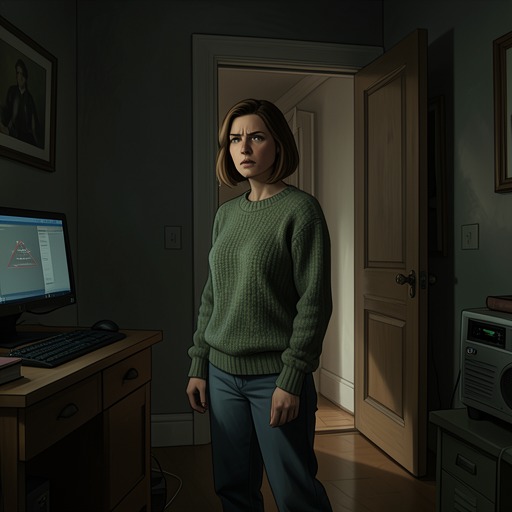
People in the house and overlapping space appear
You Should Have LeftThe house's manifestations are the linked apparitions, distortions, and impossible interior spaces through which the mountain house becomes a rupture in ordinary reality. They first appear as ambiguous disturbances—a voice transmitted through the baby monitor, a delayed image, an unlocked door shown in a reflection, and a photograph that should not exist—before expanding into figures standing on ceilings and rooms repeating behind rooms. The manifestations do not merely frighten the unnamed narrator; they make perception, memory, and physical orientation incapable of guaranteeing Esther's safety.
First Signs: Voice, Image, and Delay
The most sustained manifestation begins when the unnamed narrator is reading the notebook and hears a sound from the baby monitor. It resembles a human voice, but its pitch and singsong movement are unfamiliar, and its words cannot be understood. The monitor shows Esther asleep, with her head on the pillow and one hand outside the blanket, apparently alone. The narrator runs upstairs and finds no one in her room, while the silence of the house offers no explanation for what was heard.
The voice returns as the narrator walks toward the living room. This time it seems to speak in strange, ancient-sounding words, half whisper and half sigh. On the monitor, a large figure leans over Esther's bed. The apparent supernatural presence is briefly given a rational explanation: the figure is the narrator himself, and the image is delayed by roughly a minute; the sound may be a radio signal. Yet the explanation does not restore safety. Esther sits up, sees the figure that is apparently her father, and screams, while the narrator reaches her room only to find her asleep. The technology that should connect parent and child instead produces two incompatible versions of the same moment.
The discrepancy becomes unbearable when Esther appears to be sleeping peacefully on the monitor while she is unmistakably lying beside the narrator on the sofa. He moves her from her bed after deciding that he cannot leave her alone upstairs, carries her downstairs, locks the living-room door, and pulls the plug from the monitor. The gesture is practical but also defensive: by severing the device, he tries to sever the house's capacity to multiply and transmit reality. The manifestation therefore changes the narrator's priority from investigating the phenomenon to containing it around Esther.
Reflections and Objects That Should Not Be There
The house's distortions continue after the monitor is disconnected. The narrator's knee hurts after he falls on the stairs, and the window reflection becomes another unstable threshold. At one moment it shows the narrator and Esther as expected, but the door behind them is wide open even though he has locked it. He repeatedly tells himself that these are only images and phantoms that cannot touch or harm either of them, yet the open door converts a visual inconsistency into the possibility of an intrusion. The reflection does not simply reproduce the room; it presents a version of the room whose actions and conditions no longer obey the narrator's choices.
A framed photograph intensifies the same conflict between memory and present space. The picture shows a despairing, bearded man in an old-fashioned suit leaning against a tree, with a hat in his hand. It hangs slightly askew beside the kitchen cabinet across from the television. The narrator remembers writing that there were no pictures anywhere in the house and cannot decide whether he overlooked this one or whether it has appeared afterward. Its placement near the television and its faded colors make it a concrete object, but its contradiction of the narrator's own written record makes it function as evidence against stable memory. The house seems able to insert not only figures and voices but also a history that the narrator has already denied recording.
The manifestations thus exploit ordinary acts of verification. The narrator checks the monitor, runs upstairs, consults his recollection, looks at the reflection, and remembers the notebook. Each test produces another contradiction. What initially might be dismissed as a technical malfunction, fatigue, or a missed detail becomes a pattern in which every method of checking reality generates a second reality.
The House as Overlapping Geometry
The spatial distortion becomes explicit when the unnamed narrator tries to move Esther backward through the house. He takes her hand, tells her that turning around is forbidden because it is a game, and proceeds in reverse. They reach the hall, where the wooden floor and white walls appear familiar, but a half-open door beside the washing-machine room seems not to have been there before. Inside is an empty room with a naked lightbulb and a wooden chair missing one leg. The room's incompleteness gives it the quality of a discarded duplicate of a domestic space rather than a usable part of the house.
The narrator feels a powerful desire to enter, but resists and pulls Esther onward. That moment makes the spatial anomaly a test of action, not merely a visual curiosity. The house offers a new threshold at the precise point where the narrator is attempting to protect his daughter and leave. Esther asks to use the bathroom, and the narrator refuses to stop, subordinating ordinary care to the urgent need to maintain their movement. The familiar household route has become a sequence of choices in which pausing may mean surrendering to the altered space.
Later, while carrying Esther down the hall, the narrator sees that the empty room now has another door on its far side. Beyond it lies a second empty room with another lightbulb and another open door, followed by a third. He sees the sequence only briefly and cannot determine whether something moves across the floor of the third room. The uncertainty is part of the manifestation's force: the impossible geometry is not presented as a fully visible mechanism but as a glimpse that defeats confidence in what was seen. The repeated rooms turn depth into recursion, replacing the house's expected layout with an interior that extends through itself.
The narrator concludes that the problem is not the house as an ordinary building but the place itself. The building is harmless in isolation, yet it stands where nothing should stand. This distinction separates physical architecture from the spatial condition that has invaded it. The house becomes a visible object occupying an impossible position, while the rooms behind rooms disclose a larger breach whose boundaries cannot be mapped.
Figures, Recurrence, and Consequence
The overlapping spaces are accompanied by human forms that cannot be securely classified. A man briefly appears in the room while Esther sleeps on the sofa. He does not look dangerous, but tired, and he resembles the woman with the narrow eyes. He is not the bearded man in the framed photograph. Most disturbingly, he is not standing on the floor but on the ceiling, looking down as though asking for help. The image reverses the house's vertical order: the ceiling becomes a floor for another occupant, and the narrator becomes the person being observed from an impossible position.
The narrator allows that exhaustion may have made him imagine the man, just as it may have made him imagine the additional doors. This self-doubt does not cancel the threat, because the manifestations repeatedly produce effects before they can be interpreted. The monitor makes Esther scream; the unlocked door appears despite the lock; the rooms multiply during an attempted escape; and the ceiling figure appears within the same unstable interior. The question is no longer whether every apparition is objectively present, but whether any distinction between hallucination and environment can protect the narrator from its consequences.
The earlier road and village journey provide a sharp contrast to the later interior distortions. Driving down the hairpin road, the narrator fears an ordinary accident: the car slides toward an unprotected edge, and he repeatedly brakes, reverses, and resumes until he reaches Gruntner's General Store. The return drive is calmer and contains recognizable details—the ruined barn, a rusted tractor, birds rising from a bush, and a deep-orange cloud. Inside the house, however, physical orientation loses the modest reliability that the road eventually grants. A drive can be survived through caution; the house's manifestations make caution itself uncertain.
The danger finally becomes routine. Footsteps sound on the second floor, something falls and shatters, the stairs creak, and the front door closes. The narrator is no longer frightened by these sounds in the earlier sense, because his fear has shifted toward larger consequences. Esther sleeps on the sofa beneath his jacket, food remains for another two days, and he senses that provisions may soon cease to matter. The manifestations have therefore transformed the house from a place containing frightening incidents into a condition of entrapment whose duration and rules are unknown.
Narrative Significance
The house's manifestations organize the book's movement from domestic realism to impossible geometry without providing a stable explanatory key. The narrator records events in writing because he fears that without doing so he may go mad or that something may happen to him, but the notebook itself becomes part of the problem when the framed photograph contradicts what he remembers writing. Documentation preserves the experience while also exposing the failure of memory and measurement to master it.
The manifestations also make caregiving the central measure of reality. The unnamed narrator's choices are repeatedly defined by Esther's body and location: he runs to her room, carries her downstairs, locks the living-room door, takes her hand, and refuses to enter the incomplete room. Yet the house produces incompatible versions of Esther—sleeping on the monitor and sleeping beside him—so that even protection requires choosing which visible reality to trust. The supernatural threat is consequently inseparable from parental responsibility.
At the level of space, the repeated doors and rooms literalize a world in which boundaries have become thin. The village, the road, and the house begin as parts of a recognizable journey, but the house eventually reveals an interior that may connect to other inaccessible places, perhaps beneath seas or inside mountain caves, or perhaps to nothing that can be reached at all. The manifestations are significant because they convert a vacation house into the visible edge of that larger uncertainty: a domestic structure that appears harmless while standing in a place where ordinary space should not exist.