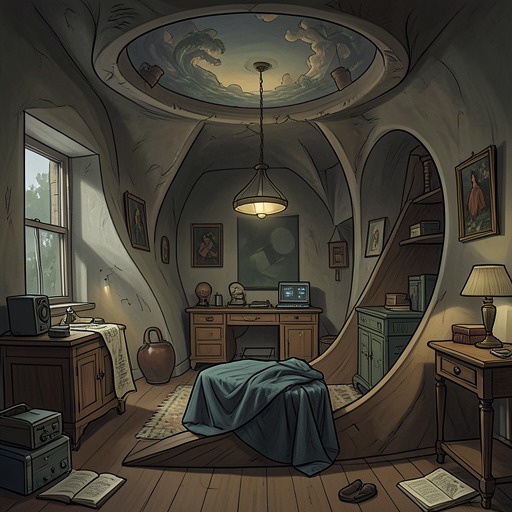
Sangakushi
You Should Have LeftThe triangle ruler is a small transparent plastic object whose significance expands from a practical measuring instrument into one of the clearest physical signs that the mountain house is governed by impossible geometry. Given to the unnamed narrator in the village, it first appears to belong to the ordinary world of school supplies and family errands. Later, however, its right angle becomes the means by which the house’s spatial contradiction is measured, recorded, and briefly explained. The ruler does not merely symbolize the breakdown of reality: its scale participates in that breakdown by producing measurements that cannot coexist within conventional geometry.
Appearance and Arrival
The ruler appears at Gruntner's General Store, the only shop in the village, after the unnamed narrator has driven down the dangerous hairpin road from the house. The shopkeeper places it in front of him as a gift and describes it as a small triangle ruler made of transparent plastic, like the instruments used in school. The object therefore enters the story through an exchange that initially seems mundane and even generous. Its transparency, familiar form, and educational association make it an apparently reliable tool, while the setting links it to the village’s local knowledge rather than to the architect-designed house rented by the family.
The shopkeeper’s cryptic instruction gives the ruler an immediate second status. He tells the unnamed narrator to try the right angle and indicates that the relevant number is four years. The narrator understands this as a reference to the house’s age, but the shopkeeper adds that a different house stood there before. The ruler thus arrives carrying an unexplained relation between measurement, construction, and replacement. It is both a gift and a warning, although the unnamed narrator initially lacks the framework needed to recognize the warning.
Measurement and Contradiction
Later, while Susanna is upstairs with Esther, the unnamed narrator uses the ruler on a notebook page. He draws a straight line, rotates the instrument, draws another at a right angle, and then positions it to bisect that angle. The resulting diagram looks peculiar. The right angle measures ninety degrees, as expected, but the two component angles measure forty and forty-two degrees, leaving several degrees apparently unaccounted for even though nothing is missing from the right angle itself.
The contradiction becomes more disturbing when the unnamed narrator repeats the construction. A second right angle still measures ninety degrees, yet the two parts of another figure do not divide it consistently. After completing a rectangle and drawing a diagonal, he finds that angles that should be precisely bisected appear blurry and difficult to hold in focus. One measurement gives forty-nine degrees below the dividing line and fifty-one above it. The ruler’s scale remains intact, but the relation between the scale and the space being measured has become unstable.
The unnamed narrator tries to dismiss the result as a consequence of confusion and the feeling that the world is ending. He lifts the ruler toward the light, shuts one eye, and finds the right angle apparently normal, with no absent numbers on the degree scale. This inspection matters because it separates a defective tool from a defective environment: the object looks sound, yet it cannot impose sound geometry on the house. Its material reliability survives just long enough to make the surrounding unreliability harder to deny.
A Tool Inside a Failing Cognitive System
The ruler works alongside the notebook, the phone, the reflections in the window, and the locked doors as an external support for the unnamed narrator’s memory and judgment. When the reflection in the large window behaves impossibly, he writes down what has happened because he fears that the event will soon seem distant or imaginary. The ruler serves a related purpose in a more concrete form. Drawing and measuring allow him to move uncertainty from perception into an apparently objective record, but the record itself produces incompatible results.
That failure is intensified by repetition. After Esther is moved downstairs and the baby monitor is unplugged, the unnamed narrator measures the angles again. One result remains unchanged, while the other shifts to thirty-nine and forty-one degrees. The page is torn from the notebook, crumpled, and thrown away. The discarded measurement marks a collapse in confidence not only in the ruler but also in the possibility that writing can stabilize experience. The instrument has been used to verify reality, yet its changing results make verification another source of fear.
The ruler’s presence also links abstract spatial disturbance to domestic life. It lies on the table while Susanna sings a lullaby upstairs, and it is handled amid the narrator’s discovery of the messages that expose Susanna’s infidelity. The same household object becomes entangled with marital suspicion, childcare, and the house’s physical anomalies. Ordinary systems of trust fail together: the narrator cannot trust the messages, the reflection, the locked door, or the angles drawn with a tool designed to make them certain.
Explanation and Larger Geometry
When the unnamed narrator later searches the garbage and finds the crumpled bill from Gruntner's General Store, he phones the shopkeeper and asks what the triangle was meant to show. The shopkeeper confirms that the angles do not fit together and says that they never fit up there. His explanation invokes a local figure, Hans Ägerli, who says that an ant does not know what a cathedral, a power plant, or a volcano is. The comparison suggests that human geometry may be as limited relative to the house as an ant’s understanding is relative to structures beyond its scale of comprehension.
The ruler’s right angle therefore becomes a boundary between familiar and inaccessible dimensions. Near the end, the unnamed narrator says that he understands the angle better: the explanation would require imagining additional dimensions from the other side, or from within. The ruler cannot fully represent that geometry, but it provides the first tactile evidence that ordinary spatial assumptions are inadequate. Its failed measurements are not random decoration; they are the small, repeatable trace of a larger order that the narrator can perceive without mastering.
Recurrence and Narrative Significance
The triangle ruler is introduced as a modest village gift, tested as a scientific instrument, rejected as a possible trick, and finally absorbed into the house’s impossible spatial logic. Its trajectory parallels the unnamed narrator’s movement from everyday skepticism toward recognition that the environment cannot be explained by ordinary physical rules. Because the object remains visually simple and materially intact, its strangeness comes from what it measures rather than from any overt transformation.
Its significance also reaches beyond the scenes in which it is held. The house initially appears new, minimalist, and better in reality than in its Internet pictures; its living room contains polished surfaces, a large window, and the reassuring order of contemporary design. Against that promise of controlled space, the ruler exposes a structure in which a right angle can remain ninety degrees while its parts change, blur, or fail to sum correctly. The object turns architectural confidence into a question of scale and perspective.
The ruler is consequently one of the narrative’s most precise instruments of epistemic collapse. It offers the unnamed narrator a way to test the world, but the test reveals that the world cannot be contained by the terms of the test. Even after the family’s movements become trapped by doors that return to the same room and reflections show spaces without their occupants, the ruler’s contradiction remains distinctive: it makes the impossible calculable without making it intelligible. Its final force lies in that tension between measurement and understanding, between a transparent object that seems to show everything and a geometry that remains visible only through what refuses to fit.