Spouse quarrels due to cheating text messages
You Should Have LeftThe marital confrontation over Susanna’s messages with David is the decisive rupture between the unnamed narrator and Susanna. What begins with packing bags and the care of Esther turns into a confrontation over a phone, copied messages, and the identity of David; Susanna’s refusal to deny the affair destroys the narrator’s hope that the evidence might somehow be explained away. The quarrel then expands beyond infidelity into a crisis of perception, memory, parenthood, and physical safety.
Domestic Strain Before the Discovery
The confrontation does not emerge from an otherwise peaceful marriage. Earlier, the unnamed narrator describes a household in which work and family life continually obstruct one another. While he is trying to write, Susanna and Esther enter the room, play noisily on the carpet, and make concentration impossible. He keeps scribbling so that Susanna will believe he is working, even as he insists that the production is genuinely waiting for him. His frustration is inseparable from his attachment: he says that he loves Susanna and wants no other life, yet cannot understand why they fight so constantly.
That pattern is visible again at dinner in the mountain house. Susanna asks twice what is wrong, and the unnamed narrator answers that nothing is wrong before accusing her of acting strangely. She returns the accusation. Esther’s rambling account of a preschool friend temporarily absorbs the adults’ attention; their exaggerated responses create a brief relief that brings them closer together. The family’s routines therefore both reveal and postpone the conflict. Childcare, conversation, and bedtime do not resolve the tension, but they provide short-lived ways for the adults to avoid naming it.
The Confrontation Over the Messages
The immediate scene occurs while Susanna is preparing to leave with Esther. She peels an apple for their daughter, asks the unnamed narrator to carry out the bags, and says that she will gather Esther’s toys. When she notices that something is wrong, he initially answers that nothing is wrong and dismisses her insistence as nonsense. The exchange becomes irreversible when he begins to shout, or believes he is shouting, while suspecting that his voice has deteriorated into a croak.
He tells Susanna that he has copied the messages into his notebook and asks who David is. The phone becomes the material center of the accusation. Susanna immediately takes it from the table, and the unnamed narrator tells her that there is no point hiding it because he has already recorded the messages. His discovery is also entangled with his attempt to find a reference to Steller, so the phone serves simultaneously as evidence of the marriage’s betrayal and as an object connected to his wider investigation.
The unnamed narrator recognizes the scene as resembling one of his films, but the comparison offers no protection. In fiction, he observes, the collapse of a life can appear funny because characters produce clever lines while everything is falling apart; in reality, the same collapse is merely dismal and repugnant. He asks whether Susanna will deny the affair, only to discover that he had been depending on precisely that denial. Her calm statement that she does not want to deny it confirms the betrayal while exposing his last emotional defense.
Counteraccusations and Escalation
Susanna responds by telling him to pull himself together and think of Esther. She then picks up their daughter and announces bedtime, turning the child’s immediate care into a barrier against the adults’ conflict. Esther protests that it is still light and not late, but Susanna kisses her and carries her upstairs. The gesture is maternal and controlled, sharply contrasting with the unnamed narrator’s loss of control below.
When Susanna returns, she offers her own account of how affairs are discovered: the un-deleted messages on a cell phone, the lover’s attachment to keeping them, and the jealous spouse’s persistence. She implies that the unnamed narrator searched her bag, even though he says he did not steal the phone from it and that it had been lying on the table. Susanna then states, in an actor’s voice, that he went through her bag. The accusation reverses the scene’s moral direction without disproving the messages. The unnamed narrator feels that he is the injured spouse, but he is also forced to confront his own intrusive act and the violation of privacy through which he obtained the evidence.
The argument is repeatedly interrupted by Esther. When the child sits up in bed and appears through the baby monitor, Susanna runs upstairs and sings beside her. The monitor thus carries the child’s voice into the quarrel and forces Susanna back into her parental role. It does not repair the marriage; instead, it divides the confrontation into bursts of accusation and enforced calm, with Esther functioning as both the vulnerable person at stake and the presence that prevents the adults from remaining absorbed entirely in each other.
Fragmented Memory and Separation
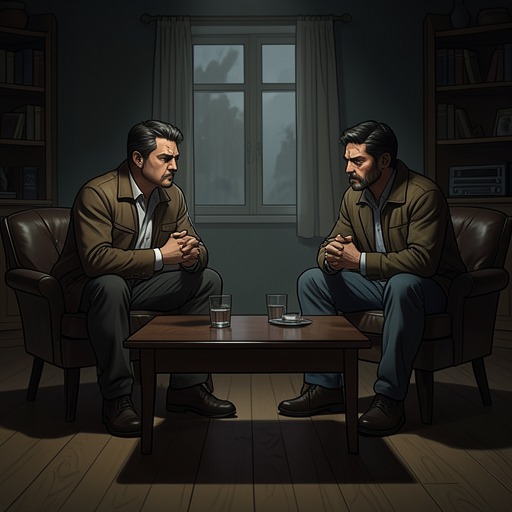
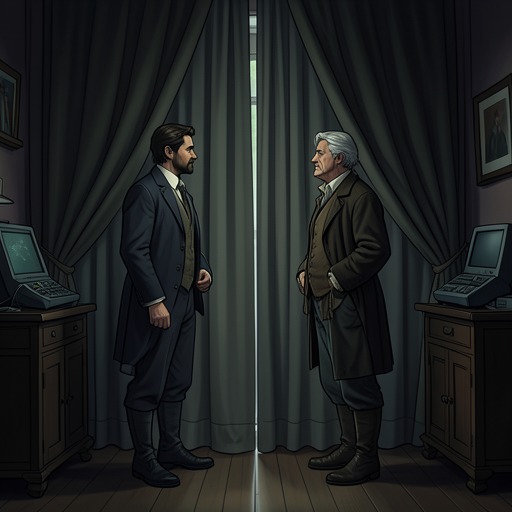
The unnamed narrator remembers the later quarrel only in fragments. He recalls shouting, throwing something onto the table, pounding his fist, crying, calming down, asking questions, and watching Susanna move back and forth. At another point Susanna is crying at the table while he stands silently by the window; later they shout across opposite sides of the table. The darkness outside has become dense by the time the conflict reaches another peak, so the passage of time is registered through the changing light rather than through a stable sequence of events.
The emotional movement briefly turns toward reconciliation. The unnamed narrator wants to go to Susanna, hold her face, and say that they should forget everything because he loves her. Yet he knows that forgetting is impossible. He goes to her anyway, but she asks to be left alone and says that he does not understand. Their attempted contact therefore produces renewed shouting rather than forgiveness. The front door slams, an engine starts, and Susanna leaves, while the unnamed narrator remains inside listening to the faint silence and writing down what happened without understanding it.
The immediate consequence is practical as well as emotional. He is left to face the next morning and Esther’s needs, asking what he will do when the child wakes. Later, when he speaks with Susanna by telephone, he kisses and hugs the sobbing Esther after hanging up. Esther cries out for her mother, and the unnamed narrator realizes with horror that he cannot remember which white lie he used to explain Susanna’s absence. His failure is no longer only that of a husband trying to interpret betrayal; it is also that of a parent whose account of reality is becoming unreliable in front of his child.
From Marital Rupture to Existential Danger
The confrontation becomes inseparable from the mountain house’s spatial abnormalities. Before the fight, the unnamed narrator has already experienced ordinary objects becoming unreachable, including a bathtub faucet that appears only a foot away but cannot be touched until he closes and reopens his eyes. After the quarrel, the phone, the baby monitor, the notebook, and the bedroom door acquire comparable weight: each is a device for contact or proof, yet none can restore a shared reality.
The separation also prepares the later danger surrounding Esther. The unnamed narrator writes everything down so that anyone who finds the notebook will know what happened, while imagining that people will later say that his wife left him and that something happened quickly among the mountain crevices. This imagined future combines the marital breach with the possibility of disappearance and death. Esther watches a film and suspects nothing, while rain, fog, and the vanishing glaciers make escape increasingly uncertain.
By the time Esther lies completely relaxed and breathes deeply and evenly, the unnamed narrator says that there is absolutely nothing he can do. The family conflict has thus moved from the question of whether Susanna betrayed him to the more terrifying question of whether ordinary human action still has power. When Susanna later describes the situation as a horrible mistake, the unnamed narrator tells her to start driving and asks for time alone to think. His command is not a reconciliation or a renewed accusation. It is the exhausted residue of the confrontation: a man attempting to regain agency after the marriage, the household, and the space around them have all ceased to behave normally.