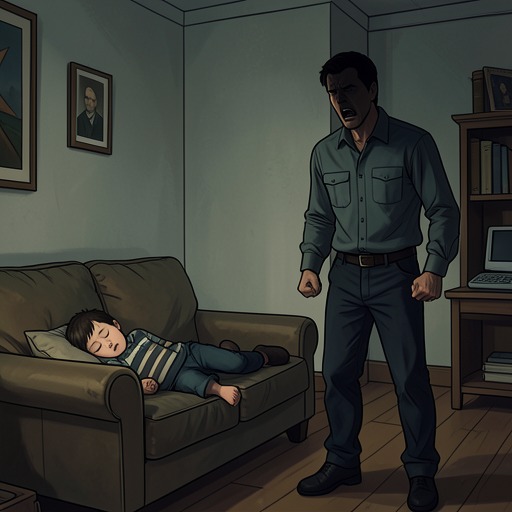
Suzanna and David's extramarital affair
You Should Have LeftSusanna’s affair with David is the central hidden rupture in her marriage to the unnamed narrator. It is not presented through an earlier scene of courtship or a complete account of the relationship, but through the sudden material evidence of messages on her phone. That narrow disclosure changes the meaning of the couple’s previous tension, makes their domestic intimacy unstable, and ultimately accompanies the separation in which Susanna takes Esther away from the mountain house while the narrator remains behind.
Conditions Before the Discovery
The affair emerges against a marriage already marked by irritation, exhaustion, and emotional displacement. The unnamed narrator insists that he loves Susanna and does not want another life, yet he also admits that they fight constantly. His work deepens the strain: when Susanna and Esther enter the room while he is writing, he pretends to be busy so that Susanna will not accuse him of complaining without working, even as he continues writing because the entire production depends on him. Work is therefore both an actual obligation and a defense against domestic conflict, while Susanna’s presence makes concentration impossible.
Their conflict remains partially concealed in ordinary family routines. At dinner, Susanna asks twice what is wrong; the narrator answers that nothing is wrong and then accuses her of acting strangely. Esther’s confused story about a preschool friend briefly gives the adults a shared task: they respond with enthusiastic exclamations, and the relief when the child stops talking brings them closer together. The child functions as a temporary buffer between them, but the closeness is fragile. Even the narrator’s care for Esther, including bathing her and drying the inside of her ear because she likes it, takes place beside an atmosphere in which the adults are unable to speak plainly.
The Messages and Their Meaning
The discovery begins when Susanna’s phone is lying beside the narrator on the table. He knows or believes that Steller’s number may be stored in it and reaches for the device. A message flashes on the screen. Before accepting what he has seen, he constructs harmless explanations: it might be a joke, out of context, or sent to the wrong number. That hesitation shows the narrator’s simultaneous suspicion and wish to preserve the marriage’s ordinary appearance.
The sender is identified only as David, a man the narrator does not know. The messages are unmistakably sexual and emotionally intimate. David asks how much longer Susanna will be away, says that the separation feels endless before having her in his arms, declares that he misses her, and expresses a desire to touch and enter her. The fragments also indicate an ongoing correspondence rather than an isolated mistake: the narrator finds exchanges from both Susanna and David and tries to copy them into his notebook without letting her know. His attempt to preserve the evidence converts the phone from an everyday object into the instrument through which the marriage’s hidden structure becomes visible.
The affair is thus revealed through partial text rather than direct observation. The messages supply enough concrete detail to destroy plausible denial, but they do not explain how long the relationship has lasted, how often the lovers met, or what Susanna expected from it. The narrator is left with the humiliating position of reconstructing intimacy from fragments, while the phone’s portability and saved messages make secrecy dependent on a physical object that can be seized, opened, and remembered.
Confrontation and Admission
When Susanna returns to the room, the narrator confronts her about David. He tries to shout, though he begins to suspect that his voice is only a croak. Esther is present and looks up at him as he says that he has copied the messages into his notebook. The scene turns the affair from private suspicion into a family crisis witnessed by the child, even though Esther cannot comprehend its adult meaning.
The narrator asks whether Susanna will deny what he has found. Her calm refusal is devastating precisely because he realizes that he had hoped she would deny it. The confrontation exposes not only her infidelity but also his dependence on denial as the last possible protection for the marriage. Susanna tells him to pull himself together and think of their daughter, then picks Esther up and carries her upstairs for bed. Her immediate movement toward maternal care interrupts the quarrel without repairing anything; the child is removed from the room, but the family system has already been altered.
Susanna later describes the narrator’s behavior as that of a jealous husband who has gone through her bag and retained the phone. She says that people who are caught in affairs often fail to delete the messages, that they keep the device with them and underestimate the persistence of the jealous partner. Her explanation frames the phone as evidence of both her mistake and the narrator’s surveillance. He denies stealing it from her bag and says that it had been lying on the table, but Susanna replies that she would never have left it there and accuses him of searching her bag. The dispute over the phone does not disprove the affair; it reveals how quickly the couple’s moral argument shifts toward competing accounts of intrusion, concealment, and culpability.
Consequences for the Family
The affair intensifies an existing conflict between marital attachment and parental responsibility. Before the discovery, Susanna and the narrator can still use Esther’s stories and bedtime routines to create brief moments of cooperation. During the confrontation, Susanna invokes Esther directly, and the narrator’s attention likewise remains entangled with the child’s presence. Later, when the mountain house becomes spatially impossible, Esther becomes the person he tries to protect and carry, while the affair remains the emotional knowledge that has already separated him from Susanna.
The couple eventually agree that they will leave the house and spend not one more night there. That decision is made in a moment of physical closeness, with Susanna embracing the narrator in the rain, but the reconciliation is provisional and shadowed by the affair. When Susanna returns by car, she says that David is not important, that she does not care about him, and that she never wants to see him again. She calls the relationship a mistake, specifically a horrible one. These statements do not erase the messages or restore trust; they recast David as an unwanted episode at the exact moment when the family must decide who can leave and who cannot.
The narrator tells Susanna to start driving. After a pause, she gets into the car with Esther. He embraces his wife but feels divided, as though another person were performing the gesture under the same name. He then pushes Susanna away and tells her to go. She drives off, and the narrator sees Esther’s pale face in the rear window before the car disappears around the bend. The affair’s final consequence is therefore not a reunion or a negotiated repair but a physical departure: Susanna and Esther leave together, while the narrator is left facing the house alone.
Narrative Significance
The affair connects the novel’s domestic realism to its uncanny spatial crisis. The narrator’s first response is to interpret the messages through the conventions of his own films, where a life falling apart can be made funny by clever dialogue; he recognizes that reality is instead dismal and repugnant. The affair exposes the failure of artistic distance. A betrayal that might serve as a plot device in a screenplay becomes an irreversible experience when it happens inside the narrator’s family.
Its discovery also prepares the novel’s broader movement from ordinary relational uncertainty to a world in which familiar rules no longer hold. The phone, the notebook, the child’s bedtime, and the couple’s argument are recognizable domestic details, yet they unfold beside rooms whose distances change and exits that return to the same house. In that setting, the affair is the most legible form of dislocation: before space becomes impossible, intimacy has already become divided. Susanna’s denial, confession, retraction, and departure leave the narrator with no stable version of marriage to return to, just as the house offers no reliable route back to ordinary reality.