Tao tui taofou hou chong xin duo huai shan wu
You Should Have LeftThe impossible return is the decisive reversal in the unnamed narrator’s attempt to flee the mountain house with Esther. After choosing to move backward rather than turn around, he leads the four-year-old child down the dark road, but the route that should carry them toward the village bends back to the house. The return destroys the practical meaning of distance and leaves the narrator responsible for a child inside a space whose rules he cannot explain.
The Escape Begins
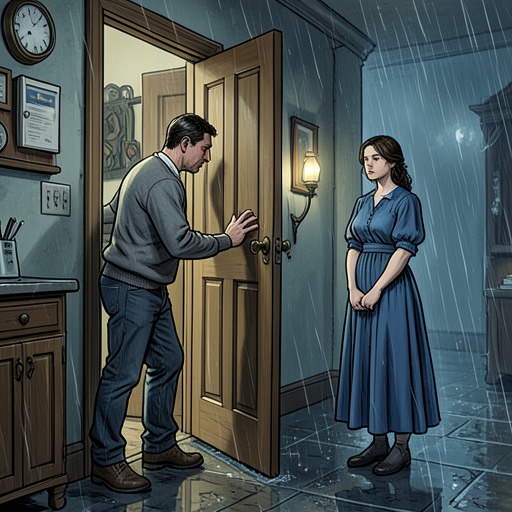
The escape grows out of the house’s increasingly threatening spatial condition. Earlier, the unnamed narrator has already experienced the building as a place where ordinary orientation cannot be trusted, and he understands that simply walking toward an exit may not be enough. In the early evening, he takes Esther’s hand and tells her that they must not turn around. Instead, they walk backward through the house, reaching the hall with its wooden floor and white walls. The washing-machine room lies to the left, while beside it stands a half-open door that the narrator feels was not there before. He looks inside and sees an empty room, a bare lightbulb, and a wooden chair missing a leg. The room exerts a confusing attraction, but he resists it and pulls Esther onward.
The backward movement is therefore both a survival tactic and a game imposed on a frightened child. Esther interrupts the escape by saying that she needs to go to the bathroom, but the unnamed narrator refuses to stop. His response shows how quickly ordinary parental care has been subordinated to the need to maintain a route out. The house is no longer merely a setting from which the family can depart; it has become an active spatial problem, one that dictates the family’s movements and turns familiar decisions into dangerous ones.
Down the Mountain
Once outside, the unnamed narrator and Esther follow the road in darkness. The window behind them still throws a little light onto the road, which runs straight for about fifty yards before reaching the first bend. That measurable stretch briefly preserves the appearance of a normal landscape. The road seems to possess a clear direction, and the narrator can still imagine that successive bends will lead them away from the house.
They reach the second bend and then the third. The darkness beyond the narrow beam of the phone’s flashlight is impenetrable, and the phone has no reception. The narrator sees bushes, rocks, and earth at the roadside, but cannot see the valley or the moon. The absence of distant lights removes every external confirmation of their position. The journey becomes a sequence of bodily acts rather than a navigable passage: walking, carrying, listening, and trying not to lose balance.
A sudden animal passing nearby intensifies the danger. A crunch sounds beside them; Esther cries out; the unnamed narrator jumps protectively in front of her; then a large four-legged body bounds past and gallops down the road. Esther cries, and he picks her up and kisses her. Her tears taste salty. The detail binds the impossible landscape to immediate physical vulnerability: whatever the mountain is doing to space, the child remains cold, frightened, and dependent on him.
After two more bends, the world seems extinguished. The silence and cold reduce reality to Esther, the unnamed narrator, and the sound of their footsteps. He begins humming and recognizes the melody as London Bridge Is Falling Down. He asks Esther to sing along, but she stops, and he can no longer bear the sound of his own voice. When she begins crying again, he carries her, while the darkness and uneven road make every step more precarious.
Recognition of the Return
The pair eventually sees the sky grow slightly brighter and makes out tree trunks. After another bend, the trunks become distinct, and light shimmers between them from a house. The unnamed narrator believes they have reached safety. His arm muscles tremble from Esther’s weight, but relief makes the physical strain seem irrelevant. He speaks to her as though the ordeal has become an adventure, presenting their arrival as something fun and crazy even though the child does not answer.
He switches off the flashlight as the woods thin and the road approaches the illuminated window. Then the apparent destination resolves into the mountain house itself. The pointed roof, wide front door, empty parking area, and large lit window match the building they had left. Through the window, the unnamed narrator can see the long table, the kitchen, and the open door to the hall. These specific interior details make the recognition more devastating: the house is not merely similar to their starting point, but continuous with it, visibly displaying the rooms from which they had tried to escape.
The narrator says that they are back. He sets Esther down and feels as if he is going to vomit, but fights the reaction because he cannot allow it to happen in front of the child. Esther begins to object that they had been going down the entire time. Her unfinished protest identifies the contradiction at the center of the event: their movement has been continuous and apparently directed downhill, yet the result is a return to the same place.
Spatial Reversal and Aftermath
The unnamed narrator answers that the situation is complicated and promises to explain it tomorrow, then tells Esther that she must go to sleep. The promise postpones explanation rather than providing one. It also restores, at least verbally, a fragment of ordinary family routine: a child should sleep, and an adult should explain confusing events the next day. But the return has made tomorrow’s explanatory framework doubtful, because the problem is not simply fear or poor navigation. The road itself has defeated the distinction between departure and arrival.
The event reverses the value of the escape. At the beginning, backward walking appears to offer a controlled method of withdrawal from the house; at the end, the same method has delivered Esther and the unnamed narrator back to the source of danger. The narrator’s practical competence is replaced by recognition that he cannot guarantee a destination, call for help, or even establish whether the village lies below them. His earlier panic while driving down the mountain had been attached to ordinary physical hazards such as hairpin bends, blinding sunlight, missing barriers, and the abyss near the road. The return produces a more radical fear: the environment has ceased to remain stable enough for those hazards to be the whole problem.
The contrast with the later drive to the village sharpens the event’s significance. On the downward journey, the unnamed narrator is overwhelmed by his fear of driving, stopping repeatedly at the bends and reaching the village after thirty minutes with trembling hands. The village contains one street and one shop, Gruntner’s General Store, across from the church. On the later drive back up, the fading winter light allows him to notice a pile of stones, a rusted tractor, the long shadow of the car, birds rising from a bush, and an orange cloud. That drive still belongs to a recognizable world of roads, distances, and observable landmarks. The backward escape with Esther does not. It converts the mountain route into an impossible loop and establishes the house as a trap whose boundaries cannot be measured by ordinary travel.