The Village
You Should Have LeftThe Village is the isolated settlement beneath the rented mountain house, the nearest recognizable human environment in a narrative where roads, rooms, and exits gradually lose their ordinary logic. Its single street, single shop, church, difficult access, and local stories of vanished vacationers make it both a practical destination and a fragile measure of normality: the narrator can still drive there, buy supplies, and ask questions, even as the house above it begins to behave as though it occupies the wrong place in the world.
Setting and Physical Character
The narrator sees The Village far below the house, where the valley is divided by three narrow lines: a road, a river, and a railroad. Another road branches away like a pencil mark and climbs toward the rented house. From above, the settlement appears reduced to dice-sized houses, while the surrounding landscape is dominated by glaciers, granite, woods, and steep mountain slopes. This perspective places the village within an immense and difficult terrain rather than presenting it as an independent community; it is a small human arrangement at the bottom of a hazardous route.
The journey between the house and The Village is itself a test of physical control. The road rises and falls through tight hairpin bends without side barriers, and the narrator, who considers himself clumsy, absentminded, and slow to react, experiences driving as a potentially reckless act even in good conditions. On the descent, the sun blinds him, the valley swings from one side of the car to the other at each bend, and the vehicle slides dangerously close to the edge. He brakes repeatedly, reverses to correct his position, and finally reaches the village after thirty minutes with trembling hands and a heartbeat that is only gradually returning to normal.
The settlement does not offer picturesque reassurance. Its low houses seem to cower; their roofs are pointed, their windows small, and their gray walls covered with flaking plaster. A bus stop stands beneath a gloomy rain shelter, and there are railway tracks but no station because the train does not stop there. These details define The Village through limited access and diminished movement. It is connected to the wider world by road and rail, yet neither connection is dependable: the road is dangerous, and the train passes without stopping.
The General Store and Local Contact
The Village’s only shop is Gruntner's General Store, situated across from the church. A bell announces the narrator’s entrance into its small room, where a counter and cash register are attended by a fat man with bags under his eyes. The shopkeeper’s face appears to have been kneaded from red dough, and he moves slowly, leaning on the counter and looking the narrator over before going out to collect the groceries. The encounter is spare and awkward rather than welcoming. When the narrator begins to read his shopping list, the shopkeeper interrupts him with a wave, then returns after an interminable interval with butter wrapped in foil.
The store nevertheless becomes the narrator’s main point of contact with local knowledge. After the house begins to seem impossible, he searches the kitchen garbage for the discarded bill from Gruntner's General Store, finds the address and telephone number stamped at the top, and calls. The practical object of shopping is thus transformed into a potential lifeline. The bill, once merely evidence of supplies purchased, gives the narrator a way to seek a taxi and someone who might get him and Esther away from the house.
The storekeeper’s limited speech carries more weight than his manner initially suggests. He explains that the newer house is not even ten years old, then indicates that another house stood there before it. He also says that a vacationer once disappeared from the place and was never found, probably falling somewhere among the mountain’s crevices and smooth slopes. The paths are poorly marked, and Hans Ägerli, who is responsible for mountain rescue, drinks. The account expands from one disappearance into a local pattern: people have always vanished there, including in earlier times.
Local Knowledge and the House’s History
The Village provides the first social explanation for the house, but not a complete one. The shopkeeper’s remarks establish a succession of buildings on the site: the present house replaced an older one, which in turn stood where a different house had existed before. The repetition makes the location seem older and more unstable than the apparently recent building suggests. The house may be new as an object, but the ground beneath it carries a history of replacement, absence, and disappearance.
The local explanation remains uncertain because it is filtered through rumor, dialect, drinking, and incomplete knowledge. The shopkeeper attributes a striking idea to Hans Ägerli: an ant cannot know what a cathedral, a power plant, or a volcano is. He immediately qualifies the statement by noting that Ägerli has been drinking and says many things. The comparison nevertheless becomes a useful model for the narrator’s predicament. The house’s geometry cannot be understood from within ordinary human assumptions, just as a creature with a radically smaller scale of experience could not comprehend a structure vastly beyond it.
The Village therefore functions as a threshold between familiar explanation and metaphysical terror. Its inhabitants can describe falls, crevices, bad paths, and repeated disappearances, but their practical account cannot contain what happens inside the house. The narrator hears that a vacationer disappeared, then encounters doors that return to the living room and corridors that seem to multiply. Local history does not solve the anomaly; it shows that the anomaly may have been present long before the narrator recognized it.
Relation to the Narrator’s Attempts to Escape
The Village is associated with escape because it is the place where the narrator can obtain food, telephone assistance, and a route downward. Yet the movement between the house and the village is never secure. After receiving the warning to get away, the narrator drives back uphill. The return journey is less frightening than the descent: the winter sun has moved behind the rocky ridge between the glaciers, the valley lies in shadow, and the narrator notices a ruined barn, a pile of stones, a rusted tractor, and a flock of birds lifted suddenly from a bush. The road appears temporarily legible, allowing him to believe that ordinary distance still functions.
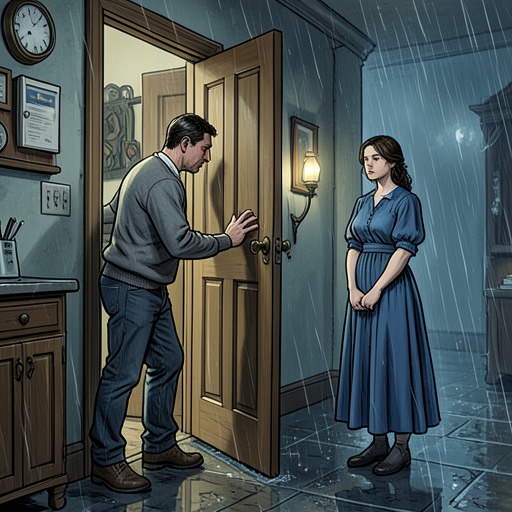
That belief is undermined when the narrator later tries to leave the house with Esther by walking backward. He treats the movement as a game and instructs her not to turn around. They reach the hall, pass a washing-machine room and a newly perceived half-open door, and continue into darkness. Using the fully charged phone as a flashlight, the narrator leads Esther down the steep road, holding her warm hand in his ice-cold one. The route seems to descend toward safety, and the trees eventually reveal the light of a house.
The apparent destination is not The Village but the same mountain house. The pointed roof, broad front door, empty parking area, illuminated window, long table, kitchen, and open hall door reproduce the place they were trying to escape. Their path has closed into itself. Against the house’s spatial trap, The Village remains an imagined point of ordinary rescue, but the narrative never grants the narrator a reliable route from the house to that human settlement.
Narrative Significance
The Village gives the mountain landscape a social scale. The house’s impossible space might otherwise seem wholly detached from human history, but the village supplies groceries, telephones, roads, local memory, and records of people who disappeared. At the same time, its poverty of infrastructure and shrinking appearance emphasize how little protection ordinary society offers in the mountains: there is no train station, the paths are poorly marked, rescue responsibility rests with a man who drinks, and the only store is a small room across from a church.
Its most important function is comparative. In The Village, danger can still be named as a bad road, a missing barrier, a fall, or a vanished tourist. Inside the house, those categories break down. A door leads back to the room it should have left; spaces overlap; reflections and pictures contradict memory; and the narrator suspects that the house is harmless but stands where nothing should stand. The Village is thus the last visible framework of shared reality, while the house represents a place where the substance of space has become thin and words no longer capture what is happening.