The former romantic relationship between Jana and Martin
You Should Have LeftJana and Martin’s former romantic relationship is defined by a reversal: Jana rejected Martin partly because he was a senior tax official, yet he later became the partner Ella wanted to bring into the apartment Jana had shared with her. The relationship’s afterlife turns an apparently practical housing decision into a test of loyalty, dignity, and self-control.
History and Character of the Relationship
Jana and Martin had already been a couple before the events surrounding the apartment. Their breakup was not presented as the result of a lack of attraction or personal compatibility alone. Martin is described as good-looking, sensitive, well-read, and multilingual, but Jana considered his profession decisive: she did not want to be in a relationship with a senior tax official. The objection is both personal and comic, reducing a potentially desirable man to the institutional role that, in Jana’s view, made him unsuitable.
The breakup therefore established a contradiction at the center of their history. Jana could recognize Martin’s appealing qualities while refusing the social identity attached to his work. Her later description of the separation insists that Martin was simply not right for her, but the tax service remains the concrete reason attached to the decision. The former relationship is consequently remembered through both intimacy and ridicule: Martin was once close enough to date, yet his occupation became the feature that made closeness impossible.
The Apartment Conflict
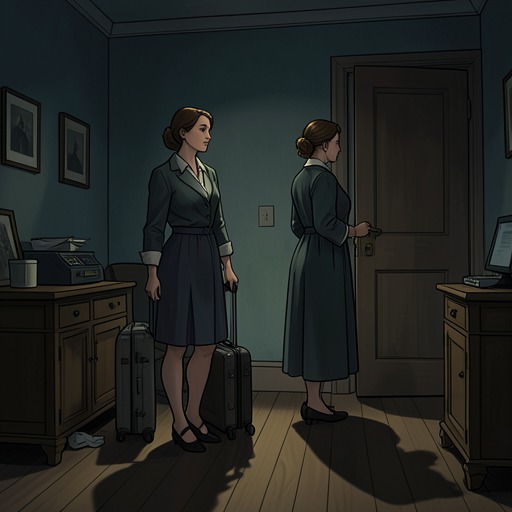
The past relationship becomes active again when Ella asks Jana to move out of the apartment where Jana had been living so that Ella’s new boyfriend can move in. That boyfriend is Martin, Jana’s former partner. The request places the two women’s friendship and Jana’s romantic history in the same confined domestic space: Ella is not merely choosing a new roommate arrangement, but making room for the man Jana once rejected.
Jana’s reaction is unexpectedly calm. Because she is known for impulsiveness and for sudden verbal eruptions, the expected response is an angry outburst. Instead, she remains composed when Ella tells her to leave. Ella finds this composure provocative, suggesting that Jana’s restraint does not reduce the conflict but changes its emotional balance. Jana’s calm can be read as a refusal to give Ella the dramatic reaction everyone anticipates, while it also leaves the injury unresolved beneath the surface.
Jana explains that she and Martin broke up because he was not right for her, then tells Ella that he is clearly right for Ella. She also defends the social necessity of tax officials, arguing that without them the state and even the streets would fail, leaving anarchy. The argument is deliberately elaborate and tonally pointed: Jana appears to justify the profession she once used to reject Martin, while preserving the distinction between Martin’s suitability for Ella and his unsuitability for herself. When Martin enters wearing a suit and carrying a briefcase, Ella redirects her anger toward him, while Jana stands there without smiling. Her silence and expression register the cost of seeing the former relationship converted into Ella’s present romance.
Martin After the Breakup
Martin’s professional identity, which helped end his relationship with Jana, is examined separately after the quarrel. At the office, he becomes dissatisfied with himself and recognizes in his colleagues what other people see in him: tax officials. He realizes that he is one of them, and the question of how he became one is traced through images of his past.
School photographs show Martin before he was a tax official. University photographs show the transformation beginning: he wears a tie and solves crossword puzzles with a serious, almost devoted expression. Looking down at himself, he loosens his tie, feels insecure, and tightens it again. He then notices a casually styled pop singer in a magazine and orders a tax audit of the singer before slowly loosening his tie. The action is petty, deliberate, and revealing. Martin briefly acts against the bureaucratic self that Jana despised, but he does so through the authority of that very profession. His former relationship with Jana thus remains tied to an identity he cannot simply remove.
Narrative and Thematic Significance
Jana and Martin’s past relationship supplies the apartment sequence with its hidden charge. Without their history, Ella’s request would be ordinary domestic rearrangement; with it, Jana is displaced by a former lover who has been selected by her closest friend. The scene also turns Jana’s reputation for uncontrolled anger into a dramatic expectation and then withholds the expected release. Her calm becomes a form of pressure, provoking Ella and allowing the conflict to move through tone, silence, and gesture rather than through Jana’s familiar explosion.
The relationship also links private desire to public identity. Jana rejects Martin not because the narrative denies his attractiveness, intelligence, or sensitivity, but because his occupation represents a life she does not want. Later, Martin’s uneasy self-recognition and retaliatory tax audit show that the profession is not a detachable surface. The former couple’s separation therefore anticipates a recurring concern of the story: people are caught inside roles, relationships, and structures that they can perceive but cannot easily escape. Jana’s past with Martin is brief in direct chronology, yet it continues to shape the loyalties, humiliations, and emotional reversals of the present.