The protagonist and Susanna decide to leave the mountain house
You Should Have LeftThe decision to leave the Vacation House marks a crucial reversal in the mountain-house narrative: the narrator and Susanna stop treating their unease as a passing discomfort and agree that staying even one more night is impossible. What begins as a practical family decision, made while Esther sleeps and rain settles over the mountain, becomes the first collective recognition that the house itself may be the source of danger. Its significance is sharpened by the fact that leaving does not restore ordinary space; the attempt eventually returns the family to the house they meant to escape.
Causes and Background
The decision follows a day spent outdoors during the short winter days in the mountains. The narrator had already considered hiking with four-year-old Esther unwise, placing it high on the list of activities that should not be attempted with a small child, but Susanna insisted. The excursion therefore begins within an ordinary family disagreement, shaped by fatigue, responsibility, and the practical limits of caring for Esther in an unfamiliar place. The daylight is fading when they return, giving the scene a narrowing temporal frame even before the house becomes openly threatening.
The more decisive cause is Susanna’s changed perception of the Vacation House. She says that something is wrong with it, though she finds the problem difficult to explain. The disturbance is atmospheric rather than immediately physical: she does not sleep well and has unusually bad dreams, dreams resembling the feverish visions produced by illness. Her account remains incomplete when Esther pinches the narrator’s ear and interrupts the conversation, but the interruption does not remove the fear. Instead, it leaves the house’s influence partly unnamed, experienced as a bodily and psychological pressure that exceeds ordinary explanation.
The narrator initially responds poorly to Susanna’s attempt to describe the dreams. He becomes obsessive about learning what she saw, while Susanna objects to the intensity of his questioning. Their failure to communicate turns the walk into a scene of mutual irritation. Esther falls asleep, the narrator carries her until his shoulders hurt, and drizzle begins. These physical details transform an abstract suspicion about the house into an immediate condition of exhaustion, vulnerability, and exposure.
The Decision Itself
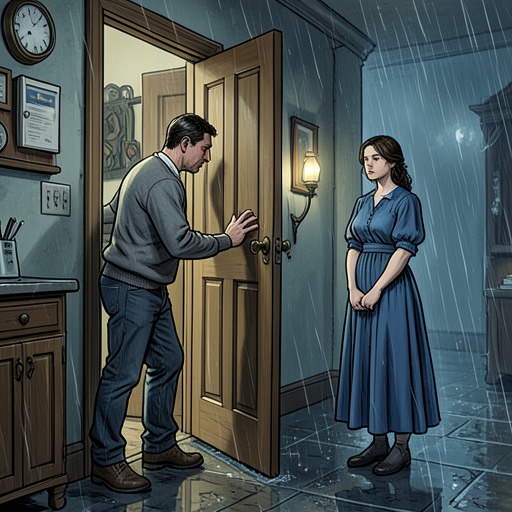
The turning point comes when the narrator asks whether they should leave. The question is practical in form but decisive in consequence: it gives Susanna a possible action instead of requiring her to justify an intuition she cannot fully articulate. Susanna stops, and the two look at each other while rain runs over their shoulders. She then moves toward him and embraces him, replacing the preceding irritation with a brief recovery of solidarity.
Susanna agrees that they must leave that day and spend not one more night in the house. The narrator immediately repeats the decision, confirming that it is mutual rather than merely Susanna’s demand or the narrator’s temporary concession. Esther remains asleep during this exchange, making the child both the reason for urgency and the silent center of the family’s shared responsibility. The decision thus unites the adults around protection, departure, and the recovery of a world outside the house.
The scene also carries an ironic counterpoint. The narrator privately associates his writing with progress and wonders whether Susanna may believe that he and Esther are happy there because his screenplay is advancing and he is constantly writing in his notebook. The house has therefore offered an apparently productive retreat at the same time that it has begun to damage the family’s sense of safety. Their agreement to leave rejects the assumption that creative progress or beautiful surroundings can compensate for the atmosphere of the place.
Attempted Departure and Spatial Drift
The departure is complicated by the narrator’s fear of driving down the mountain. He describes himself as clumsy, absentminded, and slow to react, and regards a car as a fuel-filled capsule in which everyday life can become a crash through one careless turn. On the narrow hairpin road, the sun blinds him, the valley swings from side to side, and the car repeatedly slides too far toward the edge. He brakes, reverses, and starts again, sweating as he tries to keep control without a barrier between the road and the abyss.
After thirty minutes he reaches the village, where there is only one street and one shop, Gruntner's General Store, across from the church. He waits in the car with trembling hands until his heartbeat slows. The village itself appears constricted and withdrawn: low houses seem to cower, windows are tiny, walls are gray and flaking, and the railway tracks have no station because the train does not stop there. The intended escape route consequently leads not into reassuring normality but into another marginal, enclosed setting.
The return drive is calmer. The sun is partly hidden behind the rocky ridge between the glaciers, the valley lies in shadow, and the narrator notices details missed on the way down, including stones beside a ruined barn, a rusted tractor, and the long shadow cast by the car. The drive seems to restore ordinary perception, and he reaches the house, stores the groceries in the refrigerator, and sits at the table to write. Yet the apparent return to routine is deceptive. The house remains the destination and the enclosing frame of the family’s movements.
Consequences and Aftermath
The decision’s failure becomes unmistakable when the narrator later tries to leave the Vacation House with Esther by walking backward. He takes her hand and presents the movement as a game, insisting that they must not turn around. They reach the hall, passing the washing-machine room and a half-open door that seems not to have existed before. Inside is an empty room with a bare lightbulb and a wooden chair missing a leg; the narrator feels an unnaturally strong desire to enter but resists and pulls Esther onward. The route outward is therefore already contaminated by altered architecture and impulses he cannot explain.
The backward walk does not produce freedom. After crossing the woods, the narrator sees a brightly lit house with the same pointed roof, wide front door, empty parking area, large window, long table, kitchen, and open hall door as the Vacation House. He hopes that the resemblance is only a mistake, but recognizes that it is not. The family has returned to the place they were trying to escape. The decision remains emotionally valid, but its practical objective has been defeated by a space that refuses to behave like ordinary geography.
The aftermath changes the meaning of the original embrace and agreement. Leaving was not simply a response to a bad night or a marital quarrel; it was an attempted break from a trap whose danger lies in encouraging delay. The narrator later understands the inhabitants’ altered expressions as the result of what they have seen and compares the place to a crevice that appears climbable until every movement leads deeper. In that structure, the decision to leave is the first recognition of the trap, while the failed escape demonstrates that recognition alone cannot restore an exit.
Narrative Significance
This action occupies the threshold between domestic realism and spatial horror. Its immediate materials are familiar—an argument during a family outing, a sleeping child, rain, fatigue, a proposal to go home—but the emotional current beneath them has already become collective and pre-verbal. Susanna’s unease passes into the narrator’s conduct, the child’s weight becomes a physical burden, and the weather and fading daylight make the family’s ordinary route feel increasingly unstable.
The decision also establishes a recurring contrast between movement and escape. The narrator drives down to the village, shops at Gruntner's General Store, drives back up, and later walks through the woods, yet these movements do not guarantee progress. Roads, corridors, doors, and forest paths become variations of the same enclosure. The family can change direction, reverse their steps, or imagine a destination, but the Vacation House continues to reassert itself as the place to which their movement returns.
As a result, the decision is both a moment of marital cooperation and a structural warning. The narrator and Susanna briefly recover a shared “we,” agreeing that the house must be abandoned, but the narrative immediately tests the limits of that agreement. Their common will can identify the danger and initiate departure; it cannot yet overcome the geometry that makes departure impossible.