The protagonist refuses to leave with Susanna
You Should Have LeftThe protagonist’s refusal to leave with Susanna and Esther is the final reversal of the family’s attempted escape from the Vacation House. Although Susanna returns in the car and takes Esther away, the protagonist does not follow them. His decision converts a possible family rescue into a separation: Susanna and Esther move back toward ordinary life, while he turns again toward the house and the spatial impossibility surrounding it.
Circumstances of the Refusal
The decision follows an increasingly unstable retreat from the Vacation House. Earlier, the protagonist had already understood driving as a terrifying passage between ordinary life and catastrophe, especially on the narrow hairpin road descending toward the village. He regarded himself as clumsy, absentminded, and slow to react, and the drive to Gruntner's General Store left him with trembling hands before he had even entered the shop. The return drive was calmer, but its fading winter light, ruined barn, rusted tractor, bird-filled bush, and orange cloud belonged to a landscape that had begun to feel less like a route home than a shifting border between worlds.
The family’s wish to leave had once seemed shared. Susanna had insisted that there should be not one more night in the house, and the protagonist had agreed. Yet the Vacation House had already disrupted the ordinary movements by which a family defines safety. A bathtub faucet seemed farther away than its visible position allowed, and the protagonist and Esther later had to walk backward through the hall as part of an improvised game because turning around was forbidden. The modern, architect-designed house, which looked better in reality than in its Internet pictures, thus became the setting in which familiar domestic actions—driving, bathing, walking, putting a child to bed—ceased to obey stable rules.
The Encounter Outside the House
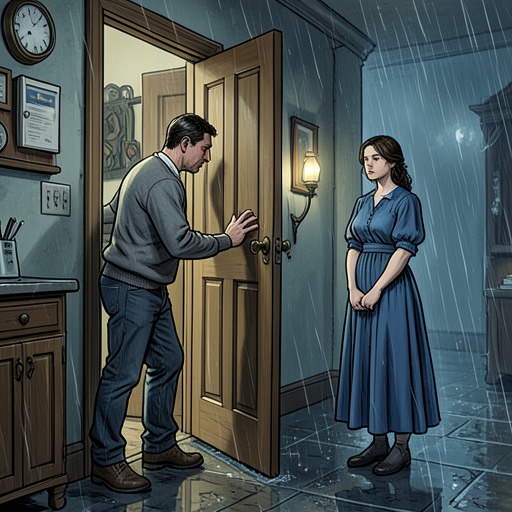
The protagonist’s refusal occurs after a night in which the house has again rearranged itself around him and Esther. When Esther is close to waking, he hears an engine and understands that he must act quickly. He carries her through a hall that is no longer the hall from the living room but a much longer second-floor corridor. The passage expands as he runs; he stumbles, hears a car horn, and reaches the stairs only after fearing that the corridor might continue without end. Esther strikes a picture on the wall, glass shatters, and he finally bursts outside.
There he finds the car with its headlights still on and its windshield wipers moving in the drizzle. Susanna is behind the wheel. Her return supplies the practical possibility of escape that the house has denied him: she has come to retrieve both him and their daughter. She gets out without switching off the engine, pale and furrowed, and explains that she has been desperately worried and has called repeatedly. Her anger is inseparable from concern; she rebukes him for stopping communication when they have a child together, making parental responsibility the immediate ethical ground of the encounter.
The protagonist places Esther in the back seat and kisses her. She is wide-eyed, hot-cheeked, and feverish. He has no suitable words for her, so he closes the car door. This small gesture gives the separation its physical form: Esther is not merely being sent away in theory but placed inside the vehicle from which she will soon disappear. The child’s fever also makes the moment more urgent, while her vulnerability intensifies the cost of the protagonist’s choice to remain.
Susanna, David, and the Decision to Stay
Susanna’s first explanation addresses the infidelity that had already shattered the marriage. She says that David is not important, that she does not care about him, and that she never wants to see him again. She calls the affair a mistake, specifically a horrible one. Her words do not undo what the protagonist discovered in the messages, but they clarify the immediate direction of her loyalty: she presents David as someone she intends to abandon and the family as the relationship she is trying to recover.
The protagonist nevertheless refuses the offered reconciliation. He tells Susanna to start driving and says that he needs time alone to think. His language is deliberately provisional: he repeats that he must think about everything, as though the marriage, the affair, the house, and his own identity have become too entangled to address in conversation. When Susanna objects that they cannot remain there, he answers that the place is good for thinking and asks her to drive fast. The request is not an attempt to persuade her to wait for him; it is an instruction to take Esther away while he stays behind.
Susanna hesitates, but the protagonist insists that she trust him and start driving. The refusal therefore contains both withdrawal and care. He rejects the role of husband returning with his wife, but he does not prevent Susanna from taking Esther to safety. His separation is aimed at himself: he removes his own body from the family’s departure and leaves the mother and daughter to continue without him.
The Parting and Its Consequences
When the couple look at each other, the protagonist feels divided into two beings. One part knows that never seeing Susanna and Esther again would be unbearable; another experiences them as already remote, and cannot tell whether he would even want to return to the place to which return seems impossible. The refusal is consequently not presented as a clear, confident act of independence. It is a rupture in self-recognition. He embraces Susanna while feeling that somebody else is performing the gesture, somebody who shares only his name.
The embrace lasts several seconds and then feels too long. He lets go, pushes Susanna away, steps back, and tells her to go. She nods, gets into the car, and drives around him. For a moment he sees Esther’s pale face in the rear window; then the car vanishes around the bend, although he continues to hear the engine for a while. The departing vehicle carries away the last visible connection to the family, leaving the protagonist with rain on his head and the house before him.
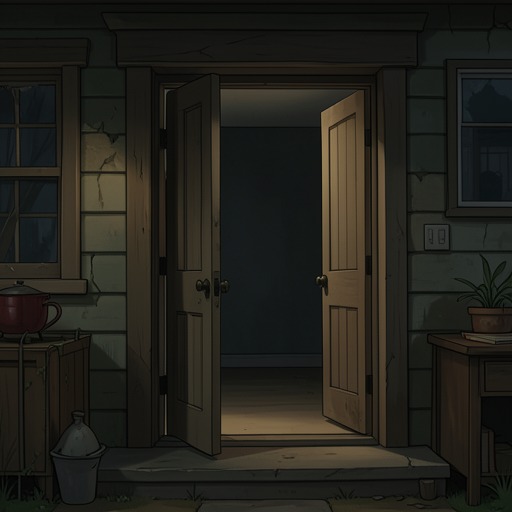
After the car disappears, the protagonist looks up at the Vacation House and notices that it appears different. He then goes back inside. The consequence of his refusal is therefore not simply marital separation but renewed enclosure. Susanna and Esther achieve a form of physical departure, while he re-enters the location whose corridors, doors, and distances have already ceased to behave normally. The decision closes the possibility of an ordinary family exit and opens the final stage of his solitary entanglement with the house.
Narrative Significance
The refusal reverses the expected rescue pattern. The protagonist has carried Esther through the expanding interior, reached the outside, and found Susanna waiting with the engine running, yet the threshold does not restore him to domestic reality. Instead, it divides the family. The ordinary symbols of escape—the car, the road, the returning wife, and the child in the back seat—remain available, but the protagonist cannot inhabit the future they imply.
The scene also gathers together the story’s two forms of crisis. The marriage has been damaged by Susanna’s relationship with David, while the Vacation House has damaged the protagonist’s confidence in stable space, continuous identity, and reliable perception. Neither crisis is resolved before the departure. Susanna’s admission that the affair was a mistake offers a possible emotional repair, but the protagonist’s response shows that knowledge alone cannot restore the previous arrangement. At the same time, his decision to stay does not give him mastery over the house; it places him more completely within its altered geography.
As a threshold event, the refusal marks the protagonist’s passage out of the family unit without delivering him into a new secure identity. Susanna and Esther cross back toward the road, whereas he remains on the side of the house, rain, and impossible return. The act is thus at once a sacrifice, an escape that he declines, and a surrender to the place that has made ordinary departure inconceivable. Its decisive meaning lies in that contradiction: he sends away the people he loves in order to remain alone with the reality he can no longer leave behind.