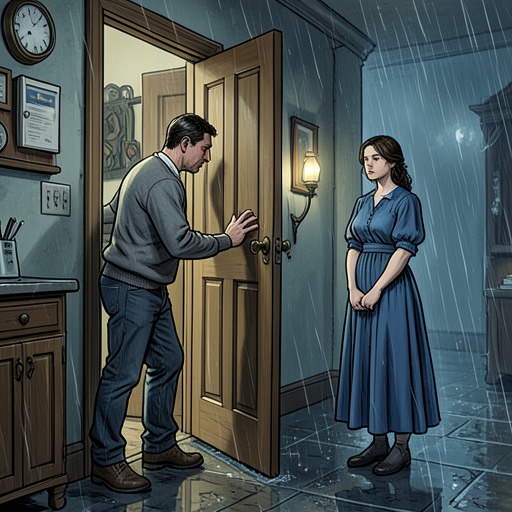
The space in the house is abnormal
You Should Have LeftThe spatial abnormality in the mountain house is the central mechanism that transforms a rented vacation home into a trap. It first violates the practical promise of architecture— that a door leads somewhere else—then expands into a disturbance of rooms, reflections, scale, direction, and bodily orientation. Because the narrator records each anomaly while repeatedly doubting his own senses, the phenomenon remains suspended between supernatural intrusion and the collapse of ordinary cognition, yet its consequences are concrete: escape routes fail, Esther is endangered, and the narrator’s confidence in the house, his notes, and his perception dissolves.
Ordinary Space Before the Rupture
The house initially belongs to a recognizable landscape and a recognizable system of use. It has been rented for a family stay, stands above a valley, and is approached by a steep road of hairpin bends. From its window, the narrator sees a meadow descending toward woods, a pale willow, and, far below, the valley’s road, river, and railroad. The setting is remote but legible: the road branches toward the house, the rooms have domestic functions, and the surrounding terrain appears to provide an outside to which the occupants can return.
That apparent legibility is reinforced by the routines of consumption and documentation. The narrator drives down to the village, reaches Gruntner’s General Store after thirty minutes, buys provisions, and returns by the same mountain road. The newness of the house is treated as an ordinary property question; the narrator even remarks that it cannot be more than ten years old. The house therefore enters the story through the language of rental, shopping, driving, and family logistics rather than through an obviously ancient or ruined architecture. Its abnormality is not announced by its age. It emerges when familiar spatial arrangements cease to honor the uses assigned to them.
Doors, Rooms, and Failed Exits
The decisive breach occurs when the narrator leaves the living room with Esther. He has no network on his phone, so he takes her by the hand, unlocks the door, and leads her outside. Esther reacts with surprise because they are suddenly back in the living room. The narrator confirms the spatial contradiction: they did leave the living room, but the door they passed through returned them to that same room. The exit has not merely been blocked; it has performed a loop, converting departure into repetition.
The narrator tries to preserve normality by turning on a film stored on his phone, but the domestic distraction cannot restore a functioning layout. Later, he makes a more deliberate attempt to escape by walking backward with Esther and refusing to turn around. This route reaches the hall, where the wooden floor and white walls seem familiar, yet the passage contains a half-open door that the narrator feels was not there before. Inside is an empty room with a naked lightbulb and a wooden chair missing a leg. The room is already unsettling, but its strongest effect lies in the temptation it creates: the narrator feels a powerful desire to enter and must resist it while pulling Esther onward.
The abnormality then proliferates. While carrying Esther through the hall, the narrator sees another door on the far side of the empty room. Beyond it is another empty room with another lightbulb and another open door, followed by a third. The repetition suggests not a hidden wing but an endless or layered interior, a sequence that defeats the assumption that rooms are finite containers arranged within a stable building. The narrator sees something moving on the floor of the third room, though he immediately admits uncertainty. He and Esther reach the living room again, and he locks the door, converting the supposedly safe domestic center into a sealed point within the same spatial trap.
Unstable Scale and Impossible Orientation
The house’s exterior becomes as unreliable as its interior. Looking toward it, the narrator sees a figure shift farther to the left, then a second figure appear, then no figure at all. At the same time, the front of the building ripples around the window. Its size becomes impossible to determine: for a moment it projects far into the distance, pointed and gigantic, not upward but in a direction the narrator had never imagined. Esther sees the house as small, while the narrator encounters it as something extended beyond ordinary architectural orientation. Their incompatible perceptions show that the anomaly is not simply a concealed passage or a deceptive facade; it alters the coordinates by which the building can be recognized.
The figures intensify this dislocation. A man briefly appears inside the room, not on the floor but on the ceiling, looking down as if asking for help. He is not the bearded man in the framed photograph, although he seems to resemble the woman with the narrow eyes. The figure is therefore both bodily present and spatially impossible, and the narrator cannot decide whether he witnessed another inhabitant of the house or imagined him. The uncertainty does not neutralize the event. It makes perception itself part of the abnormal architecture, since every sight may be either evidence of a larger space or a symptom of the narrator’s inability to stabilize what he sees.
Measurement, Memory, and Cognitive Failure
The spatial disturbance also attacks the tools that ordinarily secure reality. The narrator uses a notebook to preserve events because an experience that has just happened already feels long ago, and he fears that he will soon no longer know whether it occurred. His writing is an external memory, a defense against the possibility that the mind will revise the scene into imagination. Yet the notebook cannot provide an uncontested outside perspective: even while writing, he thinks the event must have been imagined.
The triangle ruler becomes another failed instrument of verification. After Susanna takes Esther upstairs, the narrator draws a straight line, rotates the ruler, and draws a second line at a right angle. He then bisects the angle and measures the result. The right angle measures ninety degrees, as expected, but the two component angles measure forty and forty-two degrees, leaving several degrees apparently missing even though the whole remains a right angle. When he constructs further right angles and a rectangle, the geometry becomes increasingly unstable: a diagonal produces blurred oblique divisions, and later measurements yield forty-nine and fifty-one degrees. The ruler does not simply reveal an unusual drawing. It exposes a contradiction in which the whole remains mathematically correct while its parts refuse to add up in the expected way.
This contradiction parallels the house’s architecture. A room can remain recognizably a room while its doors lead back to the same place; a building can remain visibly present while its scale extends in an impossible direction; a right angle can remain ninety degrees while its divisions appear not to total ninety. External objects— the notebook, the triangle ruler, the phone, the door lock, and the remembered layout—are recruited to stabilize experience, but each becomes entangled in the instability. The narrator’s cognition is therefore distributed across objects and spaces that no longer behave consistently, leaving him unable to determine whether the failure lies in perception, matter, or the relation between them.
The House and the Place
The narrator eventually distinguishes the building from the phenomenon itself. His conclusion is that the house is harmless and that the abnormality belongs to the place: the structure is simply standing where nothing should stand. This distinction matters because it rejects the familiar idea of a haunted object or malicious dwelling. The house does not need intention to become dangerous. Its position in reality is enough to make ordinary movement impossible.
From this premise, the narrator imagines that other such places may exist, perhaps unreachable on the sea bottom or in mountain caves, or separated from this one by light-years in an infinite universe. The house becomes a local manifestation of a wider rupture in the substance of space, a place where the ordinary world grows thin. The explanation expands rather than resolves the danger: if the anomaly is a property of reality’s structure, then the family is not confronting a single locked house but an opening onto possibilities that language cannot contain.
The final image preserves that unresolved condition. After the narrator returns in the rain, the house looks different, and the window once again reflects the room clearly: table, cabinet, kitchen, and door. No one appears in the reflection, but a notebook lies on the table. The apparently stable reflection offers neither confirmation nor relief. It repeats the story’s governing contradiction: the room can be visible and empty while its occupants are absent, the house can look ordinary while remaining spatially impossible, and the written record can survive even when the reality it was meant to secure has become inaccessible.