Three-act structure
You Should Have LeftThe three-act structure is the book’s explicit large-scale rule of organization. It divides the narrative into successive dramatic phases rather than treating the characters’ experiences as one continuous sequence, and it establishes a contrast between Jana’s forced independence and Ella’s first experience of living with a man.
Act One: Separation and New Domesticity
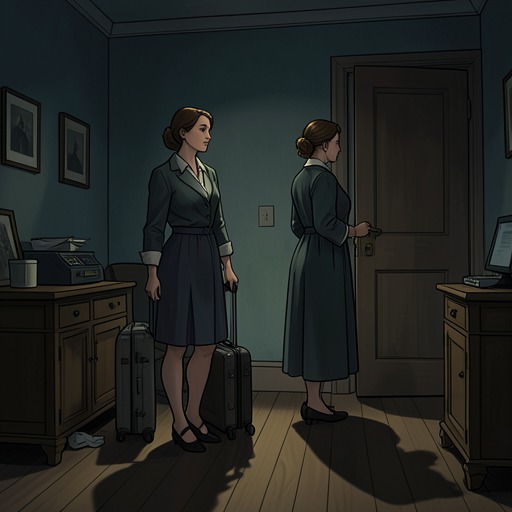
The first act begins when Jana moves out of Ella’s apartment. Jana must manage on her own, so the act converts a shared domestic arrangement into a condition of independence and uncertainty. Her departure is therefore both a plot action and a structural rupture: the relationship between the two women can no longer be represented through the routines of living together.
At the same time, Ella enters a new phase of domestic life. She lives with a man for the first time in her life, creating a direct counterpoint to Jana’s solitary adjustment. The act thus places two changes beside one another: Jana loses the familiar support of the apartment, while Ella gains an unfamiliar form of cohabitation. The structure makes their divergent circumstances legible as parallel consequences of the same separation.
The Second Act and the Incomplete Transition
The available outline states that, in the second act, Ella has to learn something, but the supplied passage ends before completing that sentence. What can be established is that the second act is conceived as a period of learning for Ella rather than as a simple continuation of the first act’s setup. Its dramatic function is consequently transitional: the new living arrangement introduced in the opening act becomes a condition that demands adaptation.
Because the evidence does not identify what Ella must learn, the content of that transformation cannot be specified without invention. The fragment nevertheless distinguishes the second act from the first. Act one establishes the changed living arrangements; act two is marked by the pressure those arrangements place on Ella and by the expectation of development that follows from them.
Structural Contrast and Dramatic Function
The three-act rule gives the early narrative a paired movement. Jana’s story is defined by departure and self-reliance, while Ella’s is defined by entering shared life with a man and confronting the consequences of that change. These are not interchangeable versions of independence. Jana is pushed outward into having to get by alone; Ella is drawn into a new domestic situation that requires her to learn how to inhabit it.
The structure therefore organizes character change through spatial and relational shifts. The apartment is the starting point of Jana and Ella’s shared life, and Jana’s move makes the space itself a marker of altered relationships. Ella’s new cohabitation carries the first act beyond simple separation, while the incomplete transition into act two indicates that the central dramatic question concerns what the characters become after their arrangements change.
Narrative Significance
As an explicit three-act design, the rule supplies a framework of setup, development, and eventual continuation beyond the surviving excerpt. Its most concrete achievement is to make the opening rupture meaningful: Jana’s move is not an isolated incident, because it simultaneously opens Ella’s first life with a man and prepares the learning process assigned to the second act.
The evidence does not reveal the third act or the final resolution. It does, however, show that the narrative’s architecture depends on asymmetry: one character must cope alone at the very moment another begins a new form of domestic life. The three-act structure turns that divergence into the book’s initial dramatic engine and leaves the later acts responsible for testing whether either new arrangement can last.