Vacation House
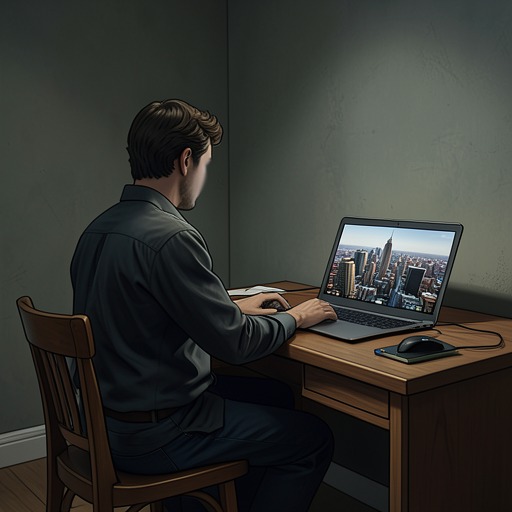
You Should Have LeftVacation House is the rented Alpine home at the center of the narrative’s spatial and psychological crisis. Introduced as an attractive modern property, it gradually ceases to function as a stable shelter: rooms, images, doors, and routes no longer obey ordinary continuity. The house itself is eventually distinguished from the anomaly surrounding it, becoming the fixed-looking surface of a place where reality has grown thin.
Setting and Physical Appearance
Vacation House stands above a valley, outside a meadow that slopes gently for about a hundred yards toward woods of spruces and pines, ending at a huge pale willow. From its windows, the narrator can hear the wind but otherwise encounters an unusual silence. Far below are the valley’s dice-sized houses and three parallel lines of road, river, and railroad, with the narrow road to the house branching away like a pencil mark. The setting combines precise geographical orientation with isolation: the valley is visible, yet access to it depends on a steep road with repeated hairpin bends and no side barriers.
The building initially exceeds the expectations created by its Internet listing. It is not a musty Alpine hut but a new, minimalist, two-story house with a narrow upper balcony and a large living-room window. Its architectural appearance is clean and contemporary, and the narrator understands it to be no more than ten years old. This distinction matters because the house does not announce itself as an ancient ruin or visibly haunted dwelling. Its danger emerges against the background of modern design, commercial rental, and the confidence that a recently built property should be legible and safe.
The journey to the property is already a test of the space around it. The narrator, who considers himself clumsy, absentminded, and slow to react, experiences driving as a reckless surrender to a fuel-filled machine. On the descent, the blinding sun, the narrow bends, the ruined barn, and the unguarded abyss bring the car close to catastrophe. Thirty minutes later, he reaches the village and remains in the car until his trembling hands and heartbeat settle. The only shop, Gruntner’s General Store, stands across from the church on the village’s single street, making the house’s rental transaction seem both ordinary and strangely remote from the systems that supposedly support it.
From Rental Property to Unstable Space
The house enters the story through an ordinary commercial arrangement. The narrator and his family rented it through Airbnb, and the storekeeper reacts to the owner’s name, Steller, as though everyone should recognize it. The owner almost never comes to the village anymore. Even the purchase at Gruntner’s General Store carries a faintly dislocated quality: the shopkeeper writes the amount, forty-seven thirty, on a stamped slip of paper, takes a fifty, and does not appear inclined to give change. These details place Vacation House within a network of rental, ownership, payment, and local knowledge, while also showing how little control the visitors possess over the property or the story attached to it.
At first, the house appears to offer the predictable structure of family life. The narrator has come with Susanna and their four-year-old daughter Esther, whose recent fourth birthday has made everyday care easier. Yet the house’s apparent order begins to fracture through visual contradiction. The narrator remembers a photograph in the laundry room, showing a terrifying narrow-eyed woman, positioned beside the washing machine and dryer. When he returns to inspect it after a disturbing dream, the photograph has vanished. There is no nail, no hole, and no other picture anywhere in the house. The absence is not merely an object missing from a room; it invalidates the narrator’s own written record that the walls contain no pictures.
Later, a photograph does appear. It hangs in a thin metal frame beside the steel kitchen cabinet across from the television, slightly askew. It depicts a bearded, despairing man in an old-fashioned suit, leaning against a tree and holding a hat. The colors have faded. The narrator remembers having written that there were no pictures in the house and cannot decide whether he overlooked this one or whether the room itself has changed. Vacation House therefore undermines not only visual certainty but documentary certainty: notes, memory, and present perception no longer guarantee the same inventory of objects.
Entrapment and Impossible Exits
The spatial crisis becomes undeniable when the narrator leaves the living room with Esther. After the phone shows no network, he takes her hand, unlocks the door, and leads her out. Yet Esther squeals because they are suddenly back in the living room. They have left the room, but the door has returned them to the same room. The house has converted an ordinary threshold into a loop, making the most basic distinction between departure and return impossible.
The narrator responds by occupying the room as if ordinary domestic entertainment could temporarily conceal the breach. He starts an emergency film stored on his phone, The Jungle Book, and gives the device to Esther. The gesture preserves a fragment of parental routine while the architecture has ceased to provide a route through the home. The contrast is central to Vacation House: the familiar objects of a family stay remain available, but they no longer guarantee familiar conditions of life.
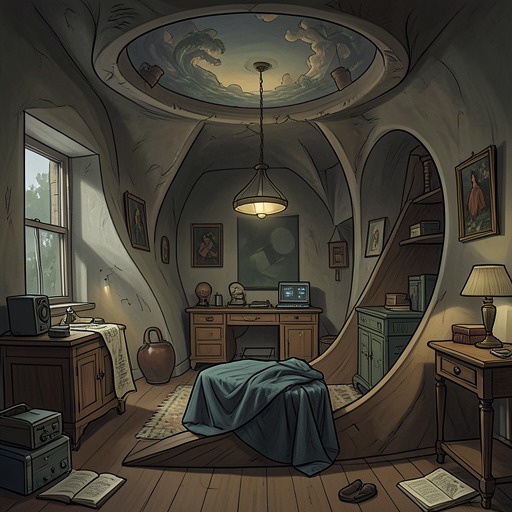
In the early evening, the narrator attempts another method. He takes the phone from Esther, grasps her hand, and tells her that they must not turn around because walking backward is a game. This time they reach the hall. The route contains the washing-machine room, a half-open door that seems not to have existed before, and an empty room with a naked lightbulb and a wooden chair missing a leg. The narrator feels a powerful desire to enter but resists and pulls Esther onward. Even progress is therefore shaped by forbidden openings and unstable recollection; the house offers corridors that may be entrances, traps, or glimpses into a larger arrangement of spaces.
The House and the Place
The escape through the woods produces the most devastating reversal. Carrying Esther, the narrator follows the road toward what appears to be a bright house window. The woods thin, the phone still has no reception, and the illuminated window reveals the familiar long table, kitchen, and open door to the hall. The pointed roof, wide front door, and empty parking area confirm that the destination is not merely similar to Vacation House. It is Vacation House again. The attempt to leave has returned the family to the same building from outside.
The narrator also glimpses figures and repetitions that intensify the uncertainty. A tired, beardless man appears briefly in a room, possibly resembling the narrow-eyed woman; another doorway seems to open into a sequence of empty rooms, each containing a lightbulb and another open door. The narrator sees possible movement in the third room but admits exhaustion may have altered his perception. Vacation House thus remains connected to the narrative’s unreliable sensory field: the house’s impossible geometry is presented through a consciousness that records, doubts, revises, and fears its own observations.
Yet the narrator finally separates the building from the larger anomaly. He concludes that it is the place itself, not the house, that is dangerous. The house is harmless; it is simply standing where nothing should stand. This formulation shifts the problem from haunted architecture to a spatial rupture with potentially cosmic dimensions. The narrator suspects that other such places may exist on the sea bottom or in inaccessible mountain caves, or that the next one may be light-years away in an infinite universe. Vacation House becomes one visible point where the substance of reality has grown thin, while language remains inadequate to capture the experience.
Family Consequences and Narrative Significance
The family’s relationship to Vacation House changes from temporary occupancy to entrapment. Susanna and the narrator decide that they will not spend another night there, after returning from a day outdoors as the short winter day fades. Their decision gives the building a direct force over family life: it turns a holiday into an emergency and converts disagreement about travel, work, and writing into a shared demand for departure.
Susanna eventually drives away with Esther. The narrator embraces his wife but feels divided, as though the person holding her shares only his name. He knows that he may never see Susanna and Esther again, yet simultaneously experiences them as impossibly distant. When he tells Susanna to go, she enters the car and drives away; Esther’s pale face remains visible in the rear window until the vehicle disappears around the bend. The narrator then looks back at Vacation House, which now appears different, and slowly goes inside. The house is therefore not destroyed or explained away. It remains standing, while the human unit that entered it has been separated.
Vacation House functions as a material building, a rented commodity, a domestic shelter, and a threshold into non-Euclidean uncertainty. Its modern appearance and precise surroundings initially promise orientation, but each promise is progressively revoked: the village is reachable only by a dangerous road, the photograph cannot be trusted to remain in place, the door returns the travelers to the room they left, backward movement leads through proliferating spaces, and the road out returns to the same illuminated window. The location’s decisive significance lies in this contrast between harmless structure and impossible placement. It does not need to behave like a monster. Its mere presence where it should not be is enough to reorganize perception, movement, family relations, and the boundaries of the real.