Yama inya ya shu zui chushou chushou kongwu daoying
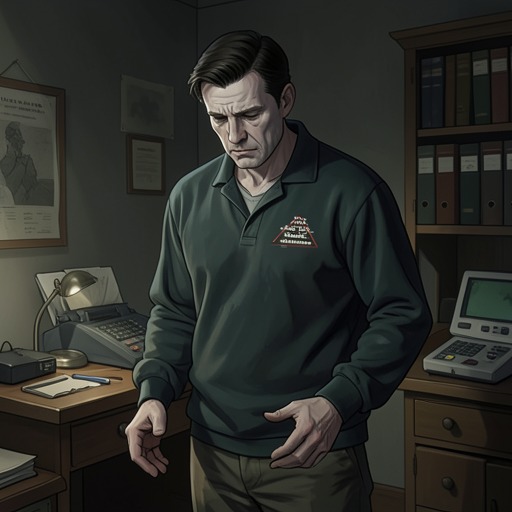
You Should Have LeftThe first appearance of the empty reflection is the mountain house’s earliest sustained breach of ordinary reality. The unnamed narrator is sitting at the long kitchen table as darkness gathers outside when the windowpane reflects the room with remarkable clarity but omits the person seated before it. The event converts an everyday act of looking into a test of whether the room, the body, and the written record can still be trusted.
Setting and Immediate Context
The episode follows the unnamed narrator’s difficult drive down from the rented house to the village and back. Driving is already associated with danger: the narrator considers himself clumsy, absentminded, and slow to react, and the narrow road’s hairpin bends, blinding sun, steep drop, and lack of barriers turn the journey into an ordeal. After reaching Gruntner's General Store, across from the church on the village’s only street, he waits in the car with trembling hands before entering. The old village and the isolated mountain setting establish a world whose apparent ordinariness is already under pressure.
The return drive is calmer but not reassuring. The short winter day is ending, the valley has fallen into shadow, and the narrator notices the ruined barn, the rusted tractor, birds bursting from a bush, and an orange-lit cloud only on the way back. He arrives at the house, puts the groceries in the refrigerator, and sits at the table to write. This sequence matters because the reflection occurs after a concrete passage through roads, shops, objects, and routine actions: the anomaly interrupts a documented return to normality rather than appearing in an explicitly dreamlike scene.
What the Reflection Shows
The narrator first suspects that the phenomenon is optical, but it does not stop. In the windowpane he sees the reflected refrigerator, stove, kitchen table, hallway door, flat-screen television, low gray-green sofa, lamp, table, chair, and the crumpled plastic grocery bag lying on the table. An empty glass appears beside the bag both in the room and in the reflection. The reflection is therefore not a vague distortion; it preserves a dense inventory of the domestic interior.
The decisive absence is the narrator himself. The reflected room contains no one. The discrepancy becomes more disturbing when the geometry of the reflection contradicts the narrator’s physical position. He is sitting between the door and the windowpane and should block the living-room door handle, yet the handle remains visible. The back of his chair, the tabletop beneath him, and the open notebook are also visible. When he covers the notebook with his hand, the entire notebook still appears in the reflection. The reflected room is not merely missing a body; it seems to preserve objects that the body should conceal.
The event recalls an earlier, momentary absence in the house, but this time the condition persists. The narrator repeatedly notes that it is still happening, watching the unoccupied reflection as if duration itself has become evidence. The repetition gives the scene a documentary rhythm: observation is followed by renewed observation, then by an attempt to stabilize what has been seen through writing.
Recording and Doubt
The unnamed narrator tries to turn perception into proof. He wants to photograph the reflection but cannot find his phone, so he writes down the arrangement of the room and the fact that no person appears in it. The notebook becomes an external memory, a defense against the expected collapse of certainty. Writing is not presented as detached description; it is an emergency procedure intended to prevent the narrator from later claiming that the episode was only imagination.
Yet the record cannot secure the experience. The narrator stands up to look for the phone and briefly looks away. When he turns back, the anomaly has stopped: he is again in the room, and his reflection performs the same action. He writes that the event has ended while simultaneously experiencing the ordinary scene it has restored. The episode has therefore produced a doubled sequence in which the narrator writes in the room and appears to write in its reflection, making the act of documentation part of the disturbance.
Immediately afterward, temporal confidence begins to erode. Although the event has just happened, it already feels long past, and the narrator expects that soon he will no longer be certain it occurred. Even while writing the account, he thinks it must have been imagination. The empty reflection thus does not reveal a stable supernatural rule; it reveals a perception that cannot remain stable when carried from immediate experience into memory and language.
Consequences for the House
The reflection is the first sustained sign that the rented house cannot be understood solely as a building with faulty light, glass, or perspective. Later experiences intensify the same conflict between physical movement and spatial representation. The narrator and Esther leave a room through a door but return to the living room, and the narrator eventually concludes that the problem lies in the place itself rather than in the house as an intentional or threatening entity. He describes the house as harmless while recognizing that it stands where nothing should stand, suggesting that the empty reflection is an early surface manifestation of a deeper spatial condition.
The episode also prepares the later appearance of objects and spaces that seem to violate the narrator’s prior records. A framed photograph of a despairing bearded man appears on a kitchen wall even though the narrator remembers writing that there were no pictures anywhere in the house. The earlier reflection makes such contradictions legible as part of a continuing pattern: the room can be present while its occupant is absent, and the house can contain details that memory insists were not there.
The practical supports of ordinary knowledge begin failing together. The road is difficult to navigate, the phone is unavailable during later attempts to contact the outside world, written notes cannot guarantee memory, and measured geometry produces impossible results when the narrator uses the triangle ruler from the village store. The empty reflection is consequently not an isolated visual oddity but the first clear disturbance in a system of navigation, measurement, recording, and recognition.
Narrative Significance
As an event, the empty reflection changes the story from an account of marital tension and an uncomfortable mountain vacation into a record of reality becoming structurally unreliable. Its force comes from the precision of the inventory. The refrigerator, stove, sofa, lamp, grocery bag, empty glass, chair, door handle, and notebook all belong to the recognizable world of domestic routine, while the missing person exposes that routine as incomplete. Familiarity supplies the evidence, and absence supplies the terror.
The scene also makes the unnamed narrator both witness and unreliable recorder. He does not simply report an inexplicable vision; he tests it, checks what should be visible, attempts to photograph it, writes it down, and then questions his own account. That oscillation between exact description and immediate self-correction becomes the narrative’s governing method. The reflection’s emptiness is therefore doubled by a textual absence: the narrator can describe the room in detail, but cannot provide a secure explanation for why the person occupying it has disappeared.
The event’s lasting significance lies in its transformation of the window from a transparent boundary into an instrument that produces a rival version of the room. Looking outward no longer confirms the narrator’s place in the world. It returns an interior that resembles the actual one while refusing the body that should anchor it, inaugurating the house’s later impossible geometry, recursive rooms, and failed exits.