Yamayado exit returns to the living room
You Should Have LeftThe mountain house’s impossible exit is the decisive spatial rupture in the narrator’s attempt to escape with Esther. After leaving the living room through a locked door, they emerge not outside but back in the same living room, a reversal that destroys the ordinary relationship between doorway, direction, and destination. The incident turns the house from an unsettling holiday setting into an active spatial trap and makes escape a matter of altered rules rather than physical determination.
Definition and Immediate Circumstances
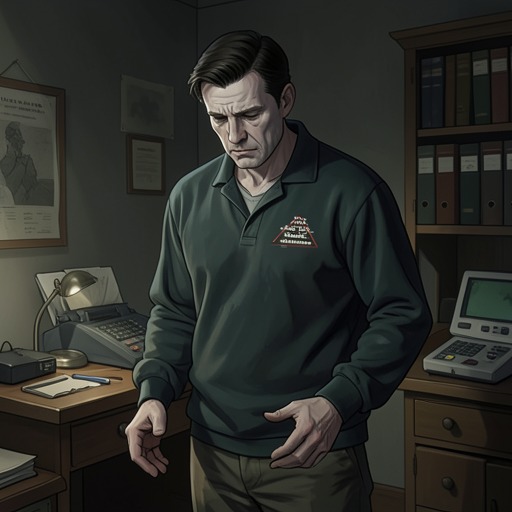
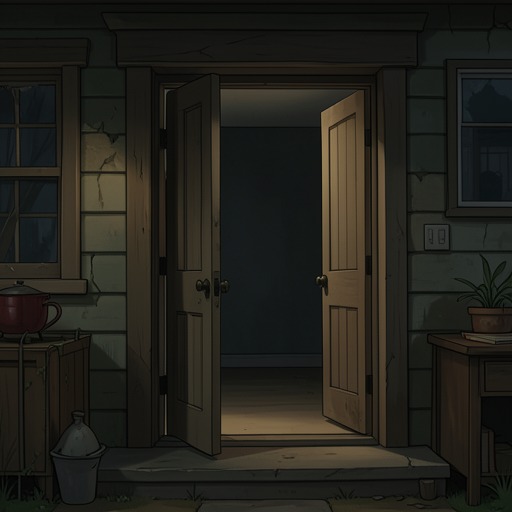
The looping doorway appears during the narrator’s increasingly desperate effort to get Esther out of the mountain house. His phone shows no network, so he cannot rely on communication or outside help. He takes Esther by the hand, remembers that he locked the door himself the previous night, turns the key, and leads her through it. The action initially follows the most familiar logic of departure: unlock the door, cross the threshold, and leave the room.
That expectation is immediately overturned. Esther squeals in surprise, and the narrator recognizes that they are back in the living room. The narration emphasizes the distinction between intention and result: they did leave the living room, yet the door they used led back into the living room. The doorway therefore does not merely fail to open; it preserves the act of departure while cancelling its destination. The house allows movement in a physical sense but denies progress.
The House as a Spatial Trap
The looping doorway changes the mountain house’s danger from an external threat into an internal condition of space. Earlier, the narrator’s movements around the area are governed by ordinary hazards: he drives down a narrow road of hairpin bends with slow reflexes, brakes near the edge, and reaches Gruntner’s General Store after thirty minutes with trembling hands. The return journey is calmer and more observant, with the winter light, ruined barn, rusted tractor, birds, and orange cloud making the route appear recoverable. Those roads are dangerous, but they remain legible: a car can descend, turn, and return.
Inside the house, that confidence collapses. The same apparent act of exit produces no corresponding change of location. The door becomes a mechanism of circularity, and the living room becomes both the place left behind and the place inevitably regained. This is the first fully concrete demonstration that the house’s geography cannot be measured by ordinary travel. Its rooms may be crossed, but their relationships no longer obey the expectations established by the outside road, the village, or the conventional holiday house depicted in the Internet photographs.
Response and Temporary Adaptation
The narrator responds by trying to protect Esther from the full meaning of what has happened. He feigns cheerfulness, turns on the old animated film The Jungle Book from his phone, and gives her the device. The film is an emergency distraction originally stored for situations such as train journeys or restaurant visits; here it becomes a makeshift barrier against an impossible reality. The gesture does not solve the spatial problem, but it briefly restores an ordinary parental routine in a place where ordinary routines have lost their reliability.
The incident also explains why the narrator later changes his method of movement. In the early evening, he takes the phone from Esther, grasps her hand, declares that they must not turn around, and makes walking backward into a game. He and Esther reach the hall, passing the washing-machine room and a half-open door that seems not to have existed before. The backward movement is an attempt to evade the house’s rules by refusing the normal forward orientation that the looping doorway has made suspect. Yet even this strategy only produces another threshold experience rather than a secure escape.
Consequences for Escape
The doorway’s return to the living room removes the narrator’s immediate belief that effort alone can free them. He can unlock doors, carry Esther, use a phone, walk through the hall, and eventually enter the woods, but none of these actions guarantees distance from the house. The absence of network reception compounds the enclosure: technology cannot connect him to the outside, while the doorway cannot connect the inside to the outside.
When he later carries Esther through the woods toward what appears to be a bright house window, the apparent destination resolves into the same pointed roof, wide front door, empty parking area, long table, kitchen, and open hall seen at the mountain house. The earlier looping doorway has prepared the logic of this return. The house is no longer confined to its original walls; its spatial pattern follows the attempted escape and reproduces itself as the destination. The narrator’s recognition that they are back therefore confirms not a single malfunctioning door but a larger enclosure in which departure continually folds into arrival.
Narrative Significance
The looping doorway is the action through which the story makes the house’s abnormality undeniable. Before it, the setting can still be read as an isolated, minimalist vacation property reached by a frightening mountain drive, especially because the house looks better in reality than in its Internet pictures: it is a new, architect-designed, two-story building rather than a musty Alpine hut. The door’s impossible operation strips away that reassuring surface. Modern design, a locked entrance, a phone, and a child’s familiar film all remain present, but none can restore ordinary orientation.
The event also gives spatial form to the narrator’s increasingly fractured domestic situation. He and Susanna have already agreed that there will be no further night in the house, and the family’s attempted departure is charged with the wish to return to a life beyond the mountain. Instead, the house makes separation and return indistinguishable. Susanna and Esther ultimately drive away while the narrator remains behind, but the earlier doorway has shown that physical thresholds cannot be trusted to deliver the emotional or existential passage they promise. Its loop is consequently both a plot mechanism and the central image of a world in which leaving does not necessarily mean getting away.