Adoption and Biological Parenthood
Young Captain Jack · The Son of a SoldierAdoption and Biological Parenthood governs Jack Ruthven’s identity mystery and the novel’s eventual definition of family. Jack is raised as the son of the Ruthvens after being rescued from a shipwreck, but the discovery of his biological father, Colonel Stanton, transforms a story of nameless childhood into one of recovered parentage. The resolution does not cancel the Ruthvens’ claim upon his loyalty: adoption gives Jack his legal standing, emotional home, and enduring bond with his adoptive mother, while biological parenthood restores his name, ancestry, and inheritance.
Adoption as Legal and Emotional Kinship
Jack’s first crisis begins when he is told that he is “a nobody” who does not truly belong to the Ruthven family and may someday have to leave. The accusation attacks both his social position and his understanding of himself. Marion Ruthven answers it by explaining that, when Jack was three or four years old, her parents adopted him and that he is legally John Ruthven, her brother. In this account, adoption is not a temporary kindness or a household convenience. It creates a recognized family relationship, and Marion insists that St. John Ruthven must not disregard it.
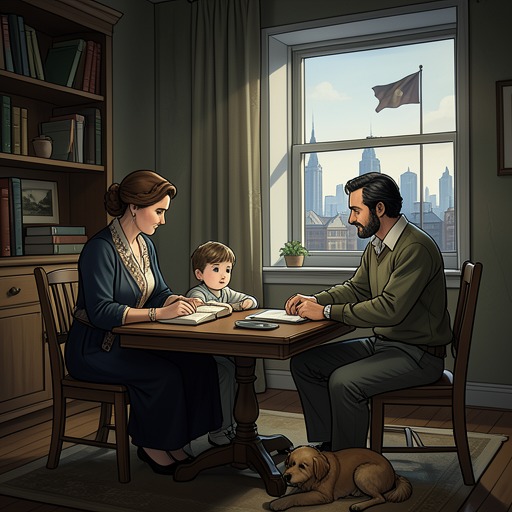
The adoption is also supported by the life Jack has actually lived. Mrs. Ruthven has raised him in the plantation household, and Jack and Marion are described as deeply attached and nearly inseparable. His place in the family is therefore established through care, shared experience, and mutual loyalty before his biological history is known. The contrast between the hostile claim that he belongs nowhere and Marion’s declaration that he is her brother makes the novel distinguish social prejudice from the lived reality of kinship.
The Shipwreck and the Material Record of Origin
The biological mystery begins with the wreck on Hemlock Bluff rocks. Marion tells Jack that he had been a passenger on the vessel when it came ashore between ten and eleven years earlier. A badly injured woman and a child were recovered; the woman died two days later, while the child survived and was eventually adopted by the Ruthvens. The woman’s name was never learned, and the only name attached to the boy was Jack, leaving the child’s identity suspended between evidence and uncertainty.
The surviving objects preserve what human memory could not. Mrs. Ruthven has kept the woman’s clothing, an unmarked lace handkerchief, and a ring that had once borne an inscription too worn to read, even after two jewelers inspected it. When she brings out the small jewel casket, Jack recognizes the ring as resembling a wedding band, but the object cannot initially identify either the woman or her family. Its value is therefore latent: it is simultaneously an ordinary remnant of the wreck and a possible link to Jack’s parentage.
A second material clue is the black-painted tin box recovered from the wreck’s filthy, water-damaged closet. It is found behind a small door and opened with one of Jack’s keys after he searches through a bunch of them. The box later proves to contain papers connected with Colonel Stanton’s fortune. After the guerrilla camp is searched, the stolen box is recovered and returned to the colonel, who recognizes the papers as his own and declares that nothing now stands between him and his fortune. The wreck thus preserves both the personal evidence of a lost family and the documentary evidence of a disputed inheritance.
Rival Accounts of Fatherhood
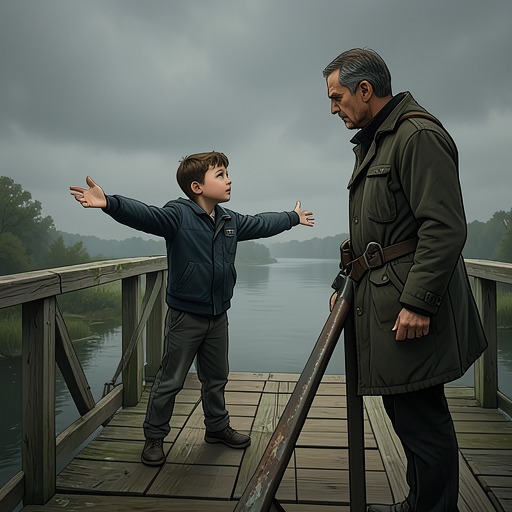
Before the true answer is established, Dr. Mackey attempts to occupy the place of Jack’s biological father. After an earlier encounter on the bridge, he approaches Jack and asks him to forget their conflict, claiming that he has come on an important mission. He then declares, “Jack, I am your father!” and repeats that assertion when Jack reacts with astonishment. This claim offers a direct verbal explanation for Jack’s uncertain origin, but it is not accepted as sufficient proof.
The later evidence overturns Mackey’s account. Colonel Stanton, wounded and feverish, speaks of a shipwreck and cries out for his wife Laura and his son Jack to be saved. His words connect the lost child to a specific family history, while his physical resemblance to Jack supplies another link. Mrs. Ruthven reports that the colonel’s fever has already produced the same shipwreck narrative, and the objects kept from the wreck complete the chain of identification.
When the ring, handkerchief, and clothing are shown to him, Colonel Stanton recognizes them as belonging to Laura and identifies the child’s clothing as little Jack’s. He concludes that Jack is his son beyond doubt. His account explains that Laura and the child were washed ashore while he believed them drowned; he himself survived separately by clinging to a spar far out at sea. The biological relationship is consequently confirmed through converging testimony, recovered objects, the colonel’s memory, and resemblance rather than through Mackey’s unsupported assertion.
Recognition and Reconciliation of Families
Mrs. Ruthven eventually tells Jack that Colonel Stanton is in the house and that the information concerns him. She states plainly that Jack is not Dr. Mackey’s son but the colonel’s son, and Jack can scarcely form the words as he realizes that he is Colonel Stanton’s child. The disclosure changes his ancestry without requiring him to abandon the family that raised him. Even before the revelation, Mrs. Ruthven remains his mother in practice; after the revelation, the novel preserves that relationship as a continuing bond.
The reunion between Jack and Colonel Stanton turns biological knowledge into an emotional relationship. When Jack enters the colonel’s room, he kisses the wounded man’s forehead and awakens him. The colonel recognizes him as his son, and Jack answers with the single word “Father!” The brief exchange is presented as the culmination of years of separation, presumed death, and uncertainty. Biological parenthood matters here not merely because it supplies a name or inheritance, but because it allows father and son to acknowledge one another directly.
The reconciliation is also institutional and financial. Once Dr. Mackey is captured, he is tied to a heavy four-poster bedstead in a garret room while Old Ben guards the door. His threat to Jack’s identity and fortune is thereby contained. Colonel Stanton later prosecutes Mackey, who receives a ten-year prison sentence, and the recovered papers help establish the Stantons’ right to a fortune worth one hundred and fifteen thousand dollars. Proof of parentage consequently restores both family history and property that had been endangered by imposture and concealment.
The Family’s Final Form
The ending refuses to make biological discovery a replacement for adoption. Colonel Stanton initially considers returning North, but Mrs. Ruthven does not want to be separated from Jack. The household therefore decides to remain at the plantation, and a year later Colonel Stanton marries the widow. Through that marriage, Mrs. Ruthven becomes Mrs. Stanton and once again becomes Jack’s mother within the reorganized family. Jack’s response shows that this arrangement fulfills rather than disrupts his deepest expectation: he says that it is exactly what he wanted.
The family expands through another marriage as well. During the same double wedding, Marion Ruthven marries Dr. Harry Powell, who has established a profitable medical practice in Philadelphia. The conclusion thus joins adoption, recovered biological parenthood, marriage, inheritance, and household continuity. Jack is at once the adopted son who was protected by the Ruthvens, the biological son recognized by Colonel Stanton, and the heir whose recovered documents secure the family’s fortune.
Narrative and Thematic Significance
The novel treats identity as a revisable story assembled from different kinds of evidence. Jack passes through several incompatible descriptions: an apparently nameless shipwreck child, a Ruthven adoptee, the supposed son claimed by Dr. Mackey, and finally Colonel Stanton’s lost son. Each version affects his social position and emotional security, but the decisive resolution comes when testimony, physical resemblance, fever-recovered memory, clothing, the ring, and the tin box’s papers reinforce one another.
This structure gives adoption and biological parenthood distinct but compatible meanings. Adoption provides the durable family of everyday life, law, care, and loyalty; biological parenthood supplies the recovered past and the inheritance that had been severed by disaster. The final arrangement makes neither form of kinship subordinate. Jack’s identity is secured because the story recognizes both the family that raised him and the parent who lost him, turning a contest over who may call him a son into a broader affirmation that family can be formed by love and confirmed by blood.