American Civil War (27dc5b34)
Young Captain Jack · The Son of a SoldierAmerican Civil War is not merely the backdrop to the Ruthven family’s adventures. It reorganizes everyday life, brings the retreating Confederate army within a few miles of Oldville, exposes the difference between disciplined military authority and predatory guerrilla violence, and forces civilians to defend both people and property. Its pressures make the plantation a hospital, a temporary fortress, and a place where questions of loyalty, courage, social rank, and lawful conduct are tested. When the war finally ends, its consequences remain in the recovery of the Stanton fortune, the punishment of Dr. Mackey, and the marriage that reunites the surviving family.
War Reaches Oldville
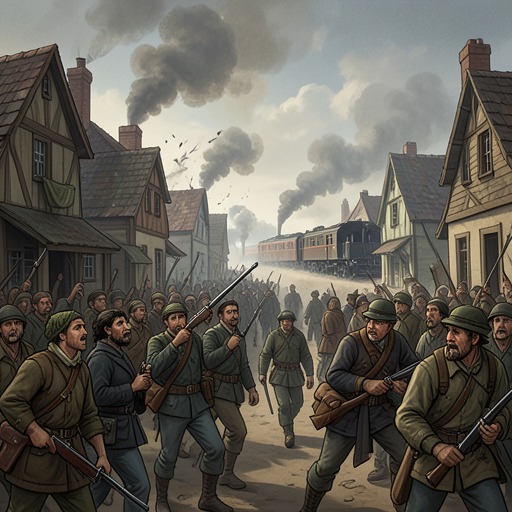
The war enters the story through geography and sound. The Ruthven mansion stands on one of the richest plantations in South Carolina, set back from the river, but its apparent security proves fragile when the army of the North steadily drives the army of the South backward. Confederate forces eventually encamp less than four miles from Jack Ruthven’s home, and for two days the inhabitants can distinctly hear cannon fire. Oldville, the name given to the district around the plantation, becomes a community governed by dread: the women fear that Northern soldiers will descend upon their homes and pillage them, while Marion Ruthven repeatedly asks Jack whether the enemy will come.
The military crisis also disrupts civilian commerce. When Mrs. Ruthven and Jack Ruthven go to Oldville for necessary trading, they find the town in intense excitement. The stores are closed, the tavern alone remains open, and men who have recently joined the Confederate ranks gather there. Lemuel Blackwood’s general store, once crowded with goods, has had its trade almost destroyed by the war; its remaining stock is scanty and shop-worn. These details place the conflict inside ordinary economic life. Retreats and advancing armies do not only change battle lines: they empty shops, close towns, interrupt supply, and make the simplest household errand part of a military emergency.
The Plantation as Hospital and Defensive Ground
The Ruthven mansion becomes a field hospital when Confederate soldiers carrying stretchers can go no farther and ask Mrs. Ruthven to receive their wounded. She agrees immediately and orders servants to prepare cots on the lower floor, because moving the injured upstairs would be impractical. Six wounded Confederates are eventually laid in the sitting room, where a young surgeon begins treatment while Mrs. Ruthven and Marion Ruthven assist him. The domestic interior is therefore converted into humanitarian and medical space without ceasing to be a family home.
That improvised hospital changes the moral and strategic meaning of the property. As enemy cavalry approaches, a warning is given that the Northern troops will arrive within ten minutes. The cavalry passes the homestead without stopping, but a company of guerrillas follows behind. These men are described as followers of every army who fight chiefly to loot afterward. Their presence distinguishes the war’s formal military movement from the opportunism that flourishes in its disorder.
Jack Ruthven answers that threat by assembling nineteen boys in his company. Each carries a loaded gun or pistol, and their formation across the lawn presents an imposing appearance despite their youth. Old Ben also reveals that he has a long, old-fashioned pistol and promises to defend Jack. Jack’s reply, that he will remember Old Ben if he grows up and becomes rich, makes the defense more than a tactical arrangement: it expresses a bond of loyalty across the plantation’s social hierarchy.
When the guerrillas demand entry, Jack insists that the property is private and must be respected, adding that the house is a hospital containing six wounded Confederate soldiers under a surgeon’s care. The guerrillas question whether the boys will resist, and the boys answer that they will. Jack repeats the same appeal when speaking to a Confederate colonel, emphasizing both private property and the wounded men inside. The colonel replies that an officer who is a gentleman respects private property and that Jack and his men have nothing to fear so long as they act without treachery. The contrast makes wartime authority an ethical distinction: uniform and military affiliation do not guarantee honorable conduct, while the colonel’s restraint marks a boundary between legitimate command and looting.
Civilian Violence and Guerrilla Predation
The war’s breakdown of order is shown most sharply at the plantation stable. While Jack is inspecting the stable and barns, he hears Old Ben and two Home Guard boys fighting three guerrillas who are trying to steal several horses. Old Ben protests that the horses are private property, but the guerrilla leader dismisses him and declares that the animals will be taken. The episode repeats the conflict at the mansion in a more immediate form: the Home Guard must translate a principle of property protection into physical resistance, and the guerrillas treat the absence of effective law as permission to seize what they want.
The same lawless structure later makes Jack Ruthven vulnerable to captivity. Dr. Mackey, enraged when Jack calls him a fraud, seizes the boy by both arms and orders Confederate soldiers to conduct him to camp and prevent his escape. Jack’s detention is thus connected to the wider wartime system in which military movement, private violence, and personal conspiracy overlap. During two days in a guerrilla cave, Jack and his companions are treated brutally and given barely enough food to avoid starvation. Pete Gendron is especially bitter toward Jack and even speaks of killing him to obtain the money under dispute. The cave becomes the opposite of the Ruthven hospital: instead of sheltering the wounded under medical care, it confines captives under coercion and deprivation.
The war’s violence eventually destroys the men who exploited it. After Jack returns home, a prolonged battle in the mountains takes place between Federal troops and the guerrillas. Several outlaws are killed, including those who had held Jack prisoner, and Pete Gendron also dies without revealing what he knows about Dr. Mackey’s past. The military defeat removes the immediate agents of Jack’s captivity, but it does not erase the material traces of their crimes. A search of the outlaw camp uncovers stolen goods and the tin box taken from the wreck of the Nautilus.
Retreat, Reversal, and Personal Loyalties
The war repeatedly reverses apparent victories. Alarming news reaches the Ruthven plantation when a large Federal force appears nearby and the Confederate army is forced to fall back toward the mountains and the valley beyond. Marion Ruthven describes the situation as a victory swallowed up in defeat. Yet the retreat produces an emotionally complex consequence: the return of Federal forces may bring Harry Powell back into her life. Marion contrasts his courage with St. John Ruthven’s cowardice and prays that Harry will survive the fighting.
Her hope is fulfilled when Harry Powell rides to the plantation early the next morning. He explains that he could not stay away after hearing that the fighting had been fierce and that he wanted to learn whether the household had suffered. Mrs. Ruthven reports that a cannonball passed through the sitting room, a concrete reminder that the war has crossed directly into the family’s living space even though the homestead has also served as a protected hospital.
The war therefore measures character through action rather than declared allegiance. Jack Ruthven defends the household, the wounded, and the animals; Old Ben and the Home Guard boys join that defense; the guerrillas exploit military disorder for theft and revenge; and the colonel represents a version of military conduct that recognizes limits even amid battle. The conflict’s social world includes civilians, young volunteers, enslaved or formerly subordinated plantation workers, surgeons, regular troops, and guerrillas, each occupying a different position within the unstable wartime order.
End of the War and Its Aftermath
Colonel Stanton’s recovery is slow, and by the time he is able to move about again, the great war has ended. The conclusion is welcomed by Colonel Stanton, Jack Ruthven, Mrs. Ruthven, and Marion Ruthven alike. Peace does not simply stop the cannon fire; it permits the legal and familial consequences of the wartime plot to be settled. Colonel Stanton resigns from the army and begins prosecuting Dr. Mackey while seeking to recover the fortune that belongs to himself and Jack.
The recovered tin box is central to that transition from battlefield disorder to postwar justice. Found in the searched guerrilla camp, it contains papers that Colonel Stanton identifies as precious. Once the box and its contents are returned to him, he tells Jack that nothing now stands between them and their fortune. Dr. Mackey receives a ten-year prison sentence, while the Stantons, father and son, gain possession within a year of a fortune worth one hundred and fifteen thousand dollars. Material evidence gathered amid wartime theft is converted into legal recognition and economic restoration.
The ending also turns military separation into domestic reconciliation. Colonel Stanton initially considers returning North to settle there, but Mrs. Ruthven does not want to part with Jack. The household decides to remain at the plantation, and a year later Colonel Stanton marries the widow. Mrs. Ruthven consequently becomes Mrs. Stanton and once again becomes Jack’s mother. The war that divided armies and made the plantation a site of danger is followed by an arrangement that joins formerly separated personal histories, while the family’s decision to remain at the plantation gives the conclusion a distinctly domestic form of national and familial settlement.
Historical and Narrative Significance
Within the novel, American Civil War functions as both historical setting and active narrative machinery. It supplies the retreat, the advancing forces, the cannon fire, the wounded soldiers, the Home Guard, the guerrilla cave, and the final mountain battle. Each military development alters the characters’ available choices: commerce becomes difficult, the plantation must organize its own defense, the mansion becomes a hospital, and Jack’s search for truth exposes him to wartime captivity.
The conflict also establishes a sustained contrast between protection and predation. The Ruthven household responds to war by receiving wounded men and defending private property; the guerrillas respond by threatening the mansion and stealing horses. The colonel’s promise to respect the hospital shows that even combat may be governed by principles, whereas Dr. Mackey’s seizure of Jack demonstrates how wartime authority can be appropriated for private fraud. The novel’s moral language consequently treats courage, humanitarian care, and restraint as forms of order resisting the war’s violence.
Finally, the end of the war allows the story to move from survival to recognition. The armies withdraw, the guerrilla captors are killed, the stolen tin box is recovered, Dr. Mackey is imprisoned, and Colonel Stanton’s fortune is restored. Yet the most lasting consequence is not financial. Peace makes possible the reunion of Colonel Stanton with Jack Ruthven and the re-formation of a household in which adoption, blood relationship, marriage, and loyalty can coexist. The war is therefore the force that threatens the family, tests its members, and ultimately creates the conditions under which its scattered identities can be brought together.