Captivity
Young Captain Jack · The Son of a SoldierCaptivity is a recurring condition in Young Captain Jack, and its decisive significance lies in the way physical imprisonment intensifies the novel’s struggle over identity. Jack Ruthven is confined because Dr. Mackey seeks control of him and of property connected with his past, yet each enclosure also brings him nearer to the truth: he is first treated as a troublesome foster child, then as an alleged son, and finally recognized as Colonel Stanton’s son. Captivity therefore becomes both an instrument of power and a pressure that exposes imposture.
Seizure and Forced Removal
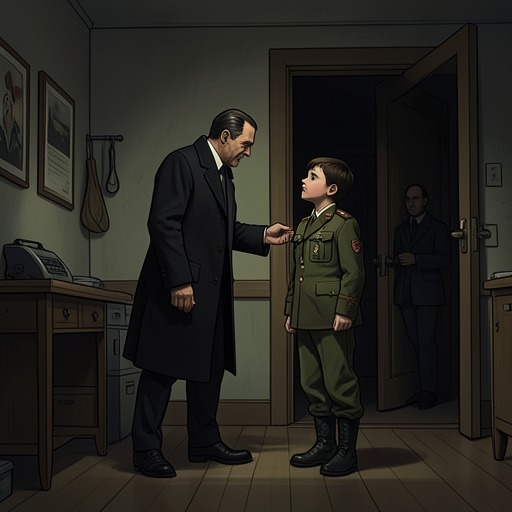
Jack’s most immediate captivity begins when Dr. Mackey orders Confederate soldiers to conduct him to camp and prevent his escape. Jack protests that he will not be taken from home, struggles against the two soldiers, and calls Dr. Mackey a fraud, but the soldiers overpower him and make him their prisoner. The transfer is deliberately secretive: he is led across the plantation by a back way toward the Old Red House, while one soldier levels a gun and commands him to remain silent. The episode removes Jack from the protective world of the Ruthven plantation and places his body under the authority of men acting on Dr. Mackey’s orders.
The confinement is not presented as legitimate military detention. Dr. Mackey’s command is linked to a private scheme, and the soldiers’ obedience serves a personal criminal purpose rather than a clearly stated wartime necessity. The contrast matters because Jack’s resistance is simultaneously physical and moral. He refuses to accept the authority of the man claiming to be his father, and his insistence that Dr. Mackey is fraudulent anticipates the later proof that the claim is false.
The Mountain Cabin and Guerrilla Cave
At the mountain hideout, Jack is held in a small cabin far up the mountainside. His hands are bound tightly behind him and fastened to a heavy wooden stake driven into the hard mud floor. Night passes, the Confederates leave him alone, and he remains thirsty and hungry, asking himself what his captors intend to do. The cabin turns military language into an experience of abandonment: whatever formal identity the captors claim, Jack is left as a helpless prisoner without adequate food or water.
His captivity then becomes collective and more openly lawless. After Jack and his companions surrender their firearms to a group of roughly twenty guerrillas, the captors bind Jack’s hands and march him up the mountainside into a fair-sized cave. There he and his companions are tied to jagged rocks at the rear while the outlaws establish themselves around a fire, drinking, smoking, and playing cards. The captives remain in the cave for two days. During that time the guerrillas treat them brutally and provide barely enough food to prevent starvation, while Pete Gendron directs particular bitterness and insults at Jack. Gendron even declares that, if he were Dr. Mackey, he would shoot Jack to obtain the money for himself, making the connection between captivity, greed, and the disputed inheritance explicit.
The cave’s social order is therefore one of force rather than law. Weapons are taken, bodies are tied, information is withheld, and the prisoners are told only that they will be held until Dr. Mackey returns. The phrase gives captivity an uncertain duration, which is itself a method of domination: Jack cannot plan because the captors refuse to tell him when the confinement will end or what will happen next.
Mackey’s Scheme and the Threat of Exile
When Jack demands to know what will be done with him, Dr. Mackey answers that he intends to take him out of the country. Jack is told that the destination will be disclosed only after they are aboard ship. This threat expands captivity beyond a locked room or guarded cave. Mackey’s purpose is not merely to restrain Jack temporarily but to remove him from the community in which his relationships, memories, and legal position might be tested.
The threat is tied to a larger fraud. Colonel Stanton explains that, during lucid intervals in an asylum, Dr. Mackey extracted details about property in England belonging to Stanton and an estate in Virginia belonging to Stanton’s wife, Laura Stanton. Mackey obtained the information, drugged Stanton, and disappeared after arranging for him to be recorded as incurable and subject to violent attacks. The same predatory logic governs Jack’s imprisonment: personal history is treated as exploitable property, and confinement is used to prevent the victim from contradicting the story imposed upon him.
Jack’s own identity has already been made vulnerable by competing accounts. Darcy Gilbert tells him that he is said to be a nobody who does not belong to the Ruthven family. Marion Ruthven then reveals that the Ruthvens adopted him when he was three or four years old, making him John Ruthven in the family’s lived reality even though he was not their biological child. A ring and a lace handkerchief preserved in a small jewel casket provide material traces of the earlier mystery. Dr. Mackey’s claim that he is Jack’s father attempts to seize control of these uncertainties, while the later revelation that Colonel Stanton is Jack’s true father overturns Mackey’s version.
Reversal of Captivity
Jack does not remain only the object of imprisonment. Watching his chance inside the cabin, he crawls to the edge of a loft opening. When Dr. Mackey turns, Jack makes a nimble leap, lands on the surgeon’s shoulders, and sends him to his knees. Clinging to him, Jack announces that Dr. Mackey is now his prisoner. Old Ben then reaches the floor and places the muzzle of a gun beneath the surgeon’s nose, bringing Mackey’s struggle to an immediate halt.
The reversal is significant because Jack defeats the man who has attempted to define and confine him through a combination of alertness, bodily courage, and trusted assistance. The boy once bound to a stake or jagged rock now controls the movement of the person responsible for his abduction. After Dr. Mackey asks whether Jack would imprison his own father, Jack rejects both the moral claim and the biological claim, stating that he would imprison such a fraud and villain and would never believe that Mackey’s blood flows in his veins.
Dr. Mackey is subsequently tied to an old four-poster bedstead in a garret room, a piece of furniture weighing considerably more than a hundred pounds, while Old Ben guards the door. The detail reverses the earlier architecture of domination: the heavy object that fixes the captor also makes escape difficult, and the loyal servant who helped preserve Jack’s freedom becomes the watcher who ensures that Mackey cannot resume control.
Identity, Freedom, and Aftermath
Captivity repeatedly places Jack between imposed identities. He is threatened as an unwanted nobody, claimed as Dr. Mackey’s son, and finally identified as Colonel Stanton’s son. His childhood memory of a storm and enormous waves is dim and dreamlike, while Colonel Stanton’s own recollections are fractured by shipwreck, illness, years in an asylum, and drugging. Because memory alone is uncertain, the novel surrounds identity with witnesses, objects, family testimony, and acts of recognition. Imprisonment makes that evidentiary struggle urgent: whoever controls Jack’s location can attempt to control the story told about him.
The final release is emotional as well as physical. Mrs. Ruthven tells Jack that he is not Dr. Mackey’s son but Colonel Stanton’s son, a fact the colonel has proved beyond doubt. Jack later approaches the wounded colonel, kisses his forehead, and awakens him; Colonel Stanton recognizes him as his son at last. Jack’s captivity thus ends not simply when Mackey is restrained, but when the false paternal narrative is replaced by a relationship publicly and emotionally acknowledged.
The novel’s long-term ending confirms that freedom is converted into responsible adulthood rather than mere escape. Jack enters West Point Military Academy, graduates with high honors, goes West as an officer at a well-known fort, and rises to the position of colonel, retaining the bravery and loyalty associated with his youth. The imprisoned boy becomes a legitimate military figure through conduct and service. Captivity has exposed his vulnerability, but it has also clarified the qualities by which he will be known: resistance to intimidation, loyalty to the people who protect him, and the courage to oppose a fraudulent authority even when that authority claims the name of father.