Colonel Stanton
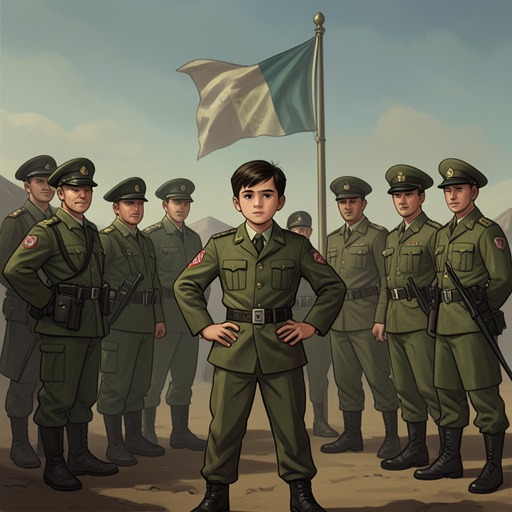
Young Captain Jack · The Son of a SoldierColonel Stanton is a Federal officer whose conduct in wartime repeatedly places military power under the discipline of conscience. He first appears as the commander of regular Federal troops approaching the Ruthven home, but his decisive importance emerges later: a shipwreck survivor presumed to have lost his wife and child, he recognizes the clothing, ring, and other preserved evidence associated with the Nautilus and concludes that Jack is his son. His recovery therefore joins battlefield history to family revelation, turning a wounded enemy officer into the missing father at the center of Jack Ruthven’s identity mystery.
Identity and First Appearance
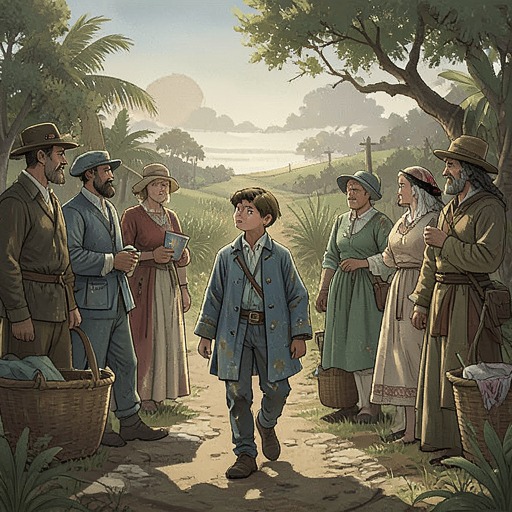
Colonel Stanton enters the narrative during a tense encounter between regular Federal troops, the Home Guard, and a band of guerrillas. The guerrillas have followed the cavalry and are characterized as men who fight chiefly to loot afterward; when a Federal regiment appears on the road, they retreat and look anxiously to their leader. Stanton rides forward, halts his companies, and comes across the lawn toward Jack and the other defenders of the house.
The contrast between Stanton and the guerrillas is established through action rather than rank alone. Jack explains that the defenders are protecting the home because the men who fled appeared ready to ransack it. Stanton acknowledges that their conduct does them credit and says that protecting their homes, mothers, and sisters is the proper thing for them to do. He then asks whose place they are defending, treating the young defenders as responsible inhabitants rather than dismissing them as irregular opposition.
Stanton’s military authority is likewise restrained by a principle of private property. When Jack anxiously asks whether the troops intend to harm the place, he emphasizes that it is privately owned and has become a hospital for six wounded Confederates under a surgeon’s care. Stanton answers that an officer who is a gentleman respects private property and assures Jack that, so long as the defenders do nothing treacherous, they have nothing to fear from him or his men. He then rides back to the road, leaving the house and its patients unharmed.
The Federal Officer in a Southern Household
The encounter continues as a visit marked by courtesy and political strain. The household recognizes Stanton’s position as a Federal colonel while remaining identified with the South. Alice Ruthven is told that she need not be alarmed because of Stanton and his men, yet she falters while welcoming him, asking him to remember that she is a Southern woman. Her reception reveals how the war makes even hospitality politically charged: the house can offer shelter without surrendering its regional allegiance.
Alice also voices the Southern view of President Lincoln, describing him as a cruel enemy intent on destroying the South. Stanton’s presence thus brings opposing wartime interpretations into the same domestic room. The scene does not erase the conflict between Federal and Southern loyalties, but it gives that conflict a human scale. Stanton’s conduct toward the house, the women, and the wounded men supplies a practical answer to the brutality represented by the looting guerrillas: military opposition need not become license for theft or cruelty.
Wounding, Fever, and the Return of the Past
Stanton’s protection of the Ruthven home does not spare him from the violence surrounding it. Later, a Federal battery rushes into view with horses covered in foam, followed by infantry, and the household receives the report that Colonel Stanton has been shot. The young surgeon who attends him says that he has been shot through the breast and lies between life and death. Stanton is brought to the plantation, where his fever remains severe and he can scarcely recognize Alice Ruthven.
During the fever, Stanton’s speech turns toward an earlier catastrophe. He cries out about a shipwreck, begs that his wife Laura and his son Jack be saved, and imagines waves, a captain who should put out to sea, rebel forces near the coast, and a child being stolen. He also relives the ship’s striking and the retreat of armies. The delirium is not a new invention within the story: it gives broken, involuntary form to the disaster that has governed his life. To Alice, it confirms that his memories of his wife and child remain bound to the sea and to the name Jack.
Stanton improves after two days at the plantation. Once his fever subsides, he explains that he has spoken to no one about the matter for years, though Alice’s kindness makes him willing to tell her more. He recounts that he once took an ocean voyage disastrous to himself and his family, and that the ship went down with all on board, including his wife and child. His account makes the wreck near Hemlock Bluff more than a local danger or a background mystery: it may preserve the material trace of his lost family and the papers connected with his former life.
The Wreck, the Evidence, and Jack’s Parentage
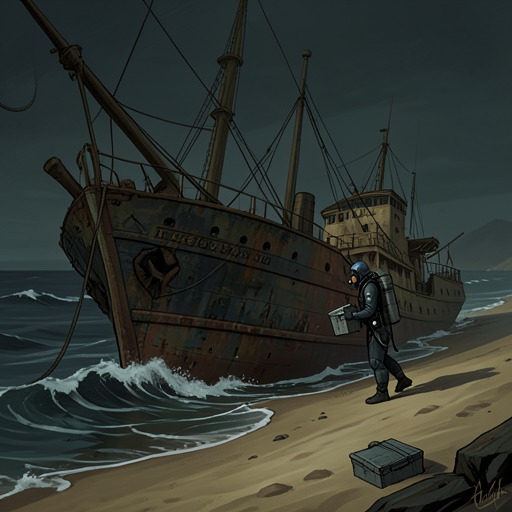
Stanton expresses a wish to visit the wreck if it remains intact because valuable papers were left in a secret closet aboard the vessel. This interest converges with the novel’s earlier chain of physical clues. The wreck has already been associated with Jack’s story; the clothing of a drowned woman was preserved with an unmarked lace handkerchief and a ring, while a heavy black-painted tin box was later uncovered from a filthy, water-damaged closet. These objects transform uncertain testimony into evidence that can be examined, preserved, and returned.
The decisive recognition begins when Stanton learns that the child’s name was Jack and that the boy is still alive. Confronted with the preserved belongings, he identifies the woman’s things as those of his beloved Laura and the child’s dress as little Jack’s. He then declares beyond doubt that Jack is his son. The conclusion is powerful because it depends on converging particulars rather than resemblance or wish alone: the name, the shipwreck, the wife’s belongings, the child’s clothing, and the surviving boy all meet in one explanation.
Stanton’s recognition revises Jack’s place in the story without erasing his history as a Ruthven foster child. Jack has been defended, fed, and treated as a young gentleman within the Ruthven household; Old Ben insists that Jack is a young gentleman and that his father was one as well. Stanton’s claim supplies biological parentage to a boy whose social belonging had already been created through care and loyalty. The discovery consequently enlarges, rather than simply replaces, Jack’s family identity.
Conflict with Dr. Mackey and Recovery
The recognition of Jack also reopens Stanton’s older conflict with Dr. Mackey. Stanton calls Mackey a vile impostor and says that he owes his long confinement in an insane asylum to him. His anger identifies the doctor not merely as an antagonist in Jack’s present crisis but as the person responsible for a long campaign of persecution and deception. When Stanton asks where Mackey is, the question carries both personal grievance and the urgency of stopping a man who has interfered with the truth of Jack’s parentage.
The danger remains active when Jack and his companions are held for two days in a guerrilla cave. Their captors treat them brutally and give them barely enough food to prevent starvation, another contrast with Stanton’s earlier insistence that military conduct must protect the vulnerable rather than exploit them. After the outlaws’ camp is searched, stolen goods are recovered, including the tin box taken from the Nautilus wreck. The box and its contents are later given to Colonel Stanton, restoring the material proof connected with his lost family and valuable papers.
Stanton’s recovery is slow, but he eventually survives the breast wound and the fever. Just before he awakens, Jack enters to see him, studies his handsome face, and kisses his forehead; the gesture awakens the wounded man. The scene gives physical and emotional form to the newly understood father-son relationship. Recognition is no longer only Stanton’s verbal conclusion about objects from the wreck; it becomes a reciprocal bond in which Jack approaches the man whose identity has been hidden from him.
Change and Narrative Significance
By the time Stanton is able to move about again, the great Civil War has ended. He is thankful for the peace, as are Jack, Alice Ruthven, and Marion Ruthven. His ending therefore links personal restoration to national cessation: the officer who first entered a Southern household as a potential military threat leaves the central conflict alive, recovering his family connection as the war itself passes into history.
Colonel Stanton’s role is built around reversals. He is first encountered as a Federal commander, yet he protects the Southern household; he is then a wounded enemy in need of care, yet his delirium reveals an intimate loss shared with the people sheltering him; finally, he becomes the father whose discovery explains Jack’s unexplained past. The wreck, the ring, the clothing, and the black tin box operate as recurring links between these stages, carrying the story from rumor to proof. Stanton thus embodies the novel’s movement from wartime division toward recognition, and from inherited hostility toward a family and national order capable of surviving the conflict.