Darcy Gilbert
Young Captain Jack · The Son of a SoldierDarcy Gilbert is Jack Ruthven’s neighboring-plantation companion, confidant, and field ally. His importance lies less in a separate private storyline than in the way he gives Jack’s courage a social and practical form: Darcy listens when Jack’s identity is challenged, helps organize the boys of Oldville, and repeatedly joins Jack in protecting homes and stores as the war approaches. Their friendship makes Jack’s development visible, turning an isolated boy’s self-reliance into shared responsibility.
Identity and Introduction
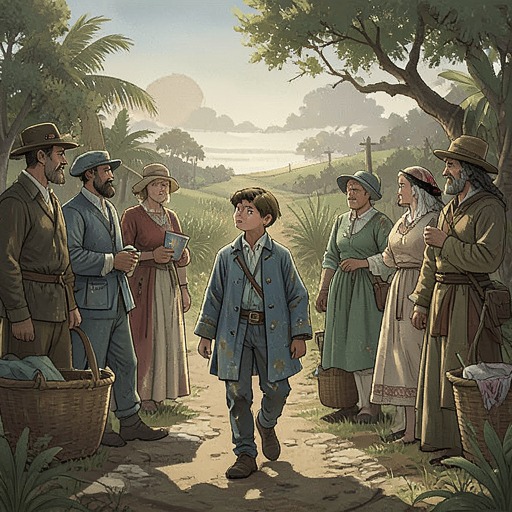
Darcy is introduced as a boy about Jack’s age who lives on the plantation next to Jack’s home. He appears while Jack is fishing, and the meeting immediately carries the ease of established friendship: Jack greets him familiarly and invites him to stay. Darcy admits that he dislikes fishing alone, while Jack, who had been preparing to go home, decides to remain because his friend has arrived. The exchange establishes Darcy as a companion sought for pleasure as well as counsel, not merely as a later recruit in Jack’s military activities.
Darcy is observant even when he is reluctant to speak. Jack notices that his friend seems distracted and asks whether he has encountered the Confederate surgeon who had recently quarreled with him on the bridge. Darcy initially minimizes what has happened, but Jack presses him until he reports the surgeon’s insult: the surgeon said that Jack was a nobody, did not belong to the Ruthven family, and would someday have to leave. Darcy’s hesitation suggests concern for Jack, while his eventual disclosure makes him the bearer of the information that begins Jack’s identity crisis. He does not create the accusation, but his friendship places the damaging rumor within Jack’s reach.
Friendship and the Identity Crisis
Darcy’s role in Jack’s story is closely tied to the competing accounts of Jack’s origin. The surgeon’s claim that Jack is unrelated to the Ruthven family first reaches Jack through Darcy, before Marion Ruthven explains that Jack was adopted when he was three or four years old and is, in the eyes of the law, her brother. The revelation changes the meaning of the household in which Darcy has known him: Jack remains John Ruthven legally and emotionally, but his biological past becomes uncertain.
The mystery is linked to the wreck on Hemlock Bluff rocks. Marion explains that Jack had been a passenger on the vessel when it came ashore between ten and eleven years earlier. The surviving material evidence is painfully slight: his mother’s clothing was unmarked, her lace handkerchief had no identifying mark, and the only potentially revealing object was a worn ring whose inscription neither the Ruthvens nor two jewelers could decipher. Darcy is not the investigator who recovers these objects, but his initial report helps activate the chain of questions that makes the wreck, the ring, and the missing family history central to Jack’s life.
The competing claims later become more dangerous. Dr. Mackey tells Jack, “Jack, I am your father!” and presents himself as the answer to the mystery, while the eventual testimony concerning Colonel Stanton reverses that claim: Jack is not Dr. Mackey’s son but the colonel’s son. The book’s successive versions of Jack’s identity therefore move from Ruthven foster child, to unidentified shipwreck survivor, to alleged son of Dr. Mackey, and finally to Colonel Stanton’s son. Darcy’s earliest contribution is crucial because he introduces the first destabilizing version from outside the family, helping set the plot’s investigation in motion without possessing the means to resolve it.
The Oldville Home Guard
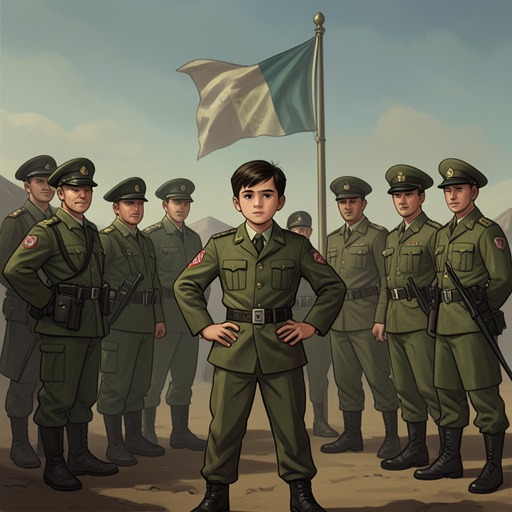
Darcy becomes Jack’s principal associate in organizing the Oldville Home Guard. Jack tells Marion that he and Darcy have formed a company of boys with twenty-three members, and that Jack is its captain. The organization gives Jack a public role at a moment when his private status feels uncertain: although he is questioning whether he belongs to the Ruthven family, he can still claim responsibility for the defense of the community.
Darcy serves as the company’s first lieutenant. When the boys gather on the green before the tavern, he runs up to Jack and asks whether there will be a drill. Jack’s new authority has not made him dictatorial, and Darcy’s prompt cooperation reinforces that the company rests on mutual loyalty rather than mere self-display. Darcy quickly summons the young soldiers, who wear improvised uniforms made from ordinary home clothing with white stripes sewn along their sleeves and trouser legs. Boys carrying pistols take the front rank, those with guns the second, and a drummer and fifer supply the company with military ceremony. Jack commands with a drawn sword, but Darcy’s lieutenantship is what helps turn the captain’s aspiration into a functioning group.
The Home Guard also reveals the limits and the value of the boys’ preparation. Their weapons are old and irregular, yet their drills, ranks, uniforms, and signals let them imagine themselves as protectors rather than spectators. Darcy’s participation anchors that imagination in collective discipline. He is not described as competing with Jack for command; instead, he accepts the first-lieutenant position and helps Jack exercise leadership without undermining their friendship.
Wartime Action and Practical Loyalty
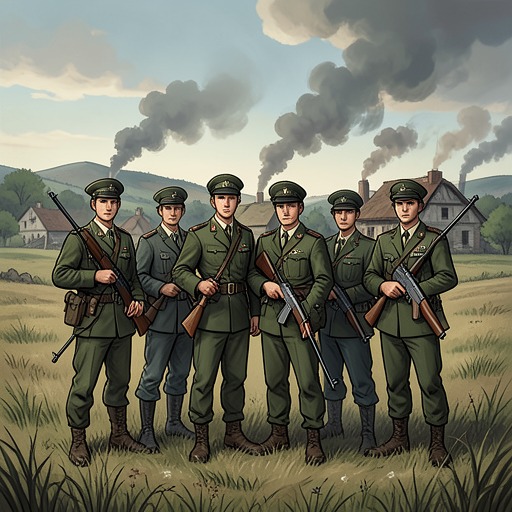
When Union troops are reported to be approaching, Darcy is with Jack and Old Ben as the warning reaches the Ruthven house. Jack immediately turns toward duty, telling Marion that if he is shot it will be at his post. He then runs downstairs to meet Darcy and Old Ben. Darcy’s presence at this moment links the domestic crisis to the organization they have built together: the Home Guard is no longer only a boys’ drill displayed before townspeople, but a means of responding to danger.
Later, after soldiers leave town at the double-quick and the possibility of fighting becomes immediate, Darcy runs toward Jack with the news that a fight is on. Jack proposes calling out the Home Guard again, and Darcy agrees that the stores and homesteads need protection. Their response is divided into practical assignments. Darcy will take the shore road to call up the boys, while Jack takes the Batsford road; Darcy is also asked to have Doc Nivers summon the boys on the mountain road. The exchange presents Darcy as dependable under pressure: he does not merely share Jack’s excitement about military life, but accepts the work of carrying orders, gathering volunteers, and protecting civilian property.
This division of labor marks the maturation of their friendship. Earlier, Darcy was the boy who stayed to fish and reluctantly repeated an insult. In wartime, he becomes a messenger and organizer whose actions extend Jack’s reach across the local community. The friendship thus develops from companionship into coordinated service, with both boys accepting danger and responsibility despite their youth.
Narrative Role and Significance
Darcy functions as Jack’s loyal counterpart and as a stabilizing presence within a plot dominated by uncertainty. Jack’s parentage is repeatedly rewritten by conflicting testimony, physical resemblance, surviving objects, and recovered papers; Darcy, by contrast, remains consistent. He knows Jack as the boy next door, speaks to him as a friend, and continues to cooperate with him when family status and military fortunes are shifting. That constancy gives the identity mystery an emotional counterweight: Jack’s legal and biological belonging may be disputed, but his lived bonds are not thereby erased.
His narrative function is also connective. Darcy carries information to Jack, helps transform Jack’s defensive instinct into the Oldville Home Guard, appears when the Yankees are reported to be coming, and helps mobilize the boys when fighting threatens the stores and homesteads. He is therefore both witness and participant: a witness to the rumor that Jack is an outsider, and a participant in the community that treats Jack as its captain. Through Darcy, the story places Jack’s personal search for family within a wider test of usefulness, loyalty, and belonging.
Darcy’s importance is finally measured by contrast. Dr. Mackey exploits Jack’s uncertainty by claiming him as a son, while the evidence eventually identifies Colonel Stanton as his father. Darcy never offers a grand theory of Jack’s origins. He offers something more durable: companionship, candor, and action. The recovered tin box from the wreck of the Nautilus ultimately helps establish Colonel Stanton’s claim and restores the connection between father and son, but Darcy’s earlier loyalty has already demonstrated that Jack’s identity is not secured by blood alone. In the story’s moral architecture, friendship is one of the first forms through which Jack belongs.