Dr. Mackey
Young Captain Jack · The Son of a SoldierDr. Mackey is the novel’s central impostor and antagonist, a Confederate surgeon who uses medical authority, intimidation, deception, and stolen knowledge to pursue an inheritance. He first appears as a dark, crafty man in a surgeon’s uniform, mounted on a coal-black horse and threatening a fisherman who obstructs him. The uniform gives him an official surface, but his conduct immediately turns that surface into a disguise: he treats another person’s livelihood with contempt and relies on menace rather than professional duty. His later claim to be Jack Ruthven’s father extends the same pattern from physical intimidation into the manipulation of family identity.
Identity and First Appearance
Dr. Mackey’s public identity is unstable from the beginning. He is recognized as a surgeon in the Confederate Army, yet the novel repeatedly places that title beside angry, coercive, and morally suspect behavior. During the war he speaks in alarmist terms about what would happen if the South lost, predicting that Northern soldiers would march to New Orleans and loot and burn every village, town, and city. His rhetoric is presented as frightening enough to terrify a timid listener, suggesting that he uses panic as readily as he uses force.
A few days later he appears at Old Ben’s Boathouse in a faded Confederate surgeon’s uniform. The change from the threatening rider to the visitor in worn military clothing does not clarify him; it deepens the impression that he moves through the story by adopting whatever appearance grants access. When he sees Jack, he recognizes the boy as the person he has been seeking and mutters, "Ha! I have found the boy at last!" That private exclamation establishes an objective that precedes his open claim of fatherhood.
The Shipwreck and the Inheritance Scheme
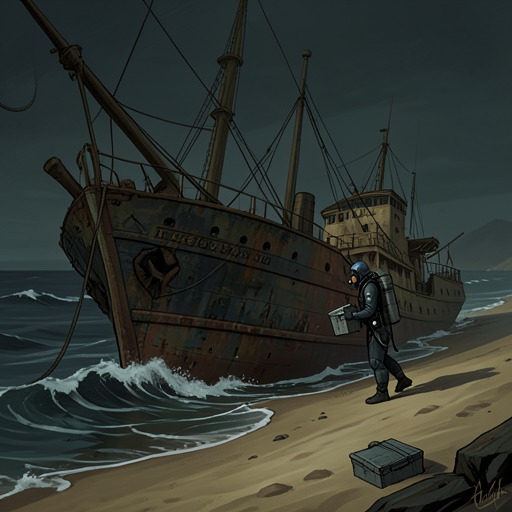
Dr. Mackey’s interest in the wreck of the Nautilus is personal and criminal rather than merely historical. He tells Old Ben that he was one of the passengers on the ill-fated ship and that his visit is intended to answer important questions about the past. His admission gives him a connection to the shipwreck, but it does not make him a trustworthy witness. He possesses information about the disaster because he was involved in its aftermath and because he obtained Colonel Stanton’s account under coercive circumstances.
In the wreck’s damaged interior, Dr. Mackey digs through dirt and water and uncovers a heavy black tin box. The object contains the papers he needs: a marriage certificate, letters concerning property from a father, and letters from a woman’s family. His reaction makes the motive explicit. He sees the documents not as records belonging to the survivors but as instruments for seizing their fortune, declaring, "The fortune is mine!" The box therefore becomes the material center of his scheme. It preserves the legal and familial evidence that can either support a rightful claim or be exploited by someone who has stolen access to it.
Dr. Mackey’s plan began with Colonel Stanton’s vulnerable memory. Stanton later explains that, during lucid intervals in an asylum, Dr. Mackey induced him to reveal his story: property in England was coming to Stanton, while an estate in Virginia was due to his wife, Laura Stanton. The ocean voyage had been undertaken to obtain Laura’s property. After drawing out every detail he could, Dr. Mackey drugged Stanton, leaving him for a long period with scarcely any knowledge of what had happened. When Stanton recovered his mind, Dr. Mackey had already left the asylum. The episode shows that his medical role is not incidental to his crime; he turns access to a patient’s mind into a method of acquiring property.
The False Claim to Jack Ruthven
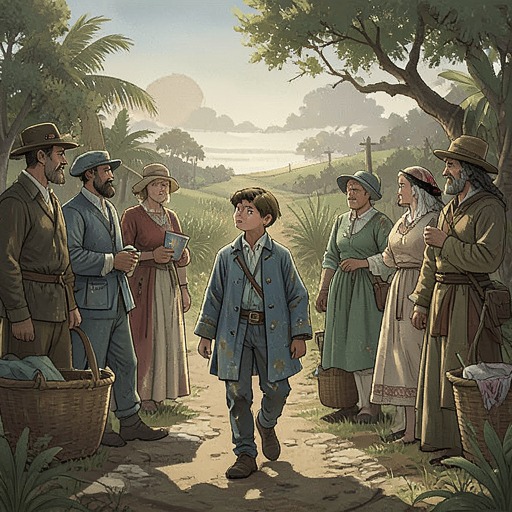
Dr. Mackey’s most consequential deception is his assertion that Jack Ruthven is his son. The claim enters a household already troubled by uncertainty. Jack has been told that he is a nobody who does not belong to the Ruthven family and may one day have to leave. Marion Ruthven counters that Jack was adopted by her father and mother when he was three or four years old and that he is John Ruthven, her brother. Dr. Mackey’s intervention turns this painful question of adoption into a contest between two competing paternal narratives.
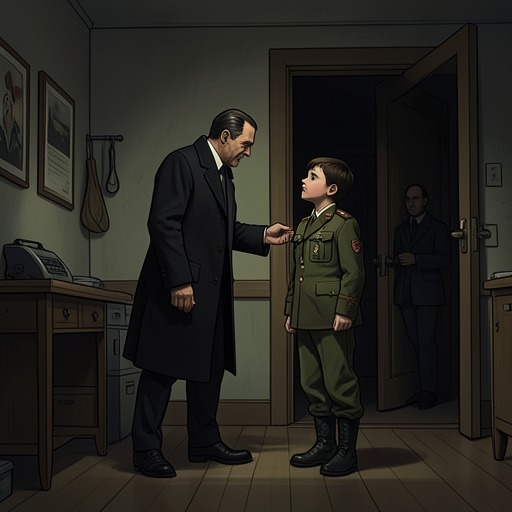
When he confronts Jack, Dr. Mackey frames the dispute as a moral failing on Jack’s part, telling him, "You are hard on your father." Jack answers with a concrete objection: Dr. Mackey is a bachelor and was never married to Jack’s mother or to any other lady. The exchange reveals the weakness of the impostor’s assertion. He offers the emotional title of fatherhood, but Jack demands a credible family history and legal basis. Dr. Mackey responds not with proof but with violence, promising, "I will make you smart for this," then seizing Jack by both arms and calling for Garder and Mason.
The claim is especially dangerous because it exploits Jack’s uncertain past. Jack remembers only a storm, terrible waves, and the wreck in a dreamy, indistinct way. That fragmentary memory cannot by itself establish parentage, leaving room for an adult who possesses a more elaborate story to impose an identity upon him. Dr. Mackey attempts to occupy that gap by presenting himself as the missing biological father. His fraud thus depends on the same principle as his inheritance plot: where memory is incomplete, an aggressive storyteller can try to substitute assertion for evidence.
Fraud, Conspiracy, and Capture
The novel supplies an external warning against accepting Dr. Mackey’s story. A wounded soldier reports that he is a fraud who came from Philadelphia, where he ran a mail-order medical bureau that the Post-office Department stopped as a swindle. The report does not merely insult him; it places his current conduct within a repeated pattern of commercial deception. The man who now claims a son and a fortune has previously used the language and institutions of medicine for dishonest gain.
Dr. Mackey’s relationship with Jack is therefore a coercive counterfeit of fatherhood. He does not care for Jack as a son or seek reconciliation through family history. He uses the claim to control Jack’s movement and to strengthen his access to the property represented by the wreck documents. At one point he announces that he intends to take Jack out of the country. The proposed removal would separate Jack from the Ruthven household and from the people capable of challenging Dr. Mackey’s account, turning a disputed identity into a practical captivity.
His conduct also converges with a wider criminal operation. After the outlaws’ camp is searched, stolen goods from a trader attacked in a storm are found there, along with other valuables and the black tin box taken from the Nautilus wreck. The recovery connects Dr. Mackey’s private inheritance scheme with organized outlawry and theft. The box is subsequently handed to Colonel Stanton, reversing the direction of power: the evidence Dr. Mackey removed from the wreck no longer serves his imposture but begins to establish the rightful family claim.
Dr. Mackey is eventually overpowered and confined. He is taken to a garret room, tied to an old four-poster bedstead weighing considerably more than a hundred pounds, and placed under Old Ben’s guard. The scene is a material answer to his earlier violence. The man who seized Jack and summoned armed assistance is deprived of movement and watched at the door. His confinement prevents further abduction while the competing claims are sorted through testimony, objects, and recovered documents.
Exposure and Narrative Significance
Dr. Mackey’s defeat is intellectual as well as physical. Jack is ultimately told that he is not Dr. Mackey’s son but the colonel’s son, and Colonel Stanton’s recovered property claim can proceed once the stolen evidence is restored. Colonel Stanton resigns from the army and prosecutes Dr. Mackey, while working to recover the fortune due to himself and Jack. The prosecution results in a ten-year prison sentence for Dr. Mackey; within a year, the Stantons, father and son, possess a fortune worth one hundred and fifteen thousand dollars.
The contrast between Dr. Mackey and Colonel Stanton clarifies the novel’s moral structure. Dr. Mackey treats names, memories, medical authority, family relationships, and documents as things that can be appropriated. Colonel Stanton’s identity, by contrast, is confirmed through converging evidence: his recovered memory, the history of the shipwreck, the marriage and property papers, the objects preserved by the Ruthven household, and the eventual return of the black tin box. Dr. Mackey’s story fails because it cannot survive comparison with the full chain of testimony and material proof.
As a character, Dr. Mackey embodies the danger of confusing institutional appearance with moral legitimacy. His surgeon’s uniform, his knowledge of the wreck, and his confident language allow him to appear authoritative, but each apparent credential is eventually tested against conduct and evidence. He is not simply a false father; he is a counterfeit interpreter of the past, attempting to rewrite a shipwreck into a private fortune and an adopted boy into a possession. His imprisonment restores the distinction between care and exploitation, testimony and manipulation, and inheritance rightfully recovered and wealth criminally claimed.