Dr. Mackey's Claim to Jack
Young Captain Jack · The Son of a SoldierDr. Mackey's Claim to Jack is the story's central false-paternity revelation: Dr. Mackey arrives with a detailed account of the shipwreck on Hemlock Bluff and declares that Jack Ruthven is the son lost to him and his wife eleven years earlier. The announcement threatens to sever Jack from Alice Ruthven, whose household rescued and raised him, but it also gives the long-mysterious shipwreck a possible family history. Jack's immediate refusal to trust the claimant turns the revelation into an evidentiary conflict rather than a simple reunion.
Causes and Background
The claim is prompted by the wreck on Hemlock Bluff rocks, which brings Dr. Mackey back to the circumstances of the earlier disaster. He says that he was a passenger on the wrecked ship, that he was swept overboard before it entered the bay, and that he survived by clinging to a spar until a ship bound for Cuba rescued him and carried him to Havana. Physical shock and exposure led hospital authorities to judge him insane; he spent years in an asylum before recovering his reason and eventually reaching the Southern States after the war had begun.
Dr. Mackey explains his late appearance by saying that he had not known precisely where the ship had stranded and did not hear of the Hemlock Bluff wreck until about three weeks before his visit. After investigating the wreck, he claims to have established that it was the vessel on which he, his wife, and their little son had taken passage. When Alice Ruthven asks for the child's name, he answers that it was Jack. The wreck therefore supplies the circumstantial foundation for his story, while the shared name supplies its most emotionally forceful link.
The claim collides with the earlier account of Jack's arrival at the Ruthven household. Old Ben had found a wounded woman on the beach after the storm, with the three- or four-year-old boy in her arms. The child was nearly dead from exposure; Old Ben carried him and his mother to the boathouse, then went to the plantation for help. The Ruthvens brought them into the house, but the woman died a few days later without an identifying mark. Her clothing and a lace handkerchief were unmarked, while the ring on her finger had once borne an inscription that was too worn to read, even after two jewelers examined it. Mrs. Ruthven preserved the clothing, handkerchief, and ring, leaving Jack with fragments of physical evidence but no confirmed name or parentage.
The Claim in Action
Dr. Mackey first tells Mrs. Ruthven that he is the father of the boy she has raised. He emphasizes that Jack is truly his son and explains the lack of a strong physical resemblance by invoking a resemblance to his dead brother Walter. He says that he saw Jack in town a day or two earlier, although Jack did not see him. This account gives the doctor an apparent chain of recognition: the wreck, the lost child, the name Jack, and a remembered family likeness.
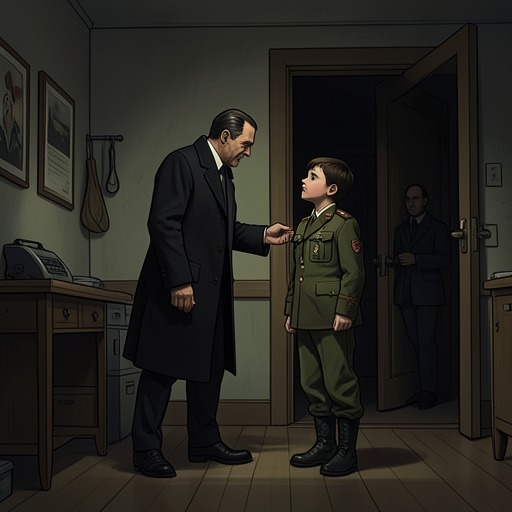
The claim becomes personal when Dr. Mackey meets Jack and refers to their earlier encounter on the bridge. He asks Jack to forget that meeting and then states directly that he is Jack's father. Jack recoils in astonishment. The scene reverses the expected emotional pattern of a recovered-family reunion: instead of moving toward the stranger, Jack moves away from him, and the word “father” functions as a demand for obedience rather than as proof of affection.
Jack's resistance is strengthened by his knowledge of adoption. Darcy Gilbert had told him that the Ruthvens adopted him when he was about three or four years old, making him John Ruthven and Darcy's brother in the household's chosen family. The information had first plunged Jack into the fear that he was “a nobody,” because he did not belong to the Ruthven family by birth and might one day have to leave. Yet Alice Ruthven's account also establishes that adoption gave him a real home, and Jack's later response shows that this bond matters more to him than an unsupported biological claim.
When Alice Ruthven hesitates over whether a genuine father should be allowed to take him, Jack asks that the man prove his paternity. He refuses to leave the woman who has acted as his real mother merely because Dr. Mackey has offered his word. He is especially suspicious because Dr. Mackey is the same man who met him on the bridge and treated him like a slave. When the doctor angrily demands whether Jack truly wishes him to prove the relationship, Jack answers that he does and insists that he will remain with Alice Ruthven until the claim is established. He later states that he does not acknowledge Dr. Mackey as his father and will not accept him until the claim is proved in court.
Evidence, Memory, and Competing Histories
The episode makes Jack's identity depend on competing narratives. The Ruthven version presents him as an unidentified child rescued from a wreck, then adopted and loved. Dr. Mackey's version presents him as a missing son whose father has finally returned. Jack himself possesses only a dim memory of the storm and enormous waves; the memory is fragmentary and dreamlike rather than sufficiently precise to identify either his parents or the ship. The story consequently places personal memory beside testimony and objects, without allowing any one form of evidence to settle the matter immediately.
The preserved ring and clothing become potential witnesses to the past. Mrs. Ruthven can produce the small jewel casket containing the ring and delicate lace handkerchief, but the ring's worn marking cannot be read. The wreck itself offers another material route into the mystery: Jack later discovers a heavy black-painted tin box hidden in a filthy, water-damaged closet aboard the wreck. Its locked contents promise documentary evidence capable of challenging or confirming the stories built around the shipwreck, even though Dr. Mackey's initial claim is made before Jack can use that evidence decisively.
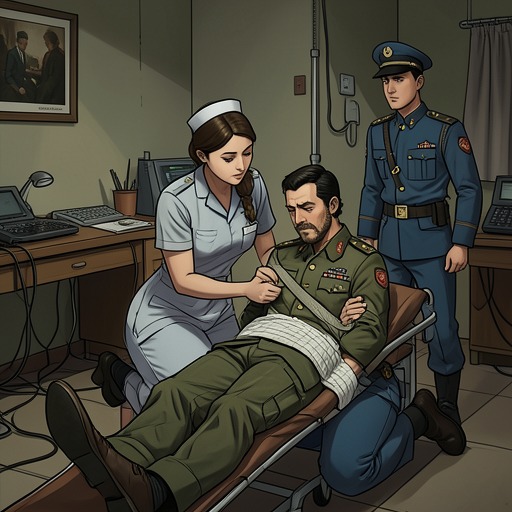
The narrative also contrasts Jack's incomplete recollection with the damaged memories of the adults who might identify him. Colonel Stanton, wounded and feverish, mutters about a ship doomed to break upon the rocks, suggesting that his battle trauma has awakened an older shipwreck memory. He later recalls being rescued after more than twenty-four hours in the water, suffering physical and mental injury, spending two months in a hospital, and then being transferred to an insane asylum. His recollection is dim and uncertain, but it points toward the same maritime disaster that Dr. Mackey has used to construct his claim.
Exposure of the Imposture
The decisive reversal comes when Colonel Stanton's history explains why Dr. Mackey knows so much about the missing family. Stanton says that a corrupt physician at the asylum tried to pry into his family affairs. During lucid intervals, Dr. Mackey extracted information about property in England belonging to Stanton and an estate in Virginia belonging to his wife, Laura Stanton. Stanton believes the ocean voyage had been undertaken to secure Laura's inheritance. After obtaining the details, Dr. Mackey drugged him and left the asylum, while Stanton was kept there for years after being falsely recorded as incurable and subject to violent attacks.
This testimony changes the meaning of Dr. Mackey's apparently intimate knowledge. His knowledge of the shipwreck, the family, and the property does not demonstrate fatherhood; it may have come from exploiting a vulnerable man's memories. The inheritance provides a concrete motive for claiming Jack and for attempting to take control of the family story. The episode's emotional appeal is therefore recast as criminal strategy: the returning father is not a rescuer reclaiming his child but an impostor seeking access to property through a disputed identity.
Later evidence resolves the conflict explicitly. Alice Ruthven tells Jack that he is not Dr. Mackey's son but Colonel Stanton's son, and that Colonel Stanton has proved the fact beyond reasonable doubt. Jack's identity thus passes through several competing descriptions: adopted Ruthven, nameless child of the wreck, alleged son of Dr. Mackey, and finally son of Colonel Stanton. The claim's importance lies not only in its falsity but in the way it forces the story to distinguish biological descent from the moral reality of parenthood.
Consequences and Significance
Dr. Mackey's assertion endangers Jack's physical safety and his place within the Ruthven household. It asks him to abandon Alice Ruthven on the strength of an unverified statement, while Dr. Mackey's prior conduct makes the demand visibly coercive. Jack's insistence on legal proof is therefore both a practical defense and a declaration of moral independence: he will not allow rank, age, or the title of father to override evidence and lived loyalty.
The episode also turns the family home into a courtroom of competing witnesses. Mrs. Ruthven supplies the preserved relics of the dead woman; Old Ben remembers the beach rescue; Jack supplies his fragmentary memory and direct experience of Dr. Mackey's brutality; Colonel Stanton supplies the hidden history of manipulation; and the wreck and tin box hold material traces capable of confirming the truth. The final identification of Colonel Stanton as Jack's father resolves the biological mystery, but it does not erase the years in which Alice Ruthven acted as Jack's mother. Instead, the false claim clarifies the book's larger distinction between inherited property and earned family, between social authority and moral worth, and between a story imposed upon a vulnerable person and an identity established through converging evidence.