Found Family and Adoption
Young Captain Jack · The Son of a SoldierFound Family and Adoption is the novel’s decisive account of family as something created through care before it is confirmed by blood. Jack Ruthven enters the story as a supposedly secure member of the Ruthven household, yet the discovery that he was adopted subjects his identity to competing claims: he is called a nobody, claimed by Dr. Mackey, and finally identified as Colonel Stanton’s son. Through each reversal, the Ruthvens’ love and protection remain the stable foundation of his life.
Adoption and the Ruthven Household
Jack Ruthven grows up in the Ruthven mansion on one of the richest plantations in South Carolina. Alice Ruthven, a widow after Colonel Martin Ruthven’s death at the Battle of Gettysburg, has two children in her household: her seventeen-year-old daughter Marion Ruthven and Jack. The narrator presents Jack and Marion as deeply attached and nearly inseparable, while Alice, weakened by grief and illness, clings to both children as her chief consolation. The household therefore functions as a family long before the story asks whether its members share blood.
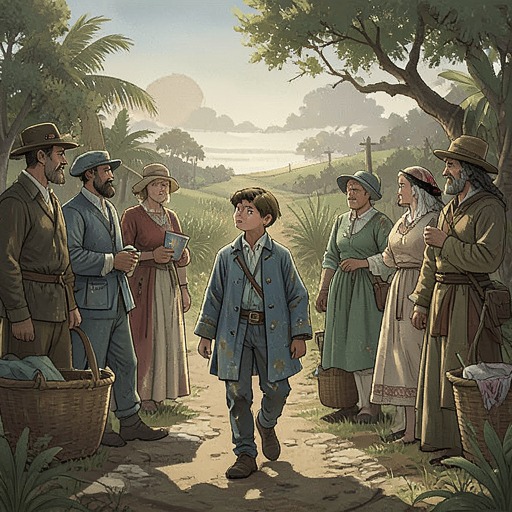
That belonging is first threatened by a hostile rumor. Darcy Gilbert reports that Jack has been called “a nobody,” someone who does not belong to the Ruthven family and will eventually have to leave. The insult is powerful precisely because Jack’s daily life has taught him to understand himself as a Ruthven. His manly self-reliance and resistance to intimidation do not prevent the accusation from producing consternation; the wound is not fear of physical danger but the sudden possibility that his home may be legally or biologically conditional.
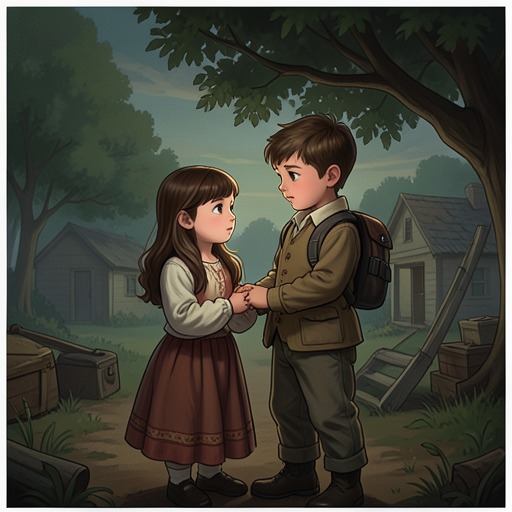
Marion then supplies the first painful clarification. She tells Jack that they are not real sister and brother, while insisting that he will always be a real brother to her. Alice is not his biological mother, but his foster mother, and Marion explains that Alice loves him as she would a natural son. The distinction between blood and affection is thus introduced through Marion’s gesture of holding Jack’s hand tightly: the family bond is not treated as an abstract sentiment but as a relationship enacted through loyalty and physical reassurance.
Motherhood Beyond Blood
When Jack confronts Alice with what he has learned, she does not deny the adoption. She embraces and kisses him, asks him to call her mother, and says that he is her son as if he were her own flesh and blood. Her explanation gives adoption a moral and emotional force: she had kept the truth secret because she did not want to hurt his feelings, not because she regarded him as temporary or inferior. She further tells him that he has been a son to her and asks him to continue in that role.
Alice’s position is reinforced by the history of the marriage. She states that her late husband and she adopted Jack, giving the household a shared parental decision rather than presenting Alice as an isolated caretaker. Jack’s uncertainty about having a “real claim” upon her is answered by both affection and a formal familial act. The novel consequently treats parenthood as having more than one foundation: legal adoption, sustained care, emotional attachment, and the child’s participation in the family all carry weight.
The small jewel casket brought out by Alice extends this problem of family into the realm of material evidence. She retrieves a ring and a delicate lace handkerchief, and Jack examines the gold circlet, which looks like a wedding ring. The object is connected to the unresolved story of his origins, but its presence in Alice’s keeping also shows how the adoptive household has preserved the traces of a past it cannot fully explain. Before bloodline is established, family memory is held in domestic objects and in the testimony of those who raised him.
Identity Under Competing Claims
The adoption story does not end with Jack’s first disclosure. Dr. Mackey later approaches him after their encounter on the bridge and claims, “Jack, I am your father!” The assertion threatens to replace the Ruthvens’ account with a new paternal narrative. Mackey presents biological fatherhood as a claim with practical consequences, but Jack does not surrender himself merely because an adult man names the relationship. He insists on remaining with Alice until Mackey proves his claim in a court of law, and the silence following his declaration marks a crucial moment of resistance.
Jack’s demand for proof gives adoption a civic and legal dimension. He does not treat Alice’s motherhood as invalid simply because Mackey alleges a blood relationship, nor does he accept paternal authority without evidence. The question is not only who produced Jack but who has earned the right to define him. In this conflict, the Ruthvens’ long care becomes the emotional evidence behind Jack’s decision, while Mackey’s unsupported assertion is forced into the stricter language of proof.
Mackey’s claim is ultimately exposed as false. Jack learns that he is not Dr. Mackey’s son at all, but the son of Colonel Stanton. The revelation changes his biological identity without changing the central fact that Alice and Colonel Martin Ruthven adopted and raised him. The plot therefore distinguishes between discovering a natural father and acquiring a family. Blood resolves one mystery; it does not retroactively create the childhood relationship that adoption already made real.
Family Reunited Rather Than Replaced
Colonel Stanton’s connection to Jack is confirmed through the colonel’s own account and is described as proved beyond doubt. Stanton recognizes that the boy named Jack is his child, while Alice explains that Jack is the Ruthvens’ adopted son. The two claims can coexist, and the narrative makes their coexistence the basis for reconciliation rather than another act of dispossession.
The final arrangement makes that principle concrete. After the Civil War, Colonel Stanton prosecutes Dr. Mackey, who receives a ten-year prison sentence, and Stanton and Jack obtain a fortune worth one hundred and fifteen thousand dollars. Stanton initially considers returning North, but Alice cannot bear to part with Jack, and everyone decides to remain at the plantation. A year later Stanton marries the widow, so Alice, now Mrs. Stanton, becomes Jack’s mother once more. Marriage joins the biological father’s household to the adoptive mother’s household instead of forcing Jack to choose between them.
Jack openly welcomes the result, saying that this is exactly what he wanted. His satisfaction shows that the resolution is not merely a legal settlement or financial recovery. The child who feared being expelled from the Ruthven family receives a family structure in which his birth and upbringing are both acknowledged. The wedding also links Jack’s restored household to Marion’s future: at the same double ceremony, Marion marries Dr. Harry Powell, turning the plantation into the scene of a renewed network of familial alliances.
Growth, Belonging, and Meaning
The family established through adoption shapes Jack’s conduct throughout the story. Even before his parentage is known, he acts as a protector of Alice and Marion and organizes a Home Guard company of twenty-three boys, serving as its captain. His courage, self-reliance, and sense of duty arise within the Ruthven household rather than waiting for confirmation from a biological father. When he is later held as a close prisoner in a mountain cabin, with his hands bound to a heavy wooden stake, the physical assault on his freedom contrasts with the secure belonging he continues to defend.
The ending confirms that Jack’s identity has been formed by both chosen family and inherited lineage. As the son of a soldier, he enters West Point Military Academy, graduates with high honors, and becomes an officer at a western fort before rising to the rank of colonel. His later bravery and loyalty recall the qualities already visible in the adopted child and Home Guard captain. Military ancestry explains part of the story’s symbolism, but it does not cancel the Ruthven upbringing that taught him where duty and affection belonged.
Found Family and Adoption therefore resists the idea that biological discovery alone can determine a person’s worth. Jack passes through the labels of Ruthven foster child, alleged nobody, supposed son of Dr. Mackey, and proven son of Colonel Stanton. The final resolution does not ask which family was real. It shows that Alice’s motherhood, Marion’s sisterly devotion, Colonel Martin Ruthven’s adoption, and Colonel Stanton’s biological relationship occupy different but compatible forms of truth. Jack becomes fully himself not by abandoning the family that raised him, but by carrying that family into a larger and newly verified history.