Harry Powell
Young Captain Jack · The Son of a SoldierHarry Powell is a young surgeon whose return to the Ruthven household links professional duty, family loyalty, and romantic commitment. A former resident of Philadelphia, he opposes slavery and joins the Union Army when the American Civil War begins, yet his allegiance does not erase his kinship with the Ruthvens or his affection for Jack Ruthven. Powell’s medical service and personal courage make him a stabilizing presence in a narrative shaped by battle, injury, captivity, disputed parentage, and deception.
Identity and Background
Harry Powell is introduced as the nephew of Mrs. Alice Ruthven, though the two relatives had not seen one another for years. He is described as a “fine fellow,” well liked by almost everyone who knows him. His one significant family detractor is St. John Ruthven, whose selfishness and evasiveness make Powell’s open, manly character especially unwelcome. The contrast is not merely temperamental: Powell’s conduct repeatedly joins competence with generosity, whereas St. John treats character as a matter of convenience and social position.
Powell had moved north several years before the war and established a medical practice in Philadelphia. He was firmly opposed to slavery, and when fighting began he promptly enlisted with the Federal troops. His decision horrifies his two aunts and Marion Ruthven, whose family sympathies lie with the South, while St. John dismisses it as typical of a supposedly impractical man. The episode establishes Powell as someone willing to accept personal and familial disapproval in obedience to principle.
Return to the Ruthven Household
Powell’s arrival during the war is marked by recognition rather than ceremony. Seeing Old Ben, he immediately steps forward, greets him as an old acquaintance, and slaps him on the back. Old Ben is startled that Powell has joined the Yankees, but Powell does not treat the old servant’s question as a breach between them. He then recognizes Jack Ruthven, whom he remembers as a much smaller boy, and calls him forward. The scene restores a relationship that predates Jack’s present danger and gives Powell an intimate basis for judging him beyond the competing claims made by adults.
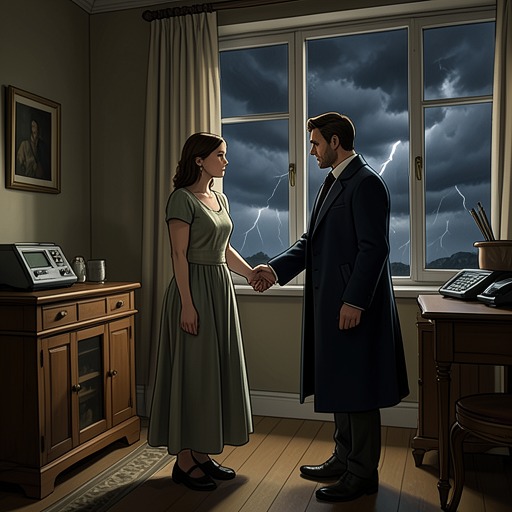
Powell’s first exchange with Jack also reveals his instinct for reconciliation. When Jack hesitates to shake hands with him as a Union man, Powell asks whether he will accept the gesture as a cousin instead. The formulation acknowledges the political wound without allowing it to destroy family connection. In a household divided by war, Powell makes kinship a bridge rather than a weapon.
His medical role becomes equally important. Colonel Stanton is willing to let the young surgeon remain at the homestead, and Powell’s presence supplies the household with an experienced practitioner while soldiers are being treated there. Later, after Powell has been exposed to danger, he returns on horseback early in the morning and reports that he was wounded in the shoulder, though he considers the injury minor. His return is therefore both professional and personal: he comes back to a place where wounded bodies and damaged relationships require attention at the same time.
Defense of Jack and the Paternity Dispute
The claim that Dr. Mackey is Jack’s father gives Powell a direct stake in the novel’s identity mystery. Marion tells him that a Confederate surgeon named Dr. Mackey has made the claim. Powell does not dismiss her anxiety; instead, he reflects that he may have heard of Mackey before and promises to do his best for her. His support is grounded in affection as well as family duty: he explicitly says that he loves Jack, even though Jack was very young when Powell left.
Powell’s knowledge of Philadelphia becomes an important corroborating detail when the disputed claim is examined. Others report that Dr. Mackey came from Philadelphia, and Powell confirms that he himself hails from there. The information does not by itself settle the question of Jack’s parentage, but it shows why Powell is a useful witness within the investigation. He can connect Mackey’s asserted background with information independently associated with Powell, while his prior acquaintance with Jack gives him a perspective unavailable to strangers.
Powell also occupies a position between evidence and emotion. Marion hopes that Mackey can prove his claim, and the possibility troubles her because the assertion threatens the family that raised Jack. Powell’s response is neither blind reassurance nor surrender to Mackey’s authority. He offers practical help while allowing the matter to remain subject to proof. That restraint distinguishes him from Mackey, whose alleged fatherhood is presented as part of a scheme to obtain property.
Love, Medical Duty, and Wartime Courage
Powell’s relationship with Marion Ruthven develops alongside the identity crisis. He tells her that he has always loved her and fears that she may abandon him. His declaration is emotionally direct, but it is not detached from the wider conflict: Marion’s family has been shaken by war, political allegiance, and the threat posed by Mackey’s claim. Powell seeks not merely romantic reassurance but the preservation of a bond under pressure.
His conduct also places love beside service rather than against it. He has chosen military medicine because he opposes slavery, and he continues to work among soldiers even when the war brings him into the territory of relatives and former acquaintances. When he is wounded in the shoulder, he minimizes the injury and returns to the Ruthven circle. The detail reinforces a pattern in which Powell’s body is exposed to wartime danger while his actions remain directed toward healing others and protecting those he loves.
The household’s medical setting intensifies this role. Jack insists that the private property of the Ruthven family must be respected because the house has become a hospital containing six wounded Confederates under the care of a surgeon. Powell’s presence makes the distinction between political sides and medical obligation especially visible. A Union surgeon can remain connected to a Southern family and participate in the care of Confederate wounded without surrendering his opposition to slavery. In this way, Powell embodies wartime humanitarianism within a domestic space transformed by conflict.
Change, Marriage, and Narrative Significance
Powell’s significance grows from his refusal to let military allegiance, regional hostility, or a contested bloodline determine every human relationship. He recognizes Old Ben, welcomes Jack, offers Marion support, and remains acceptable to Colonel Stanton despite the divided loyalties surrounding the household. Against the looting guerrillas who follow the cavalry for profit, his medical vocation represents a contrary use of wartime mobility: he moves through danger in order to preserve life rather than seize property.
His eventual marriage to Marion completes the personal side of this trajectory. The ceremony at the plantation is a double wedding: when Mrs. Alice Ruthven marries Colonel Stanton, Marion gives her heart to Harry Powell, who has established a lucrative practice in Philadelphia. The double wedding becomes a major social occasion and remains the talk of the neighborhood. The Ruthvens from the other plantation are invited; Mrs. Mary Ruthven attends, while St. John Ruthven is conspicuously absent. Powell’s union with Marion therefore closes not only a courtship but also a pattern of exclusion: the character who mocked his principles and resisted his moral example is left outside the celebration.
Powell functions as a counterweight to the novel’s imposture and coercion. Dr. Mackey uses medical knowledge, information extracted from a vulnerable man, drugs, and a false paternal claim in pursuit of inheritance. Powell uses medicine openly, accepts the risks of public service, and supports Jack without demanding ownership of him. His final place beside Marion turns those differences into a thematic resolution. The story’s families are not repaired by bloodline alone; they are repaired through loyalty, care, evidence, and the willingness to recognize one another across the divisions created by war.