Hemlock Bluff
Young Captain Jack · The Son of a SoldierHemlock Bluff is the rocky promontory overlooking the Atlantic where the wreck central to Jack Ruthven’s identity mystery came ashore. At first it is simply a familiar sight from the Ruthven home, but its wrecked vessel gradually becomes the physical center of the novel’s buried history: it preserves the circumstances of Jack’s rescue, draws Dr. Mackey back into the past, and contains the black tin box whose papers finally connect Jack with Colonel Stanton and recover the Stanton fortune.
Setting and Physical Character
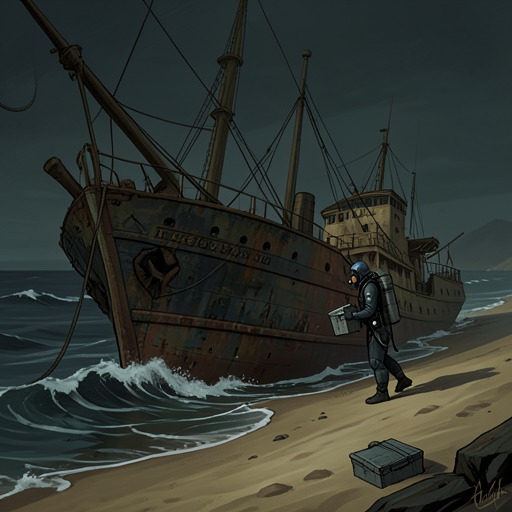
Hemlock Bluff is associated with the rocks and beach on the shore of a wide bay. The wreck lies high on the beach, with its bow driven well up on the rocks and its stern projecting over the sea. Although the site can be seen from the bluff, it is roughly a mile away by water, making the approach a deliberate journey rather than a casual walk. Jack rows there with Marion Ruthven, brings the boat into a safe corner, helps her ashore, and climbs aboard the vessel despite the difficulty of reaching its deck. The wreck itself is unstable and decayed. Its deck has deteriorated enough that Jack and Marion must move carefully, while later examination shows that fire has charred everything inside. Hemlock Bluff therefore combines openness and danger: the ship is exposed to the sea and visible from a distance, yet its damaged interior hides objects that have survived both the disaster and subsequent neglect.
The Wreck and Jack’s Lost Beginning
Hemlock Bluff is the place where Marion Ruthven recounts the event that created Jack’s uncertain identity. Between ten and eleven years before the present action, a ship came ashore there during a fearful night. Old Ben, then enslaved on the Ruthven plantation, was watching from the bluff when a signal gun announced that the ship was in distress. The vessel appeared rocking in the wild waves, with water running over its deck, but no one remained aboard: the captain and crew had gone down in the ocean. Jack had been a passenger on that ship. He was found as a small child, and the Ruthvens adopted him, but the wreck yielded no reliable name or family record. His mother had called him Jack before her death, yet the clothing carried no mark, and the only item in her pocket was an unmarked lace handkerchief. A ring from one of her fingers had once borne an inscription, but it was so worn that neither the Ruthvens nor two jewelers could decipher it. The absence of readable identification turns Hemlock Bluff into the birthplace of a question that follows Jack through the story: he belongs legally and affectionately to the Ruthven family, but his biological origin remains hidden. When Jack learns that he may have come from the wreck, the site changes from distant scenery into a personal archive. He tells Marion that he wants to row over and look around, and she recognizes that the wreck will now hold a special interest for him. At Hemlock Bluff, curiosity becomes an attempt at self-recovery. Jack’s climb onto the decayed deck is consequently both a physical act of exploration and an effort to enter the obscured history of his own childhood.
A Site of Repeated Investigation
The wreck’s importance does not end with Jack and Marion’s first visit. Years later, Dr. Mackey returns to Hemlock Bluff after seeing the vessel from the bluff and announces that the sight has brought back affairs from approximately eleven years earlier. He claims to have been one of the passengers on the ship, placing himself inside the disaster that had previously been known to the Ruthvens only through Old Ben’s observation and Mrs. Ruthven’s recollections. Dr. Mackey’s visit exposes the site’s double character as evidence and opportunity. He climbs with difficulty onto the burned deck, enters the main cabin by candlelight, and searches for stateroom No. 15. In a closet roughly a foot square and equally deep, dirt and water have formed a solid cake over a heavy black-painted tin box. He digs through the accumulation, finds the box, opens its small padlock with a key from his own bunch, and removes the papers inside. The wreck thus becomes a hidden vault: its fire, water, dirt, and decay obscure the evidence without destroying it. The contrast between the two investigations is central. Jack approaches Hemlock Bluff openly with Marion, seeking knowledge about himself, while Dr. Mackey enters the wreck secretly and takes the box for his own purposes. The same location supports innocent inquiry and criminal concealment, and the material remains of the ship become vulnerable to whoever can reach them first.
Evidence, Recognition, and Aftermath
Hemlock Bluff continues to echo through later scenes even when the characters are away from it. Colonel Stanton, feverish after being wounded, cries out about a shipwreck and asks that his wife Laura and his son Jack be saved. His words revive the connection between the wreck’s unknown mother, the name Laura, and Jack’s resemblance to the colonel. These fragments transform Hemlock Bluff from the scene of an unexplained maritime tragedy into the setting of the Stanton family’s separation. The final recovery of the tin box confirms the site’s narrative function. After Jack returns home, a battle in the mountains kills several guerrillas, including the men who had held him prisoner, and also kills Pete Gendron without revealing what he knew of Dr. Mackey’s past. A search of the outlaws’ camp uncovers stolen goods and other valuables, including the tin box taken from the wreck of the Nautilus. The box and its contents are subsequently given to Colonel Stanton. When he examines the papers, he tells Jack that nothing now stands between them and their fortune. Evidence removed from Hemlock Bluff therefore restores both a family relationship and a financial inheritance. The location’s significance lies in this progression from visible landmark to traumatic origin, secret archive, and finally recovered proof. Hemlock Bluff preserves what human memory cannot securely supply: the lost ship, the dead passengers, the mother’s unidentified belongings, and the papers that survive beneath dirt and fire. Its wreck does not speak by itself, but each return to the site or to its surviving objects brings another portion of Jack’s identity into view. By the end, the rocks no longer mark only an unresolved disaster; they stand as the place from which the story’s concealed lineage and fortune are recovered.