Hemlock Bluff wreck
Young Captain Jack · The Son of a SoldierThe Hemlock Bluff wreck is far more than a stranded vessel: it is the story’s largest surviving piece of evidence. Its ruined hull preserves the circumstances of Jack Ruthven’s childhood rescue, draws Dr. Mackey back into a crime he helped conceal, and ultimately yields the tin box whose papers confirm Colonel Stanton’s relationship to Jack and recover the fortune at stake. The wreck turns a landscape of danger into an archive, making damaged material objects speak where memory, names, and testimony have failed.
Definition and Setting
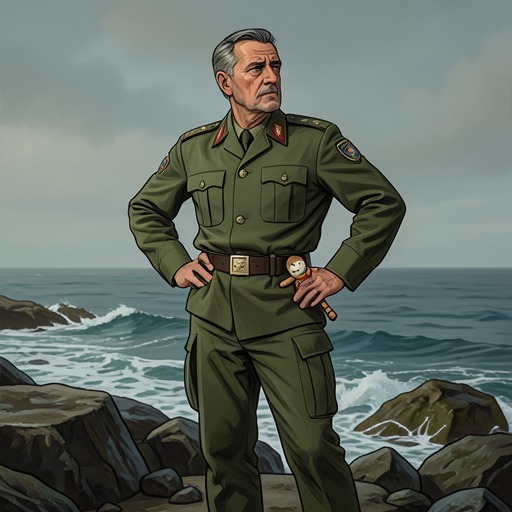
The wreck lies on Hemlock Bluff rocks, with its bow raised well up on the rocks and its stern projecting over the sea. Marion Ruthven points it out to Jack when she begins explaining that he was not born into the Ruthven family but was adopted after being found on the beach. The ship had come ashore between ten and eleven years earlier, during a night of violent weather, and remained visible from the bluff long after the disaster.
The wreck’s survival gives it an unusual double character. It is a dangerous, decaying structure that is difficult to reach, yet it is also a fixed landmark through which the past remains physically present. Jack is a capable climber and reaches the deck before helping Marion up, but the boards are so far decayed that both must move cautiously. The wreck therefore resists easy access even while inviting investigation: its secrets are close enough to see and difficult enough to retrieve.
The Original Shipwreck and Jack’s Rescue
The disaster is the beginning of Jack’s uncertain identity. A signal gun announced that the ship was in distress, and the vessel soon appeared rocking amid waves that swept across its deck. The captain and crew had disappeared beneath the ocean, leaving no one aboard when it came in. Old Ben, then enslaved by the Ruthven family, had been watching from the bluff; after hearing a cry, he found an injured woman on the beach with the young Jack in her arms.
The woman, understood to be Jack’s mother, had been struck by wreckage. Jack was only three or four years old, and exposure nearly killed him. Old Ben carried him and his mother to the boathouse, then went to the plantation for help. Martin Ruthven and several men returned with him and brought them to the Ruthven house. Jack retained only a dim, dreamlike recollection of the storm and the enormous waves, while the wreck itself supplied the setting that connected his fragmentary memory to an actual event.
The rescue did not identify the child. Jack’s mother died without providing a name beyond calling him Jack, and neither her clothing nor her pockets contained a mark that could establish her family. A lace handkerchief and a ring were preserved, but both were initially unhelpful: the handkerchief was unmarked, and the ring’s worn inscription could not be read even after two jewelers examined it. The wreck consequently creates the mystery without immediately solving it. It explains how Jack entered the Ruthven household, but not who he was before Old Ben found him.
The Wreck as a Hidden Archive
The wreck becomes an active site of investigation when Dr. Mackey visits it. He tells Old Ben that the ship has revived an important passage in his own life because he had been one of its passengers. The claim changes the wreck from a local curiosity into a point of contact between Jack’s childhood and Dr. Mackey’s concealed past. Dr. Mackey’s renewed interest is not merely sentimental; he has come to answer questions connected with the vessel and searches the charred remains for something specific.
The interior bears the marks of destruction. Fire has charred everything, and Dr. Mackey enters the main cabin by candlelight, looking for stateroom No. 15. He eventually locates a closet about a foot square and equally deep. The closet is clogged with dirt and water that entered through a crack at the top, but his search uncovers a heavy black-painted tin box. He opens its small padlock with one of the keys in his possession and reacts with satisfaction at having found it.
The box is the wreck’s decisive surviving object. Its contents are documents connected with Colonel Stanton and the property that had been lost amid the shipwreck and its aftermath. Dr. Mackey’s discovery exposes his continuing effort to control evidence, while the later recovery of the box from the outlaws’ camp reverses that control. After the guerrillas who held Jack are killed, the camp is searched and the stolen goods are found, including the tin box taken from the wreck of the Nautilus. The box is eventually given to Colonel Stanton, who recognizes the papers as his own and tells Jack that nothing now stands between them and their fortune.
Identity, Memory, and Recognition
The wreck repeatedly activates competing accounts of Jack’s identity. At first, St. John Ruthven’s insult gives the visible mystery its most painful interpretation: Jack is told that he is a nobody, does not belong to the Ruthven family, and will one day have to leave. Marion corrects the social meaning of that accusation by explaining that Jack was adopted when he was a child and is legally John Ruthven, her brother. The wreck then deepens the revelation by showing that adoption was the consequence of a maritime disaster rather than evidence that Jack had no family.
Jack’s own memory is too incomplete to settle the question. He recalls the storm only dimly, in a “dreamy-like” form, so external witnesses and preserved objects must carry the burden of proof. The ring and handkerchief maintain a material link to his mother, even though neither initially bears a readable name. The wreck thus makes identity a cumulative process: memory provides impressions, testimony supplies chronology, and objects retain traces that may become intelligible only when later evidence appears.
The same setting also triggers Colonel Stanton’s damaged recollection. While feverish after being wounded, he cries that the ship is doomed and speaks of saving his wife Laura and his son Jack. His words prompt Alice Ruthven to reconsider the earlier assumption that Jack’s mother may have been named Laura. Colonel Stanton later explains that he survived the wreck, was rescued after more than twenty-four hours, and suffered severe physical and mental consequences. After a voyage lasting several weeks, he was taken to a strange hospital, remained there for two months, and was then transferred to an insane asylum.
The wreck’s history also explains why the truth was suppressed. During lucid intervals, Dr. Mackey extracted Stanton’s account of property in England and an estate in Virginia belonging to Stanton’s wife, Laura. He drugged Stanton, learned the details of the family’s affairs, and arranged for Stanton to be recorded as incurable and violently unstable. Stanton remained confined for years while Dr. Mackey left the asylum and disappeared. The shipwreck therefore connects not only a lost family but a deliberate campaign to exploit memory loss, medical authority, and missing legal evidence.
Narrative Significance
The Hemlock Bluff wreck functions as a recurring clue whose meaning changes each time it is revisited. To Jack and Marion it is the scene of childhood rescue and the visible origin of an unanswered question. To Dr. Mackey it is a site where incriminating information and a valuable box might be seized. To Colonel Stanton it is the traumatic center of a life interrupted by separation, institutional confinement, and the presumed loss of his family. To the final plot, it is the place from which documentary proof emerges.
Its physical deterioration mirrors the fragility of the human accounts surrounding it. The vessel is burned, waterlogged, dirty, and difficult to enter, yet the black tin box survives inside a concealed closet. What appears ruined still contains the means of restoration. The wreck consequently contrasts the instability of recollection and social reputation with the stubborn persistence of material evidence: Jack can be called a nobody, claimed falsely as Dr. Mackey’s son, or recognized as Colonel Stanton’s son, but the surviving papers help determine which version can endure.
By the end, the wreck has changed from a threatening relic into an instrument of restitution. The recovered tin box helps establish Colonel Stanton’s claim and confirms Jack’s true parentage, while the recovered fortune resolves the material consequences of the deception. Its importance is therefore both personal and structural. The wreck begins Jack’s life as an unidentified child, preserves the clues that make his history recoverable, and supplies the evidence that reunites him with his biological father.