Jack Learns He Was Adopted
Young Captain Jack · The Son of a SoldierJack Learns He Was Adopted is the revelation that breaks apart Jack Ruthven’s inherited understanding of family and begins the larger search for his true parentage. Until this moment, he believes that he is the son of the late Colonel Martin Ruthven, the brother of Marion Ruthven, and a natural member of the Ruthven household. The discovery wounds him because it threatens not only his name but also his place within the family; at the same time, Marion Ruthven’s insistence that adoption makes him her brother preserves the emotional bond that the revelation appears to endanger.
Identity and the First Challenge
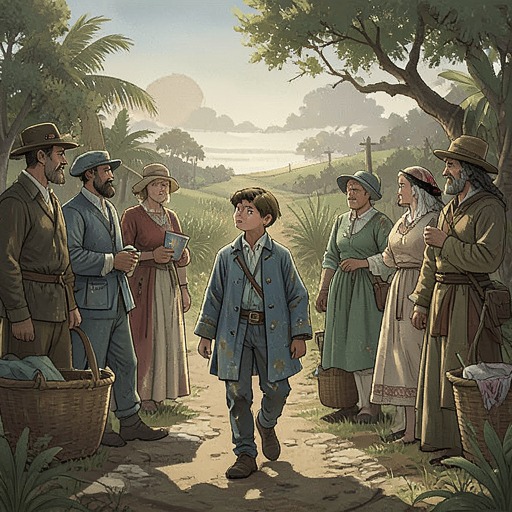
The immediate cause of the disclosure is a hostile statement that Jack does not belong to the Ruthven family. Darcy Gilbert reports that the speaker called Jack “a nobody,” claimed that he did not belong to the Ruthvens, and said that he would someday have to leave. The accusation strikes at the foundation of Jack’s self-image. He asks whether he is truly Jack Ruthven and the son of Colonel Martin Ruthven, then reacts with anger when the same claim is extended to his relationship with Marion. His first instinct is resistance: he threatens to confront the person who has insulted both his name and his family.
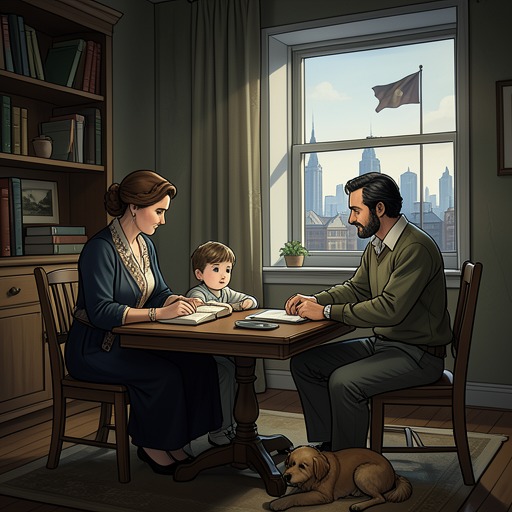
The uncertainty becomes personal when Jack asks Marion whether they are really sister and brother. Marion’s answer is direct: they are not biological siblings. Jack is momentarily choked by the words, but Marion immediately distinguishes blood relation from lived allegiance. She tells him that he will always be her real brother, catches his hand, and holds it tightly. The physical gesture matters because the revelation is not presented as a simple expulsion from the family. It separates biological identity from family loyalty without dissolving the relationship that has shaped Jack’s life.
The Adoption and the Hemlock Bluff Wreck
Marion explains that Jack was only three or four years old when her parents adopted him. In the eyes of the law, she says, he is their real brother because the adoption made the relationship legally valid. This gives Jack a new description of himself: he is not a “nobody,” but John Ruthven, the adopted son accepted into the household. The name and legal status offer a partial answer, yet they cannot tell him where he came from or what happened before the Ruthvens took him in.
The missing past is connected to the wreck on Hemlock Bluff. Between ten and eleven years before the conversation, Jack had been a passenger on the ship that came ashore there during a violent storm. Old Ben, then enslaved by the Ruthvens, watched from the bluff after hearing a signal gun announce that the vessel was in distress. The ship appeared with waves breaking over its deck, and no one remained aboard: the captain and crew had gone down in the ocean.
Old Ben found Jack on the beach in the arms of an injured woman whom the household understood to be his mother. The child cried out for bread and butter, and Jack retains only a vague, dreamlike memory of the storm and the waves. Old Ben carried him and the woman to the boathouse, then summoned help from the plantation. Colonel Martin Ruthven and several men brought them to the house, but the woman died two days later without recovering consciousness. Her only remembered words were pleas to save her husband and her little Jack. She left no account of the family’s name, origin, or fate.
Evidence, Objects, and Unresolved Parentage
The rescue explains how Jack entered the Ruthven household but does not establish his birth identity. His mother’s clothing bore no mark, and she had no identification in her pocket. The only surviving personal items were an unmarked lace handkerchief and a ring. The ring had once carried an inscription, but it was so worn that neither the Ruthvens nor two jewelers could decipher it. Mrs. Ruthven keeps both objects in a small jewel casket and shows them to Jack; the gold circlet appears to him to be a wedding ring. These items transform the adoption story from a closed explanation into an investigation supported by damaged, incomplete clues.
The wreck itself later becomes a second repository of evidence. Jack discovers a heavy black-painted tin box hidden behind dirt and water in a tiny closet aboard the wrecked Nautilus. The box is locked, but he opens it with a key from his own bunch of keys. Its contents are eventually recovered from the outlaws who had taken it, and the papers are returned to Colonel Stanton. That recovery supplies the documentary proof needed to connect Jack’s unknown past with the Stanton family and its fortune. The adoption revelation therefore functions as the opening stage of a chain in which memory, surviving objects, wreckage, testimony, and written papers gradually revise Jack’s identity.
Competing Claims to Jack’s Parentage
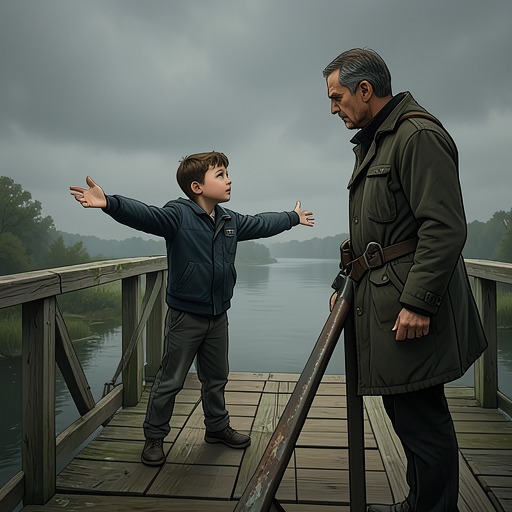
The uncertainty briefly produces a false solution when Dr. Mackey claims that Jack is his son. Meeting Jack after their earlier encounter on the bridge, Dr. Mackey asks him to forget their conflict and announces that he is Jack’s father. Jack recoils in astonishment, and the claim temporarily creates another version of his origins. It is later exposed as false: Jack is not Dr. Mackey’s son but the son of Colonel Stanton.
The authentic parentage is foreshadowed by Colonel Stanton’s fevered recollections. He cries out about a shipwreck and asks that his wife Laura and his son Jack be saved. The name Laura corresponds to the long-mysterious identity of the woman rescued from Hemlock Bluff, while Jack’s resemblance to Colonel Stanton reinforces the testimony. When the truth is finally communicated, Jack is told that Colonel Stanton has proved it beyond doubt. The adoption revelation thus does not merely replace one identity with another. It establishes a sequence of competing narratives—Ruthven son, anonymous wreck survivor, Dr. Mackey’s alleged son, and finally Colonel Stanton’s son—whose credibility depends increasingly on converging evidence rather than assertion.
Consequences for Jack’s Development
The revelation changes Jack’s conduct without reducing his capacity for action. He is described as manly, self-reliant, and difficult to intimidate, and the identity crisis tests those qualities by forcing him to act without a secure account of his birth. Even before his parentage is settled, he assumes responsibility for defending the household: with Darcy Gilbert, he organizes a Home Guard company of twenty-three boys and serves as its captain. He possesses an old sword and a pistol, while the other members carry pistols or guns. His authority therefore arises first from courage, loyalty, and initiative, not from a confirmed biological pedigree.
The same identity crisis is placed against physical danger when Jack becomes a close prisoner in a small cabin high on a mountainside. His hands are bound behind him to a heavy wooden stake, and the Confederates leave him without food or water as night passes. The episode sharpens the contrast between the frightened uncertainty of the adopted boy and the endurance of the young leader who continues to act under pressure. His eventual return, followed by the defeat of the outlaws who held him, turns the unresolved question of birth into a story of demonstrated character.
Resolution and Narrative Significance
The truth finally joins biological descent to the family that raised him. Colonel Stanton’s recovered papers restore his fortune, while Jack’s recognition as Stanton’s son resolves the central mystery that the adoption disclosure first creates. Yet the conclusion does not erase the Ruthven years. Marion continues to regard Jack as her brother, and his later achievements grow out of both his rescued childhood and his newly confirmed military lineage.
Years afterward, Jack enters West Point Military Academy, graduates with high honors, and goes West as an officer at a prominent fort. His career is marked by daring and honor, and he rises to the rank of colonel with the bravery and loyalty already associated with him as a boy. The revelation consequently serves as a hinge between two kinds of belonging: adoption gives Jack a home before it gives him an ancestry, while recovered evidence gives him ancestry without invalidating that home. His final stature confirms that his worth was never dependent solely on the name he was born to carry.