Jack Ruthven's uncertain parentage
Young Captain Jack · The Son of a SoldierJack Ruthven's uncertain parentage governs his passage from secure adoption to radical self-doubt and, ultimately, to verified biological identity. The question is not merely who his parents were. It determines whether Jack belongs to the Ruthven family, whether Dr. Mackey's claim can be trusted, and whether the wreck of the Nautilus contains the evidence capable of joining a displaced child to his lost household. His identity is repeatedly rewritten by rumor, testimony, resemblance, bodily memory, and material proof before the final recovery of the tin box establishes him as Colonel Stanton's son.
Identity Before the Mystery
Jack begins life within the Ruthven household, but his social belonging rests on adoption rather than known blood. Mrs. Ruthven is a widow whose husband, Colonel Martin Ruthven, was killed at the Battle of Gettysburg; she lives with her daughter, Marion Ruthven, and Jack on one of the richest plantations in South Carolina. Jack and Marion regard each other as brother and sister, and their intimacy gives his adopted status the emotional force of an actual family bond. His character also complicates the idea that uncertain ancestry makes him weak: he is described as manly, self-reliant, and difficult to intimidate, and he responds to danger with initiative rather than submission.
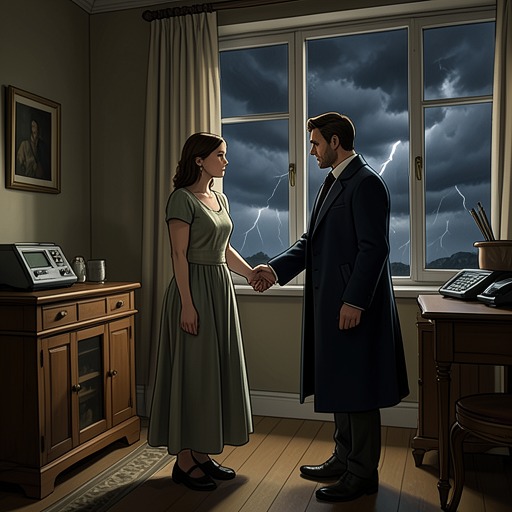
The first destabilizing version of Jack's identity comes through St. John Ruthven, who calls him a nobody who does not belong to the Ruthven family and will someday have to leave. The insult becomes powerful because it converts an obscure fact of adoption into a threat of expulsion. Jack is not simply told that his origins are unknown; he is made to imagine that his home may have no legitimate claim on him. Marion's disclosure answers the social accusation without solving the biological mystery: she explains that her parents adopted him when he was three or four years old and that, in the eyes of the law, he is John Ruthven, her real brother. The distinction between legal kinship and biological descent becomes the foundation of the entire inquiry.
The Shipwreck and the Missing Past
Marion traces Jack's arrival in the Ruthven family to the wreck on Hemlock Bluff rocks, which came ashore between ten and eleven years earlier. Jack had been a passenger, and his father and mother were believed to have been aboard. The recovered bodies were only those of sailors; no body identified as Jack's father was found. His parents had taken passage at the last moment, so their names were absent from the shipping-office list, while the ship's own books were never recovered. The disaster therefore erased the ordinary records by which parentage might have been established and left Jack with only the first name his mother called him before she died.
The surviving personal effects initially seem almost useless. Jack's clothing was unmarked, and his mother carried only an unmarked lace handkerchief. Mrs. Ruthven preserved both the clothing and the handkerchief, along with a ring worn on the mother's finger. The ring had once carried an inscription, but it was so worn that neither the family nor two jewelers could decipher it. Its appearance as a wedding ring nevertheless makes it a charged relic: it confirms the existence of a marriage while withholding the names that could identify the couple. When Mrs. Ruthven brings the small jewel casket and passes the ring to Jack, the mystery becomes tangible rather than merely verbal.
Jack refuses to accept uncertainty as a permanent condition. He declares that he will discover who he is because the mystery of the past must be solved, while also promising Mrs. Ruthven that he will not leave her so long as she wishes him to stay. This combination of investigation and loyalty is important: the search is not an attempt to escape the Ruthven family but an effort to understand how his unknown past can coexist with the home that raised him.
Evidence, Action, and Competing Claims
The identity search becomes an active quest when Jack turns toward the Nautilus wreck itself. In a neglected closet, he digs through dirt and water and uncovers a heavy black tin box hidden behind a small door. The box is secured by a padlock, but Jack tries keys from his pocket until he finds one that opens it. The scene makes physical exploration the counterpart of psychological inquiry: what memory and witnesses cannot supply may survive in a sealed object concealed within the wreck.
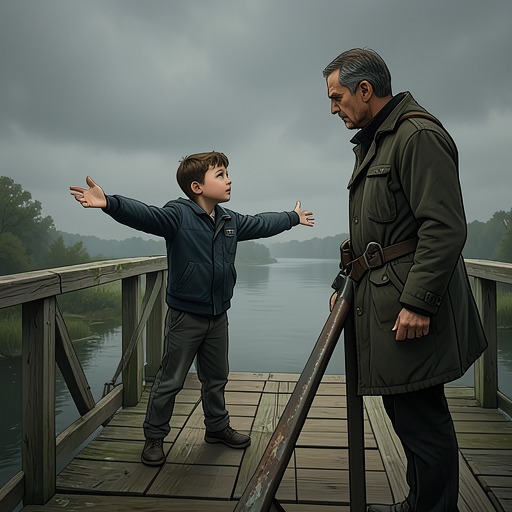
Before the box's final significance is established, Dr. Mackey attempts to replace uncertainty with an abrupt assertion. After an earlier encounter on a bridge, he asks Jack to forget their conflict and announces, "Jack, I am your father!" He repeats that claim when Jack recoils in astonishment. The declaration offers emotional certainty without immediately providing proof, and Mrs. Ruthven insists on the evidentiary question. Dr. Mackey answers that he possesses private papers and a marriage certificate proving that he married Jack's mother; he also expects an old college friend to testify about the past. Mrs. Ruthven refuses to surrender Jack on the strength of assertion alone and says that Dr. Mackey must prove the claim before she will accept it.
The challenge exposes the difference between a story about parentage and a demonstrated genealogy. Dr. Mackey's papers, marriage certificate, and anticipated witness create a plausible competing account, but the claim remains contested because it comes from the person who benefits from being recognized as Jack's father. The narrative accordingly keeps Jack's identity open between several frameworks: he is the Ruthven family's adopted son, the nameless child of a shipwrecked couple, and the alleged son of Dr. Mackey. Each version changes the meaning of the same childhood without yet securing its truth.
Confirmation as Recovery
The decisive revision comes when Colonel Stanton, gravely ill after being wounded, speaks feverishly of the shipwreck and asks that his wife Laura and his son Jack be saved. The detail reconnects the lost voyage with a named family and supplies a parental name that earlier testimony had left uncertain. A further observation that Jack resembles the colonel strengthens the connection, but resemblance alone does not settle the matter. Its force lies in joining appearance to the colonel's fevered recollection and to the documentary evidence still missing from the story.
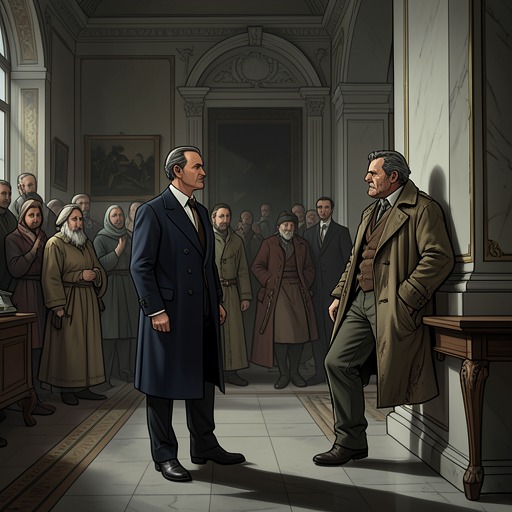
The final disclosure explicitly rejects Dr. Mackey's version: Jack is told that he is not Dr. Mackey's son but Colonel Stanton's son, and that the colonel has proved it beyond doubt. Jack's astonishment shows that the revelation is not a minor correction but the resolution of the identity crisis that has shaped his conduct. The search ends not with a new social exile but with a recovered biological father, while Jack's legal and emotional place in the Ruthven household remains distinct from that recovered blood relationship.
The black tin box supplies the material closure. After a battle in the mountains kills the guerrillas who had imprisoned Jack, the outlaws' camp is searched. Among stolen goods and other valuables, the searchers find the tin box taken from the Nautilus wreck. Its contents are turned over to Colonel Stanton, who recognizes the papers as his precious documents and tells Jack that nothing now stands between them and their fortune. The recovered papers therefore perform two functions at once: they authenticate the parentage claim and restore the inheritance attached to it. Jack's uncertain past becomes a documented family history rather than an accusation, rumor, or damaged keepsake.
Narrative and Thematic Significance
Jack's uncertain parentage is constructed as a competition among identity narratives. The Ruthven adoption gives him a family name and legal standing; the wreck explains why his biological history disappeared; Dr. Mackey offers a self-serving replacement story; Colonel Stanton's memory and the recovered documents supply the final account. The repeated return of the wreck, the ring, the handkerchief, the hidden tin box, the name Laura, and the resemblance between Jack and Colonel Stanton turns the mystery into a chain of clues whose meanings change as new evidence appears.
The state also tests whether identity is determined by blood, law, memory, or care. Jack's adoption does not become false merely because his biological father is found. Marion's insistence that he is her real brother in the eyes of the law, and the family's affection for him before his origins are known, establish belonging as something lived and defended. Yet the novel treats biological knowledge as consequential rather than irrelevant: Colonel Stanton's recognition restores a lost relationship and a fortune, while Jack's own demand to know his origins gives the investigation its moral urgency.
Most importantly, uncertainty produces action. Jack's refusal to be defined as a nobody leads him to question testimony, examine relics, explore the wreck, endure captivity in a mountain cabin with his hands bound to a wooden stake, and continue seeking proof through danger. The ending does not erase the years in which his identity was unknowable; it converts those years into the history of a recovered self. Jack emerges as both the adopted Ruthven son who was formed by loyalty and the biological son of Colonel Stanton whose ancestry is finally secured by evidence.