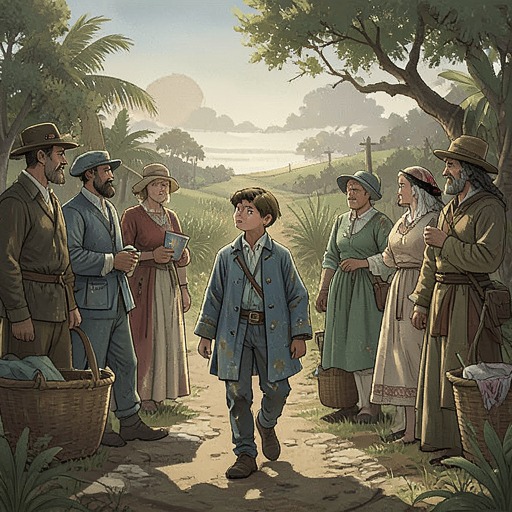
Jack Ruthven's foster-child status
Young Captain Jack · The Son of a SoldierJack Ruthven's foster-child status is the first stable identity available to him and the central condition through which the novel tests the meaning of family. Adopted by Colonel Martin Ruthven and his wife when he was only three or four, Jack is raised at the Ruthven plantation as their son and as Marion Ruthven's brother. His legal and emotional belonging is genuine, yet his unknown parentage leaves him vulnerable to the charge that he is merely an outsider who can someday be expelled. The status therefore begins as a form of protection, becomes a source of painful uncertainty, and finally survives the discovery of his biological father as an enduring family bond rather than a discarded past.
Adoption and Early Belonging
Jack grows up in a large mansion on one of the richest plantations in South Carolina, within a household already marked by loss. Mrs. Ruthven is a widow after Colonel Martin Ruthven's death at the Battle of Gettysburg, and the grief that follows makes her dependence on the children especially strong. Marion and Jack are described as almost inseparable, and her affection is not qualified by the absence of a blood connection. In the household's ordinary life, he is not treated as a guest or dependent but as a son and brother whose place has been made secure through years of shared life.
The legal basis of that place is explicit. Mrs. Ruthven tells Jack that her late husband and she adopted him, and she insists that he has been a son to her and should continue to be one. She does not reduce the relationship to charity or financial obligation: when Dr. Mackey later offers to repay the money spent on the boy if he proves his claim, she refuses compensation. Her refusal shows that Jack's position in the family rests on attachment and parental commitment, not on an account that can be settled with money.
The Crisis of Unknown Origins
The security of adoption is shaken when Darcy Gilbert reports that someone has called Jack a nobody who does not belong to the Ruthven family and will eventually have to leave. The insult strikes at the exact point where Jack's social identity is most exposed. He is self-reliant and not easily intimidated by men who try to browbeat him, but the accusation produces consternation because it converts an unspoken mystery into a threat to his home.
Marion explains the truth carefully: she and Jack are not real sister and brother in the biological sense, and Mrs. Ruthven is his foster mother. Yet she immediately preserves the emotional meaning of the relationship by declaring that he will always be a real brother to her. She also tells him that the Ruthvens adopted him when he was three or four and that he is now John Ruthven, her own brother. Jack cannot at first reconcile these facts. He understands that he is not biologically a Ruthven, but the language of being a nobody leaves him asking who he is rather than simply accepting adoption as an answer.
Mrs. Ruthven confirms both sides of the situation. She asks Jack to continue calling her mother and reminds him that he has been a son to her. At the same time, she admits that every effort to discover his past had failed; his mother called him Jack before she died, and that was all the family knew. A small jewel casket containing a gold ring and a delicate lace handkerchief preserves the remaining fragment of his early history. The ring resembles a wedding ring, but its worn marking cannot be read, even after two jewelers inspect it. The object gives Jack a possible link to his origins without yet resolving the mystery.
Adoption Under Rival Paternity Claims
Jack's foster-child status becomes politically and legally important when Dr. Mackey announces, “Jack, I am your father!” The declaration attempts to replace the uncertain story of the adopted boy with a biological claim, but it does not automatically cancel the Ruthven family's authority. Mrs. Ruthven answers that Dr. Mackey must establish his claim before she will give Jack up because she has adopted him legally and he has been as dear to her as if he were her own flesh and blood.
The confrontation reveals the difference between asserting fatherhood and proving it. Dr. Mackey speaks as though biological identity should command immediate obedience, while Mrs. Ruthven treats adoption as an existing legal and moral relationship that cannot be displaced by an unsupported announcement. Jack's foster status thus gives him protection against a powerful claimant and allows him to demand evidence rather than surrender his identity to the loudest paternal voice.
The claim is eventually shown to be false. Jack learns that he is not Dr. Mackey's son at all but the son of Colonel Stanton, a fact the colonel has proved beyond doubt. This reversal does not make the earlier adoption meaningless. The Ruthvens had raised Jack faithfully when his true parentage was unknown, and the revelation confirms the distinction between biological origin and the family that actually performed the work of care.
Preservation and Transformation of Family
After Colonel Stanton recovers and the war ends, he seeks legal action against Dr. Mackey and recovers the fortune due to himself and Jack. Father and son eventually possess a fortune worth one hundred and fifteen thousand dollars, but the resolution of inheritance is paired with a domestic decision that matters more to Jack than property. Colonel Stanton initially considers returning North, yet Mrs. Ruthven cannot bear to part with Jack, so everyone remains at the plantation.
A year later Colonel Stanton marries the widow, and Mrs. Ruthven becomes once more Jack's mother. The marriage changes the legal arrangement around Jack without erasing the years of adoption that preceded it. Jack welcomes the result because it gives him the continued maternal relationship he wants. His family is therefore assembled through several bonds at once: adoption, biological parenthood, marriage, sibling affection, and shared residence. None simply cancels the others.
Long-Term Significance
Jack's later career completes the movement from uncertain foster child to publicly recognized soldier. As the son of a soldier, he enters West Point Military Academy, graduates with high honors, and goes West as an officer at a well-known fort. His daring and honorable career eventually raises him to the rank of colonel, where he retains the bravery and loyalty associated with his youth.
The ending places his foster-child status inside, rather than outside, the story of his achievement. Adoption initially makes Jack fear that he has no rightful place, while his courage and service show that worth does not depend on inherited rank. When bloodline and fortune are finally restored through Colonel Stanton, the novel does not ask Jack to abandon the Ruthven household that formed him. His identity becomes cumulative: he is the child once adopted and protected by the Ruthvens, the son later reclaimed by Colonel Stanton, and the adult whose conduct gives substance to both forms of belonging.