Marion Rejects St. John's Proposal
Young Captain Jack · The Son of a SoldierMarion Rejects St. John's Proposal marks the point at which St. John Ruthven's courtship collapses under the weight of his contempt for Jack Ruthven. What begins as an attempted declaration of love becomes an argument over family, legitimacy, property, and moral worth; Marion Ruthven refuses not merely St. John's proposal but the social hierarchy and suspicion on which he bases it.
Setting and Immediate Occasion
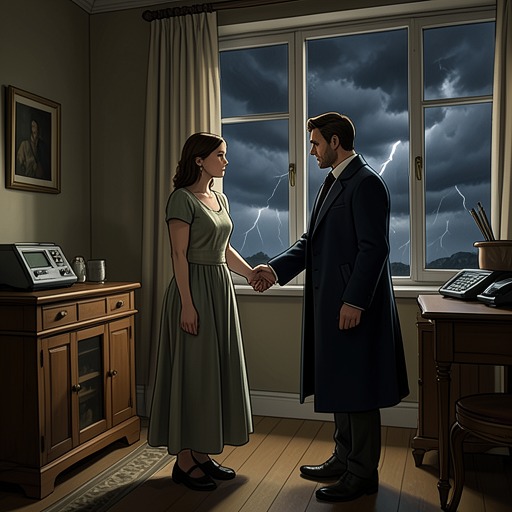
St. John approaches Marion in a summerhouse while she is arranging a bouquet of flowers. The setting gives the scene an outwardly peaceful appearance, but his thoughts are already shaped by resentment. He has considered visiting his aunt, Alice Ruthven, in order to make her think less favorably of Jack, and he treats Marion as the prize of a prosperous household rather than as an independent person whose judgment might defeat him. His confidence rests partly on his belief that he is the best catch in the neighborhood, so Marion's response exposes how poorly he has understood both her and Jack.
He begins by insisting that his feelings are not a sudden impulse. He claims to have loved Marion for years and says that he waited until she was old enough to hear him. Marion, however, does not share his expectation of an immediate marriage. She says that she is too young to fall in love and intends to wait until the war is over, if she ever marries at all. Her answer is not a coy postponement: it is a clear refusal to let St. John dictate the timing or meaning of her future.
The Proposal Turns into an Attack on Jack
When St. John realizes that Marion will not accept his declaration, he changes his appeal. He says that he wants her in order to protect her from Jack, presenting his hostility as concern. The supposed protection is immediately revealed as an attack: he calls Jack a mere nobody and insists that Jack is not Marion's brother. St. John's proposal therefore depends on separating Marion from the person she loves most as a brother and on making Jack's uncertain birth a reason for exclusion.
Marion rejects that premise without hesitation. She refuses to believe evil of Jack and declares that she thinks the world and all of him. Her defense joins affection to judgment: Jack is her brother in heart, even if he is not her brother by blood. This distinction matters because Jack has been adopted by Marion's parents, making him a legal member of the household even while his origins remain unknown. Marion recognizes that family is created through loyalty and care as well as through biology, whereas St. John attempts to reduce kinship to blood and property.
St. John presses the suspicion further by claiming that Jack knows Alice's wealth and will eventually try to take her property. Marion gives the accusation no credibility. Her confidence in Jack is grounded in his character, which she describes as true to the core and as brave as he is true. She even observes that Jack would go to the war if her mother gave her consent, contrasting his demonstrated courage with St. John's self-protective posture.
Marion's Refusal and St. John's Reaction
The refusal becomes final when Marion tells St. John that she will listen to nothing against dear Jack. She stamps her foot and hurries toward the house, turning away from both the proposal and the conversation's moral terms. The gesture gives physical form to her decision: she does not remain to negotiate over Jack's dignity, and she will not permit St. John to make affection conditional on accepting his slander.
St. John watches her leave and recognizes that she does not love him as he had assumed. He also understands that speaking ill of Jack has damaged his own suit. Instead of accepting Marion's judgment, he responds with resentment and wishes that Jack could be removed altogether. The scene thus converts a failed courtship into an active antagonism. His private reaction shows that his interest in Marion is entangled with jealousy, possession, and hostility toward a rival whom he regards as socially inferior.
Family, War, and the Rejection's Consequences
The conversation takes place against the household's grief and wartime uncertainty. Alice is a widow whose husband, Colonel Martin Ruthven, was killed at the Battle of Gettysburg; after his death, she depended heavily on Marion and Jack. Marion's attachment to Jack is consequently not a casual preference but part of the emotional structure that holds the family together. Her defense of him also anticipates the later revelation that Jack's adoption does not diminish his place in the household: Alice tells him that he has been a son to her and wishes him to continue as one, while Marion insists that he will always be as a real brother to her.
The war further clarifies the contrast between the two young men. Marion postpones marriage until the conflict is over, while St. John says that he will go to the front only when he is actually needed. His promise is less compelling than Marion's confidence in Jack's willingness to serve. The proposal scene therefore links romantic choice to judgments about courage, duty, and trustworthiness rather than treating marriage as a simple reward for rank or wealth.
The rejection also helps establish the emotional direction of the ending. Marion's bond with Jack remains intact through the later revelations surrounding the wreck on Hemlock Bluff, the disputed identity of Jack's father, and the recovery of the tin box taken from the Nautilus wreck. St. John's absence from the later double wedding confirms the lasting consequence of this rupture. When Alice marries Colonel Stanton and Marion marries Dr. Harry Powell, the household's future is reorganized around reciprocal loyalty and recognized family bonds, while St. John is excluded from the celebration he had once hoped to secure through social position.
Narrative Significance
Marion Rejects St. John's Proposal is a value reversal: St. John enters believing that love, status, and presumed superiority will give him control, but leaves exposed as a man whose contempt destroys the very relationship he seeks. Marion's refusal gives the novel a clear moral test. She chooses the adopted brother whose conduct has earned her trust over the suitor who offers protection while attacking Jack's name.
The scene also prepares the novel's broader challenge to narrow definitions of family and worth. Jack's unknown parentage, the wreck's surviving clues, and his eventual recognition as Colonel Stanton's son later alter his social and biological identity, but Marion's judgment precedes that confirmation. She values him before the evidence restores his birthright. In that sense, her rejection anticipates the book's eventual distinction between inherited rank and moral character: blood may settle a legal question, but loyalty has already settled the question of who belongs to the family.