Nautilus Wreck
Young Captain Jack · The Son of a SoldierThe Nautilus Wreck is the wreck of the Nautilus, lying on the rocks in the bay near Hemlock Bluff and less than half a mile from Ruthven Plantation. Its decisive importance is that it turns an apparently isolated shipwreck into the material center of the novel’s identity mystery: it explains how Jack Ruthven reached the coast, preserves the objects that can identify his family, awakens Colonel Stanton’s damaged memory, and ultimately yields the papers that reunite father and son and recover the Stanton fortune.
Definition and Setting
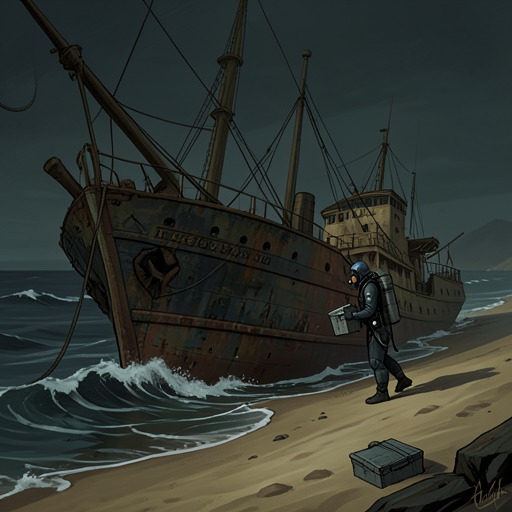
The wreck came ashore on the coast between ten and eleven years before Jack Ruthven’s later investigation. In the recollection given to him, Jack had been a passenger on the vessel and was only three or four years old when the disaster occurred. The wreck therefore belongs both to the landscape of Hemlock Bluff and to the concealed prehistory of Jack’s life. It remains physically present on the rocks in the bay, close enough to Ruthven Plantation for local residents to know it well rather than treat it as a distant maritime rumor.
The wreck’s survival is repeatedly emphasized. Colonel Stanton, after learning where the vessel went down, is told that it is still intact enough to be visited. Its continued presence makes the past inspectable: the catastrophe is not merely a story preserved by witnesses, but a location that can still be entered, searched, and made to yield evidence. Old Ben, who keeps the boathouse on the shore, knows the wreck and is able to row Dr. Mackey out to it, linking the site to the local shoreline network and to the practical knowledge of the people who live beside it.
The Shipwreck and Jack Ruthven’s Origins
The wreck is the scene of Jack’s earliest known history. Old Ben heard a cry of pain on the beach and found an injured woman, identified as Jack’s mother, with the child in her arms. The woman had been struck by wreckage. Jack, exposed to the storm and waves, cried for bread and butter; Old Ben carried him and his mother to the boathouse, then went to the plantation for help. Martin Ruthven and several men returned with him, bringing both survivors to the house, but Jack’s mother later died.
Jack retains only a fragmentary memory of the disaster: storm, terrible waves, and an atmosphere that remains “dreamy-like.” His recollection is therefore incomplete, while the wreck supplies the external setting against which that memory can be tested. The child’s name is known only because his mother called him Jack before her death. No marked clothing, pocket identification, or readable inscription survived to establish the family’s identity at the time.
The few surviving objects become more important precisely because the wreck yielded so little immediate explanation. Alice Ruthven preserved the unmarked clothing and a lace handkerchief belonging to Jack’s mother, along with a ring worn on one of her fingers. The ring had once carried a marking, but it was so worn that neither the Ruthvens nor two jewelers could decipher it. Mrs. Ruthven’s small jewel casket thus preserves the wreck’s unresolved question in portable form: the handkerchief and clothing establish continuity with the dead woman, while the worn wedding ring hints at a marriage and a family connection that the survivors cannot yet name.
Colonel Stanton’s Memory and the Hidden Closet
The wreck becomes newly intelligible when Colonel Stanton, wounded and feverish, begins to speak of a doomed ship and of a terrible battle. His muttering leads Alice Ruthven to suspect that his past may include a shipwreck. When he later recounts his history, he explains that he had taken an ocean voyage during which the ship went down with his wife and child. He was rescued only after more than twenty-four hours, then spent weeks on an uncertain voyage to a strange hospital, remained there for two months, and was transferred to an insane asylum. The exposure affected both his body and his mind, leaving his recollection dim and uncertain.
The colonel’s account supplies the human history behind the wreck, while the wreck supplies the setting needed to confirm it. When Alice identifies the Nautilus as the vessel destroyed near the plantation, Stanton recognizes the possibility that valuable papers left in a secret closet may still be on board. The site consequently shifts from a memorial of loss to a repository of legal and financial evidence. Stanton’s request to visit it is not curiosity alone: the papers may determine whether his family and fortune can be recovered from the catastrophe that appeared to have destroyed them.
The hidden closet is discovered inside the wreck. It is a tiny, dark compartment, about a foot square and equally deep, made even more inaccessible by dirt and water that entered through a crack above. Inside lies a heavy black-painted tin box. The box is locked with a small padlock, but a key from Jack’s bunch opens it. The scene gives the wreck a second concealed interior: beneath the visible decay of the vessel lies an object deliberately protected from ordinary view, and within that object lie the papers capable of changing the meaning of the entire shipwreck.
Search, Theft, and Recovery
The wreck’s evidentiary power also makes it a target. Dr. Mackey visits it after Old Ben rows him across, and Old Ben believes that the doctor brings away a tin box. This act connects the shipwreck to Dr. Mackey’s efforts to control the truth about Jack’s parentage. Mackey later claims to be Jack’s father, but the wreck’s materials point toward another explanation and give dangerous support to the competing claim that Jack is Colonel Stanton’s son.
The stolen box is eventually found in the outlaws’ camp after a battle in the mountains kills several of the guerrillas, including the men who had held Jack prisoner. The search also recovers goods stolen from a trader during the storm and other valuables, placing the box within a wider chain of wartime violence, robbery, and concealment. Its return to Colonel Stanton transforms recovery into proof: when he examines the contents, he recognizes his precious papers and tells Jack that nothing now stands between them and the family fortune.
Narrative Significance
The Nautilus Wreck functions as both setting and mechanism of recognition. At first it appears to explain only how an unknown child reached the Ruthven household; later it becomes the point where several incompatible versions of Jack’s identity converge. Jack is first described as someone who does not belong to the Ruthven family, then confirmed as their adopted son, falsely claimed by Dr. Mackey, and finally identified as Colonel Stanton’s child. The wreck does not settle that conflict through assertion alone. Its survivors, objects, location, and hidden documents progressively connect Jack to the Stantons.
Its recurring associated clues create a chain of delayed explanation. The wreck introduces Jack’s fragmented memory, the dead mother’s wedding ring, the unmarked handkerchief, Colonel Stanton’s feverish cries, the name Laura, the resemblance between Stanton and Jack, and the black tin box. Some clues initially produce uncertainty rather than certainty, but their later convergence gives the wreck a retrospective force: what seemed like an unverified childhood disaster becomes the physical origin of the family separation and the place where the missing inheritance is secured.
The wreck also embodies the novel’s treatment of trauma and memory. Jack remembers the storm only in blurred impressions, while Colonel Stanton’s bodily fever repeatedly returns him to the ship’s destruction. Both men require external witnesses and material traces to move from confused recollection toward a coherent past. The Nautilus Wreck therefore stands between memory and evidence: it is the place where private suffering, local testimony, family history, and legal property become one recoverable story.