North–South Reconciliation
Young Captain Jack · The Son of a SoldierNorth–South Reconciliation is the novel’s effort to imagine national unity after the American Civil War without treating sectional feeling as a superficial disagreement. The idea develops through encounters between Southern civilians and Union soldiers, through the contrast between honorable military conduct and predatory guerrilla violence, and through the final reshaping of a divided household into a shared family. Reconciliation becomes both a political ideal and a practical arrangement of property, kinship, and future allegiance.
Sectional Conflict Within the Ruthven Household
The concept first appears against the material and emotional background of the Ruthven Plantation, a large mansion on one of the richest plantations in South Carolina. The household is marked by loss: Mrs. Ruthven is a widow because Colonel Martin Ruthven died at the Battle of Gettysburg, and the shock left her ill for a long period. Her daughter Marion Ruthven and Jack Ruthven remain devoted to one another, but their domestic security exists within a region where military conflict is approaching the plantation and threatening to turn private property into a battlefield.
The novel also links sectional division to economic decline and social self-interest. St. John Ruthven is presumed to be wealthy, yet his inheritance has nearly vanished through his and his mother’s extravagance, while his plantation has deteriorated because he neglects it. His contemptuous remark that enslaved people are no longer worth their keep exposes a social order measuring human beings through immediate financial utility. His later refusal to serve, disguised as filial duty and expressed as preference for remaining at home rather than wearing a Union uniform, shows how political language can conceal personal cowardice and material anxiety. Against this posture, reconciliation requires more than ending combat: it requires separating loyalty to a region from moral worth.
Encounters Across the Lines
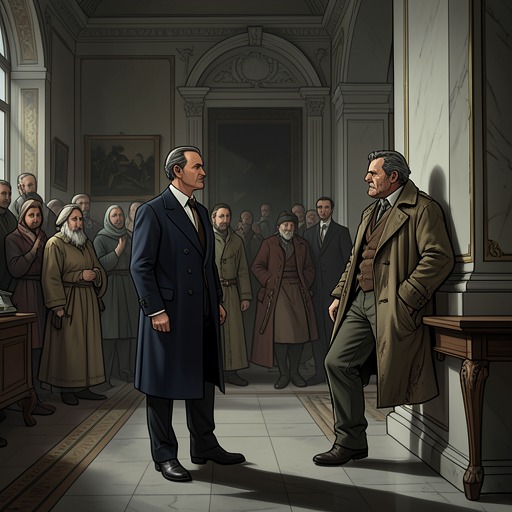
The clearest statement of reconciliation occurs when Harry Powell arrives in Union uniform and meets Mrs. Ruthven. Her sorrow at seeing a family member in the uniform of the opposing side gives the political conflict an intimate form. Colonel Stanton then tells her that he hopes she will not regard him as an enemy. When she points out that he is fighting against her country, he distinguishes between a section and the nation, explaining that he fights under a flag belonging alike to the South and the North. The exchange does not erase Mrs. Ruthven’s Southern allegiance, but it creates a language in which national identity can survive sectional opposition.
The conversation extends this distinction to the Union leadership. Mrs. Ruthven has been told that Abraham Lincoln is a cruel monster intent on destroying the South. Colonel Stanton counters that Lincoln has a warm and kind heart, sorrows over stricken homes and bloodshed, and will eventually be judged more justly. His defense does not present war as painless or simple; instead, it frames national unity as compatible with grief for Southern suffering. The dialogue gives both sides a voice, while Stanton’s position turns patriotism away from hatred of a neighboring section.
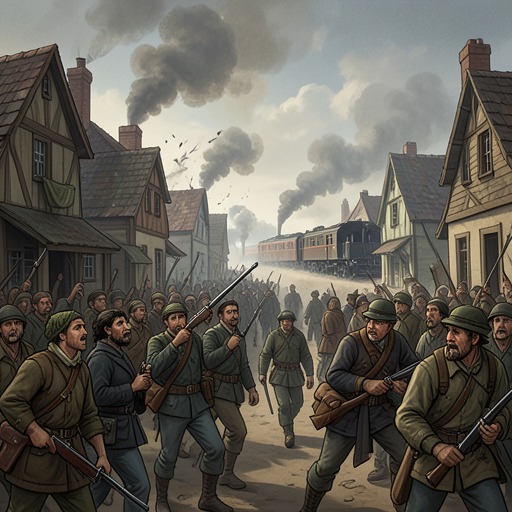
The same ethical division appears in the defense of the Ruthven home. When a company of guerrillas follows passing cavalry, the narrator describes them as men who fight chiefly to loot afterward. Jack Ruthven places his command across the lawn and declares that the property must be respected because it is private and the house has become a hospital for six wounded Confederates under a surgeon’s care. Later, Colonel Stanton gives the same principle formal military authority: an officer who is a gentleman respects private property, and the household has nothing to fear so long as it acts without treachery. The contrast suggests that reconciliation is possible where combatants recognize shared rules, but impossible where violence is reduced to plunder.
Violence, Captivity, and the Limits of Brotherhood
The novel’s reconciliation ideal is tested by acts that violate the distinction between legitimate military conflict and private coercion. Dr. Mackey, after Jack Ruthven calls him a fraud, responds not with proof but with force. He seizes Jack by both arms and orders Confederate soldiers to conduct him to camp and prevent his escape. The scene places personal fraud within the wider disorder of war: a disputed family claim becomes a reason for abduction when military power is used to suppress a challenge.
Jack and his companions then spend two days in the Guerrilla Cave, where their captors treat them brutally and provide barely enough food to keep them from starving. Pete Gendron is especially hostile, even declaring that he would kill Jack if doing so would allow the doctor to obtain the money. Such conduct is the negative image of North–South Reconciliation. It makes sectional conflict serve greed, turns prisoners into instruments, and replaces any shared national ethic with the logic of possession. The narrative therefore distinguishes between the uniformed officer who protects a hospital and private property and the guerrilla band that treats war as an opportunity for robbery.
Evidence, Inheritance, and Reunited Identity
The novel’s movement toward national and familial repair is also organized through objects that survive the wreckage of war. The unidentified woman who gave birth to Jack left no marked clothing or papers; her only possessions were an unmarked lace handkerchief and a ring whose worn inscription could not be read even by two jewelers. Later, Jack discovers a heavy black-painted tin box hidden beneath dirt and water in a small closet aboard the wreck. The box, secured by a padlock and opened with one of his keys, becomes a material form of buried history. These objects make identity and inheritance recoverable across the divisions created by death, displacement, and conflicting testimony.
The discovery ultimately allows Colonel Stanton to recognize that the papers connect him and Jack with their fortune. After the colonel slowly recovers, the Civil War has ended, and he resigns from the army. He then prosecutes Dr. Mackey and works to recover the money due to himself and Jack. Mackey receives a ten-year prison sentence, while the Stantons, father and son, obtain a fortune valued at one hundred and fifteen thousand dollars. Reconciliation here is not merely emotional forgiveness: it depends on restoring truth, legal responsibility, and property that fraud and wartime violence had threatened to consume.
The Postwar Household
The final settlement gives North–South Reconciliation its most concrete form. Colonel Stanton initially considers returning to the North, but Mrs. Ruthven does not want to be separated from Jack. The decision is made for everyone to remain at the plantation, and a year later Colonel Stanton marries the widow. Mrs. Ruthven, now Mrs. Stanton, becomes Jack’s mother once more. A Southern plantation thus becomes the home of a family joined across the former military boundary, while Jack’s status as an adopted child and Stanton’s recovered fatherhood are held together rather than treated as mutually exclusive.
This ending does not deny the war’s wounds: Colonel Martin Ruthven’s death, Mrs. Ruthven’s illness, the wounded soldiers in the mansion, Jack’s captivity, and Stanton’s slow recovery all remain part of the story’s history. Yet the close converts a landscape of opposing uniforms into a household in which North and South can coexist. The final family arrangement makes national reconciliation legible through ordinary continuance—remaining together, marrying, inheriting, and caring for a child—after the armies have disappeared.
Narrative Significance
North–South Reconciliation functions as a moral standard against which the novel measures its characters. Colonel Stanton embodies a version of patriotism that opposes rebellion without reducing Southerners to enemies; Jack protects wounded Confederates and private property even while resisting those who threaten his home; Harry Powell’s presence in Union uniform turns sectional conflict into a family test. By contrast, St. John Ruthven’s evasions, Dr. Mackey’s coercion, and the guerrillas’ brutality show how cowardice, fraud, and greed deepen division.
The concept also joins political unity to the novel’s larger concern with belonging. Jack’s uncertain parentage, adoption by the Ruthven family, disputed claim by Dr. Mackey, and eventual recognition by Colonel Stanton repeat the national problem on a domestic scale: identity must be established through evidence, conduct, and chosen bonds rather than through hostile assertion alone. The ending’s reconciled household therefore presents national unity not as an abstract slogan, but as a recovered relationship made credible by justice, protection, and continued mutual obligation.