Oldville
Young Captain Jack · The Son of a SoldierOldville is a sleepy town in South Carolina whose modest public spaces become a revealing stage for the American Civil War. Defined by two general stores, a tavern, and a blacksmith shop, it is more than a background settlement: it is where private fears become public talk, boys imitate military order, merchants report the rhetoric of war, and Confederate demands for service turn loyalty into a direct personal pressure.
Setting and Local Character
Oldville is the name given to the district around the Ruthven plantation as well as to the town at its center. Its scale is deliberately ordinary. The town contains only two general stores, a tavern, and a blacksmith shop, and its quietness is emphasized by the description of it as sleepy. Yet this apparent stillness does not mean isolation. The town is close enough to the Ruthven home for the fortunes of the armies to be heard and felt there, and its commercial and social institutions make it the natural place where residents gather when the surrounding countryside becomes dangerous.
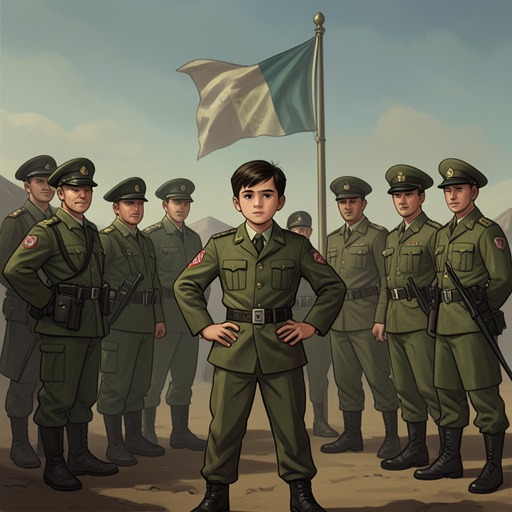
The town green in front of the tavern serves as Oldville's most visible communal space. When Jack Ruthven and Marion Ruthven go there, boys are playing games, but the arrival of Jack transforms the scene into a military display: the boys greet him as “Captain Jack,” and Darcy Gilbert, the first lieutenant of the Oldville Home Guard, summons the company. The organization has improvised uniforms made from ordinary home clothing, marked by white stripes sewn along trouser legs and coat sleeves. Boys carrying pistols stand in the front rank, those with guns in the second, while one boy has a drum and another a fife. Under Jack's drawn sword, the group forms straight rows and drills through commands such as “Carry—arms!”, “Present—arms!”, “Shoulder—arms!”, and “Forward—march!” The spectacle draws old men, women, and children, turning a children's military imitation into a public expression of threatened civic identity.
War Reaches the Town
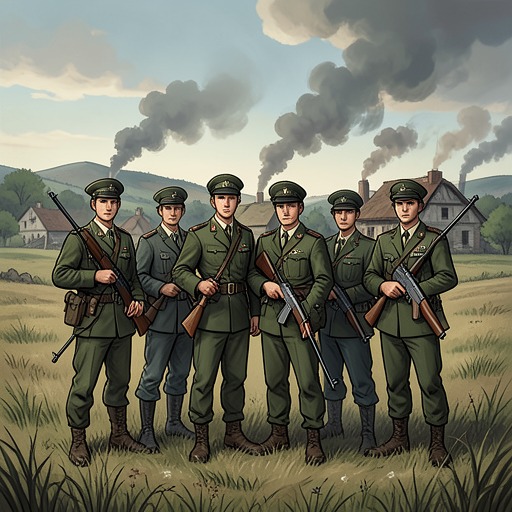
Oldville's wartime atmosphere is shaped by the retreat of the Confederate States Army. The Union Army has driven the Confederate army steadily backward until Confederate camps are less than four miles from Jack's home. Cannon fire can be heard distinctly for two days, and the women of the district fear that Northern invaders will descend upon their homes and pillage them. Marion Ruthven repeatedly asks Jack whether the enemy will come. His reassurance that the danger is not immediate cannot remove the larger uncertainty: the town's ordinary geography has become a military front, and the distance between home and battlefield is measured in only a few miles.
The town's stores register the war in material as well as emotional terms. When Marion goes shopping at Lemuel Blackwood's general store, she enters a business that was once crowded with goods of every description but whose trade has nearly been wrecked by the conflict. Its remaining stock is scanty and shop-worn. Blackwood has known Marion since childhood, so the store functions simultaneously as a commercial place and a local information exchange. His account of a surgeon named Dr. Mackey is especially important: the surgeon has been loudly predicting that a Southern defeat would bring Northern troops through to New Orleans to loot and burn every village, town, and city, leaving neither life nor property safe. The report shows how military rumor travels through Oldville's civilian network and how political alarm is converted into household fear.
Public Authority and Private Fear
The town green gives Oldville a form of local authority before the national armies fully control the area. The Oldville Home Guard is not presented as a regular army formation; its uniforms, weapons, drum, and fife are assembled from local resources, and its members are boys. Nevertheless, the drill gives shape to the community's desire to defend itself. Jack's role as captain places him between youthful play and genuine responsibility, while Darcy Gilbert's rank as first lieutenant supplies the group with a recognizable chain of command. Their readiness to give “a good account” of themselves expresses courage, but the scene also exposes the improvisational character of wartime power in a threatened district.
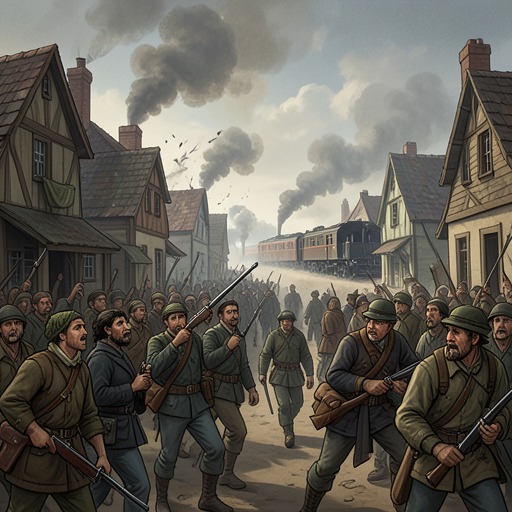
Oldville's tavern later becomes a more serious gathering place. When Mrs. Ruthven and Jack arrive there during another storm of battle, the town is in high excitement: the stores are closed, the tavern alone remains open, and men who have recently joined the Confederate ranks are gathered inside. The contrast with the earlier green is significant. The green displays youthful discipline before spectators; the tavern concentrates adult political and military pressure. In one space, war is rehearsed; in the other, it is acted upon through enlistment, rumor, and urgent decisions.
Recruitment and the Breakdown of Normal Life
The pressure to enlist reaches Oldville through a written appeal calling on local men to take up arms. The communication declares that the Southern country is suffering invasion, that every loyal Southerner is needed at the front, and that the muster roll can be signed at Wingate's Hotel at any time during the day or night. Oldville therefore becomes not merely a place where war is discussed but an administrative point at which allegiance is recorded and transformed into military service.
This appeal exposes the difference between public ideals and individual willingness. St. John Ruthven reacts with visible alarm, recognizing that he has been called upon to join and wondering what excuse can be offered for having held back. The language of loyalty leaves little room for hesitation: service is represented as a duty owed to a suffering country, while delay appears as moral failure. Through Oldville and Wingate's Hotel, the novel shows how a national conflict enters the intimate sphere, forcing individuals to explain their courage, their cowardice, and their place within the community.
Narrative Significance
Oldville links the domestic world of the Ruthven plantation to the larger movements of the war. The nearby armies, the closed stores, the improvised guard, the tavern gathering, and the recruitment notice create a chain in which military events steadily reorganize civilian space. The town is neither a distant battlefield nor a protected home. It is an intermediate zone where authority is improvised, information is uncertain, and ordinary institutions are made to carry wartime burdens.
Its importance also lies in its contrasts. The blacksmith shop, general stores, and games on the green suggest a settled local life, while cannon fire, depleted merchandise, armed boys, and enlistment demands reveal how quickly that life can be militarized. Oldville makes the conflict visible not through a single battle alone but through changes in movement, commerce, conversation, and public ceremony. As a result, the town becomes a compact map of the novel's broader wartime world: a community attempting to preserve order while the political and military order around it is collapsing.