Private-property protection
Young Captain Jack · The Son of a SoldierPrivate-property protection is the novel’s wartime principle that civilian homes, goods, animals, and medical spaces should not be treated as lawful spoils merely because armies are moving through the countryside. Its decisive significance lies in the contrast it creates between disciplined authority and opportunistic violence: Jack Ruthven invokes the rule to defend the Ruthven homestead, its six wounded Confederate soldiers, and neighboring property, while guerrillas repeatedly expose what happens when military language becomes a cover for looting.
Definition and Wartime Setting
The principle emerges during a week of mounting danger in Oldville, the district surrounding the Ruthven plantation. The army of the North has steadily driven the army of the South backward until Confederate forces are encamped less than four miles from Jack Ruthven’s home; cannon fire can be heard for two days, and local women fear that Northern invaders will pillage their homes. War also damages civilian economic life before soldiers reach it: Lemuel Blackwood’s general store, once crowded with goods, has a scanty and shop-worn stock because the conflict has nearly destroyed his trade.
The rule therefore belongs to a social world in which military retreat, shortages, rumor, and civilian anxiety overlap. At Blackwood’s store, Dr. Mackey’s alarmist account claims that a Northern defeat would bring looting and burning through every village, town, and city. The story presents such predictions as inflammatory talk rather than settled fact, but they show how fear can make the protection of property seem inseparable from the protection of life. Against this atmosphere, the novel asks whether armed men will distinguish between an enemy army and the civilians whose homes lie in its path.
The Home Guard and the Ruthven Hospital
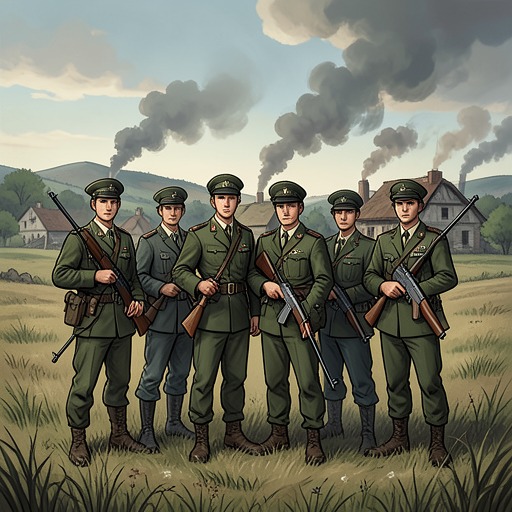
Jack turns the principle into organized local action. Inside half an hour, nineteen boys of his company assemble, each carrying a loaded gun or pistol, and form an imposing line before the homestead. Their purpose is not conquest or participation in a general battle; they have gathered to protect their homes. Old Ben quietly displays a long, old-fashioned horse pistol and promises to act if anyone tries to shoot Jack, linking the defense of property with personal loyalty and the protection of the household.
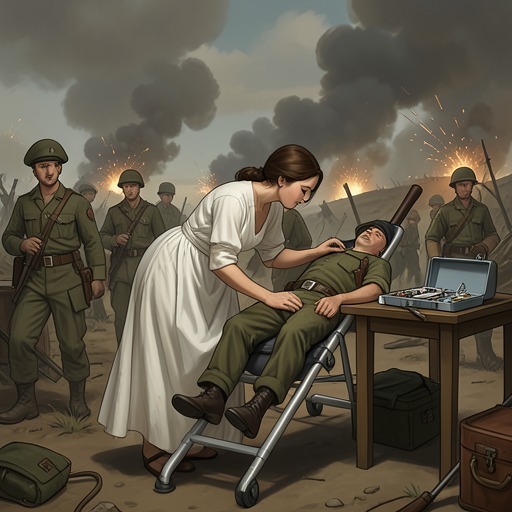
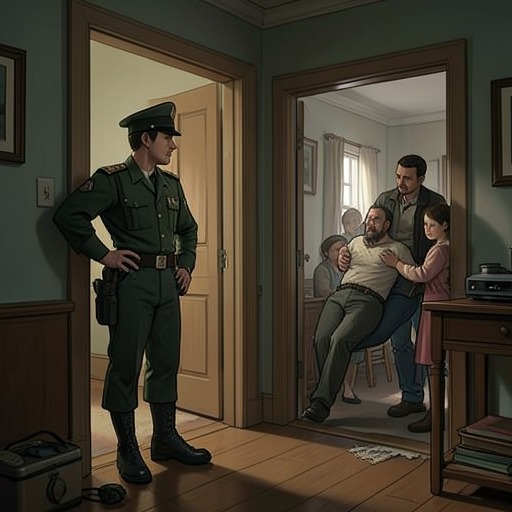
The immediate stakes are heightened by the conversion of the Ruthven mansion into a hospital. Confederate stretcher-bearers bring in three badly wounded soldiers because they can carry them no farther, and Mrs. Alice Ruthven orders them taken inside. More wounded men follow until six Confederate soldiers lie on cots in the sitting room, where a young surgeon begins treating them and Mrs. Alice Ruthven and Marion Ruthven assist. Jack’s claim that the house is private property is therefore not merely a claim about ownership. It is also a demand that the house’s medical function be respected and that wounded men not be exposed to further violence because the battle has reached the plantation.
When Sandy Barnes leads a band of guerrillas toward the house, Jack places the Home Guard across the lawn. The guerrillas are described as followers of every army who fight for the sake of looting afterward, a characterization that separates them from forces acting under recognizable military discipline. Jack tells them, “This is private property and must be respected,” and adds that the house is a hospital containing six wounded Confederates in the charge of a surgeon. The guerrillas’ response is not a legal argument but a challenge from the rear ranks that the house looks worth visiting. Their language reveals the principle’s vulnerability: property is protected only if someone is prepared to make the claim physically credible.
Military Authority and the Limits of the Rule
The appearance of a Federal colonel gives the principle a second, more formal foundation. Jack identifies himself as captain of the boys who call themselves the Home Guard and explains that they wish only to protect their homes. The colonel approves the purpose, saying that Jack could not do better than protect homes, mothers, and sisters. When Jack anxiously repeats that the Ruthven place is private property and contains six wounded men under a surgeon’s care, the colonel answers that an officer who is a gentleman respects private property and that, provided nothing treacherous is done, Jack and the household have nothing to fear from his men.
This exchange defines protection as both military discipline and a code of gentlemanly conduct. The colonel’s authority does not erase the fact that he is armed against Alice Ruthven’s country. Alice asks whether the household should consider itself prisoners of war, and the colonel rejects that status, specifically allowing the house to remain a hospital. His response establishes a distinction between military occupation and punitive seizure: troops may be encamped nearby and may be fighting the Confederate army, yet the civilian home and its medical use are not automatically confiscated.
The meeting also gives the rule a national and ethical dimension. Alice says that courtesy requires her to welcome the colonel while insisting that she is a Southern woman, and she asks whether he is not in arms against her country. The colonel replies that he hopes she will not regard him as an enemy. The scene does not dissolve the political conflict, but it shows private-property protection creating a narrow space in which opposing sides can recognize obligations toward civilians. Jack’s admiration for the colonel’s conduct, especially in contrast with the armed man who had threatened him earlier, rests on this difference between power restrained by principle and power used for intimidation.
Retreat, Restraint, and Predatory Violence
The principle is tested again when battle reaches Oldville. The town is in uproar, its stores closed and its tavern filled with men who have recently joined the Confederate ranks. Federal troops enter after hard fighting, filling the road and the green, and a systematic retreat northward begins amid continuous musketry and cannon fire. Jack longs to participate, yet recognizes that the Home Guard has no useful military role at that moment: if the boys opened fire, Federal troops would annihilate them. Their restraint is part of the rule’s logic. Defending civilian property does not mean entering a battle merely to display courage.
Although the fighting damages the church, nobody molests the stores or town buildings. This detail is important because it supplies a concrete instance of property protection during a chaotic retreat. The town remains exposed to cannon fire and military movement, but the soldiers do not turn the confusion into a general license for theft. Jack consequently distinguishes between fighting the enemy and guarding places that should not become targets. When the battle shifts toward the Ruthven plantations, he proposes going to St. John Ruthven’s place to see that no damage is done there, even though St. John Ruthven has refused to join either the army or the Home Guard.
At the plantation’s stable, however, the rule confronts deliberate criminality. Old Ben and two Home Guard boys are fighting three guerrillas who are trying to steal several horses. Old Ben protests that the animals are private property, while the guerrilla leader dismisses him and insists that the horses will be taken. The scene strips away any romantic idea that uniforms or claimed allegiance guarantee legitimacy. The thieves may pretend to represent one side or another, but their conduct makes them indistinguishable as predators. Jack’s principle is consequently not limited to protecting his own household: it rejects the claim that a thief becomes lawful by calling himself Confederate or Yankee.
Coercion, Captivity, and Significance
The novel’s sharpest contradiction of private-property protection comes through Dr. Mackey. After Jack calls him a fraud, Mackey threatens to make him suffer, seizes him by both arms, and orders Confederate soldiers to conduct him to camp and prevent his escape. This is not a battlefield seizure of goods, but it belongs to the same moral conflict. The language of military authority is being used to transform a personal grievance into coercive custody, showing how quickly protection and law can be hollowed out when an armed claimant treats another person as something to possess.
The consequences become still more severe when Jack and his companions spend two days in a guerrilla cave. They are treated brutally and given barely enough food to avoid starvation, while Pete Gendron is particularly bitter toward Jack and repeatedly insults him. Gendron even says that, if he were Dr. Mackey, he would blow Jack’s head off to obtain the money. The episode extends the property theme from houses and horses to the struggle over people, information, and money: the same predatory logic that seizes animals and threatens homes also reduces a captive human being to an obstacle between criminals and financial gain.
Private-property protection thus functions as more than a background rule of wartime conduct. It supplies Jack with a language of legitimate resistance, gives the Home Guard a boundary between courage and reckless combat, and allows the novel to compare the conduct of a Federal officer, Confederate defenders, civilians, and guerrillas. Its strongest expression is not that property outranks human life, but that the treatment of property reveals whether armed power recognizes civilian limits. The Ruthven hospital, Blackwood’s damaged store, the untouched town buildings, and the contested horses all make the same point in different forms: war may rearrange authority, but it does not automatically cancel every obligation to those who live amid it.