The Battle at Larson's Corners
Young Captain Jack · The Son of a SoldierThe Battle at Larson's Corners is the second major battle to reach the neighborhood around Oldville, transforming a distant military contest into an immediate crisis for soldiers, civilians, stores, homesteads, and the Ruthven plantations. Its decisive significance lies in the way it tests local responsibility: Jack Ruthven cannot simply watch the armies pass, yet he must distinguish useful protection from suicidal intervention. The battle therefore becomes both a military episode and a measure of competing wartime codes, from organized service and emergency defense to retreat, private-property protection, and the predatory disorder associated with guerrillas.
Causes and Background
Another battle begins while Mrs. Ruthven and Jack Ruthven are in Oldville conducting necessary trading. The town is already tense: the stores are closed, the tavern alone remains open, and men who have recently joined the Confederate ranks gather there before hurrying away to fight. They announce that the armies are engaged near Larson's Corners and that the Confederate purpose is to drive the Federal troops from the neighborhood. The fighting is first heard as distant gunfire, but the sound gradually approaches, turning the town from a place of commerce into a threatened military passage.
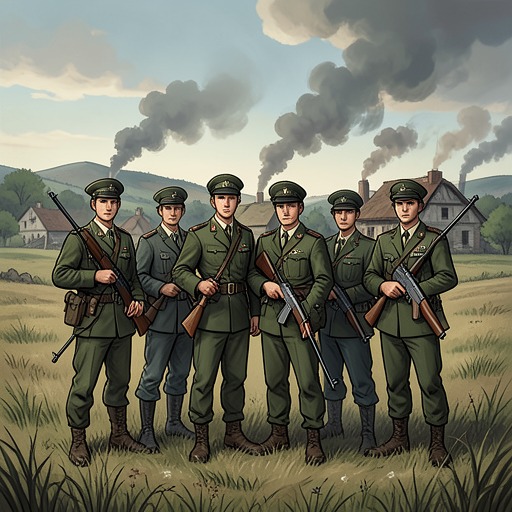
Jack Ruthven's first response is organized rather than impulsive. When Darcy Gilbert runs toward him and confirms that a fight is under way, Jack proposes calling out the Home Guard again. Darcy agrees that both the stores and the homesteads require protection, and the two divide the work of summoning the boys: Darcy takes the shore road, while Jack takes the Batsford road and asks that Doc Nivers call up those on the mountain road. The arrangement shows how the battle depends on civilian networks as well as formal armies. In less than an hour the Home Guard is assembled on the town green, with Jack in command, because the approaching firing has awakened the entire community to danger.
The episode also recalls the earlier military threat at the Ruthven homestead. A company of predatory guerrillas had followed cavalry through the area, openly treating war as an opportunity for looting. Jack had opposed them by insisting that the property was private and that the house had become a hospital for six wounded Confederates under a surgeon's care. A Confederate colonel, by contrast, had promised that an officer who was a gentleman would respect private property so long as no treachery occurred. This contrast supplies the ethical background for Larson's Corners: the battle is not only a contest between armies, but also a struggle over whether military force will preserve or destroy civilian protections.
Course of the Battle
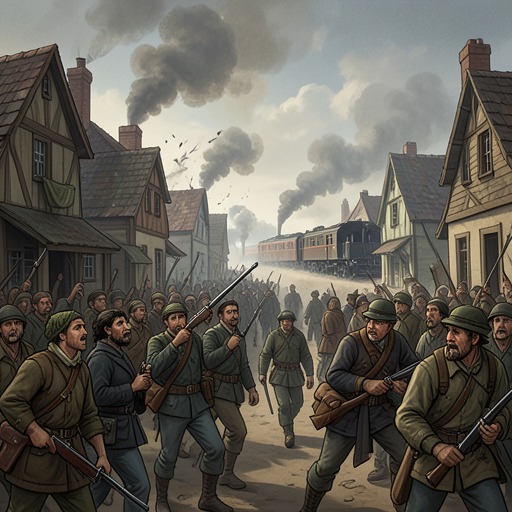
Jack tells the Home Guard that there may be hot work ahead and expects every member to do his best. The boys answer that there is no coward among them. Their confidence is immediately tested. A cry that the Federal troops are retreating is cut short by cannon fire from the mountain above Oldville, and Federal soldiers then sweep into view. The road and town green fill with exhausted troops who have been fighting hard, while further arrivals crowd the streets before beginning a systematic retreat northward.
The violence is continuous rather than confined to one visible clash. Musketry rattles without pause, cannon answers at intervals, and additional Federal troops appear as those who arrived first move toward the mountain road. Jack longs to participate, but he recognizes that the Home Guard has no useful military role at that moment. If the boys opened fire, the Federal troops would annihilate them. This decision changes the value at stake from martial glory to responsible protection: restraint, not attack, is what keeps the local defenders from becoming needless casualties.
The town nevertheless suffers the marks of battle. The stores and town buildings are not molested, but the church is struck by several cannonballs. As the combat shifts toward the mountain side and then toward the Ruthven plantations, Jack refuses to treat the danger to another property as someone else's problem. He proposes going to St. John Ruthven's place to prevent damage, even though Darcy Gilbert objects that St. John Ruthven should have protected it himself because he would join neither the army nor the Home Guard. Jack goes anyway and asks eight or ten companions to accompany him, leaving the others around town.
The movement of the battle remains difficult to read. At one point Jack and Larry cannot tell who is winning; the apparent Federal retreat may only be a temporary phase. Near the Ruthven home, a Federal battery suddenly appears, its horses covered with foam, followed by a regiment of infantry. Jack recognizes Colonel Stanton's regiment, but Larry sees that it is retreating while Confederate soldiers pursue it down the hill. The shifting formations make the battlefield a landscape of reversals, where the meaning of advance and retreat changes from moment to moment.
Colonel Stanton's Wounding
The battle's sharpest personal turn occurs when the soldiers surge forward and smoke briefly hides the Federals. As the troops reappear, Jack sees a danger more immediate than the fate of either army: Colonel Stanton is shot. The colonel falls over the neck of his horse while soldiers run toward him, leaving Jack to fear that the wound may be fatal. The military event thereby becomes entangled with the family mystery at the center of the story, because Colonel Stanton's identity has already begun to converge with Jack's unknown parentage.
Later, Colonel Stanton's fever provides a second form of access to the battle's consequences. While ill, he cries out about a shipwreck and asks that his wife Laura and his son Jack be saved. The words reinforce the resemblance others have noticed between the colonel and Jack and reactivate the unresolved evidence surrounding the wreck on Hemlock Bluff. Earlier, Marion Ruthven had explained that Jack had been a passenger on the vessel when it came ashore more than ten years before; the rescued woman had called her child Jack, but neither clothing nor a lace handkerchief identified the family. A ring had been preserved, yet its worn marking could not be read even by two jewelers. Colonel Stanton's fevered appeal does not by itself settle the question, but it converts the battle wound into a revelation-bearing moment: violence forces concealed personal history toward the surface.
Consequences and Aftermath
The battle demonstrates the unequal positions of regular troops, local defenders, and irregular fighters. The Home Guard can summon men quickly and protect stores and homes, but it cannot challenge a moving Federal force in open combat. The regular soldiers possess the weapons and numbers that make resistance meaningful, while civilians must choose when to stand aside, when to guard property, and when to move toward a threatened plantation. The episode's most responsible act is therefore Jack's refusal to mistake courage for reckless firing.
The wider wartime disorder continues after the battle. Jack is later seized by Dr. Mackey, who angrily orders Confederate soldiers to conduct him to camp and prevent his escape; he and his companions then spend two days in the Guerrilla Cave, where the outlaws treat them brutally and provide barely enough food to prevent starvation. These events extend the battle's moral instability beyond the formal engagement. Military movement creates opportunities for kidnapping, confinement, and exploitation, while the guerrillas' violence differs fundamentally from Jack's local defense and Colonel Stanton's respect for private property.
The final recovery of property links the battle to the book's long-running mystery of the Nautilus. After Jack returns home, another battle in the mountains kills a number of the outlaws who had held him prisoner, including Pete Gendron, who dies without disclosing what he knew of Dr. Mackey's past. A thorough search of the outlaws' camp uncovers stolen goods and the black tin box taken from the wreck of the Nautilus. The box and its contents are eventually delivered to Colonel Stanton. When he examines the papers, he tells Jack that nothing now stands between them and their fortune. Thus the military turmoil that endangered the community also helps restore the documentary evidence and inheritance concealed by the shipwreck.
Narrative Significance
The Battle at Larson's Corners is structured as an expanding sequence of alarms: news of fighting in the distance, the mobilization of the Home Guard, the sudden arrival of retreating troops, the shift toward the plantations, the appearance of Colonel Stanton's regiment, and the colonel's fall. Each movement narrows the distance between public war and private identity. The battle begins as a report heard in Oldville and ends as a wound, a family clue, and a material recovery whose consequences reach beyond the field.
Its central value shift is from anticipated heroism to disciplined responsibility. Jack Ruthven wants to take part, but the sight of overwhelming Federal force teaches him that defending the community may require not firing. At the same time, he acts when St. John Ruthven's plantation is threatened, distinguishing prudence from indifference. The contrast with the looting guerrillas is essential: private property and a hospital can be protected even amid battle, but only when individuals and officers accept limits on violence.
The event also advances the novel's pattern of delayed recognition. The wreck, the unidentified clothing, the preserved ring, and the name Laura have carried the identity mystery through earlier scenes; Colonel Stanton's wound and fever make those scattered signs suddenly converge. The battle therefore functions on two levels at once. It records the Confederate retreat and Federal advance through Oldville, while exposing the fragile boundary between military history and family history. In its aftermath, the black tin box and its papers move to Colonel Stanton, bringing the war's public upheaval into direct contact with Jack's private inheritance and the approaching resolution of his identity.