The Encounter on the Bridge
Young Captain Jack · The Son of a SoldierThe Encounter on the Bridge is the first decisive meeting between Jack Ruthven and Dr. Mackey. A seemingly minor dispute over a public crossing becomes a compact test of dignity and power: a fourteen-year-old boy, interrupted while fishing, refuses to yield to an armed adult who treats military rank as a license to command. The surgeon rides away threateningly, but the encounter leaves behind a practical warning as well as a moral one: the war has moved dangerously near Jack Ruthven’s home, and the stranger who demanded directions is connected with the dangers soon to threaten him.
Setting and Immediate Circumstances
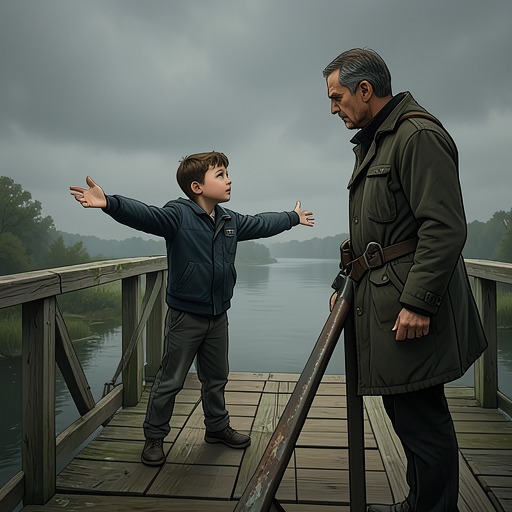
The scene takes place on a narrow bridge over a mountain stream flowing toward the ocean. Jack Ruthven is seated at its side with a basket half-filled with fish, trying to haul in an unusually large catch. The bridge is a public passage, but its narrowness makes the meeting physically coercive: the rider can block the way, while the boy must decide whether to retreat, argue, or stand his ground. When the fish escapes because of the interruption, Jack Ruthven’s irritation gives the encounter an ordinary, almost domestic beginning before the military atmosphere turns it into a confrontation.
Dr. Mackey arrives astride a coal-black horse and dressed in the uniform of a surgeon in the Confederate Army. His appearance combines official authority with menace; he is described as dark and crafty, and he shakes his hand threateningly while ordering the boy to move. He is not merely passing through. He says he is on an important mission and asks for the road to Tanner’s Mill, where the surrounding circumstances suggest that fighting may be expected. The bridge therefore becomes a meeting point between Jack Ruthven’s youthful routine and the advancing reach of the war.
The Confrontation
Dr. Mackey initially treats Jack Ruthven’s fishing as an obstacle beneath his notice. He orders the boy out of the way and dismisses the lost fish, while Jack Ruthven answers that he has as much right to the bridge as the surgeon does because it is public. The exchange establishes the central issue more clearly than the request for directions: Dr. Mackey claims superiority through rank and force, whereas Jack Ruthven insists on an equal civic right to occupy the space.
When Dr. Mackey asks again for the way to Tanner’s Mill, Jack Ruthven first refuses to answer and gathers up his fishing rod and basket. The surgeon calls him a rascal and threatens that refusal will make matters worse. He then dismounts and advances with clenched fists, apparently expecting the slender boy to retreat. Jack Ruthven does not retreat. He warns Dr. Mackey, "Don't you dare to touch me, sir. I am not your slave." The statement is both an immediate defense against physical violence and a declaration of personal status: the boy will not accept forced obedience merely because an adult possesses a uniform and a weapon-bearing military position.
The scene’s physical arrangement intensifies its meaning. Dr. Mackey moves from horseback to the ground, closing the distance between himself and Jack Ruthven, while the boy remains responsible for choosing whether the bridge will become a site of submission or resistance. Jack Ruthven’s courage is not presented as reckless aggression. He does not attack the surgeon; he refuses intimidation, waits until he chooses to answer, and preserves his right to determine what he will do. The narrative explicitly characterizes him as manly, self-reliant, and not easily browbeaten.
Departure and Immediate Consequences
After continued pressure, Jack Ruthven finally gives a deliberately brief direction: "Keep to the right and you'll be right." The answer allows Dr. Mackey to proceed without granting him the full authority he demanded. The surgeon scowls, mounts again, and mutters that he would love to warm the boy if he had time before spurring the horse away. His departure ends the immediate danger, but his threat makes clear that the conflict has not been resolved by distance.
Left alone, Jack Ruthven recognizes that the rider is going to Tanner’s Mill and considers what a battle there would mean for home. His thought turns at once from personal anger to concern for his mother, Mrs. Ruthven, who is already weak and pale after the sudden departure of Colonel Ruthven. The encounter thus changes the value of the bridge scene from a quarrel over a fish to a warning about the vulnerability of the household. Military movement is no longer remote news; it is approaching through the very route Dr. Mackey has just taken.
The family circumstances sharpen Jack Ruthven’s decision not to withdraw. He has spoken of enlisting as a drummer boy, attracted by the glory of soldiering without yet reckoning fully with its hardships. Mrs. Ruthven refuses to let him go, saying that one member of the family already gone is enough, while Marion Ruthven clings to him as well. His resistance on the bridge therefore anticipates the courage he imagines in military life, but it also remains tied to family responsibility: he does not leave after the encounter to seek battle, and his first concern is whether fighting will reach home.
Dr. Mackey’s Later Significance
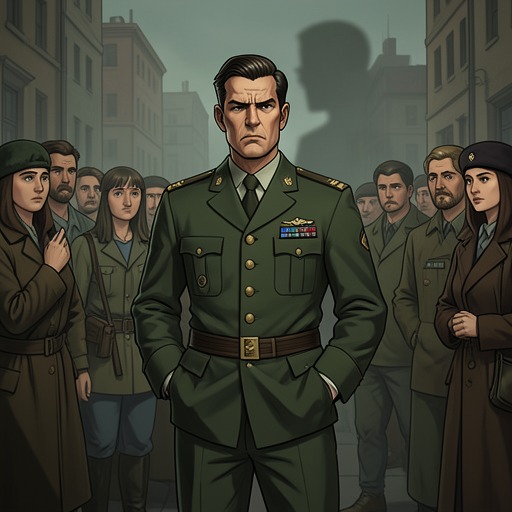
The bridge meeting gains retrospective force because Dr. Mackey is not an incidental traveler. Later evidence associates him with a charred wreck, a search through its ruined cabin, and the attempt to obtain property connected with Colonel Stanton and Laura Stanton. Colonel Stanton recounts that a physician exploited his damaged memory, extracted details about property in England and an estate in Virginia, drugged him, and then arranged for him to be recorded as incurable in an insane asylum. Dr. Mackey is consequently revealed as a figure who converts medical authority into a means of exploitation and control.
That later history casts his treatment of Jack Ruthven in a darker light. On the bridge he already attempts to make rank, threat, and physical force override another person’s rights. The boy’s refusal to submit becomes an early moral contrast with the surgeon’s conduct: Jack Ruthven protects his dignity openly, whereas Dr. Mackey uses institutions, medical knowledge, and concealed schemes to dominate vulnerable people. The bridge confrontation is therefore an early expression of the novel’s wider opposition between moral worth and social or official power.
Narrative Function and Significance
As the opening action, The Encounter on the Bridge establishes Jack Ruthven before the larger mysteries surrounding his childhood, adoption, the wedding ring, and the wreck are disclosed. He appears first not through family explanation but through action: fishing, losing his catch, answering an adult, and refusing to be bullied. The scene gives the reader a concrete basis for understanding his later conduct when he faces captivity and other forms of coercion.
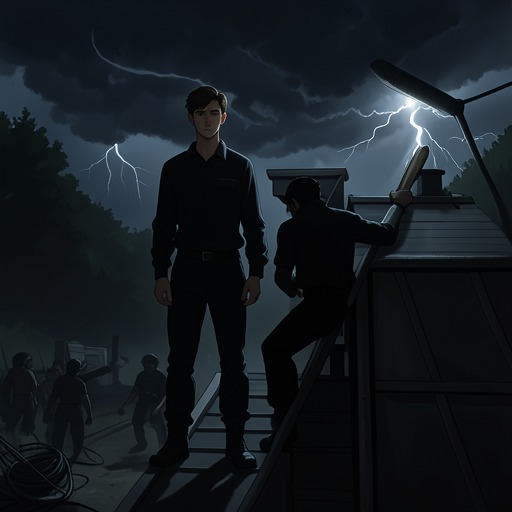
The bridge also functions as a threshold between peaceful childhood and wartime danger. Jack Ruthven is still engaged in an everyday pursuit, yet the uniformed rider brings the military world across the crossing and into his immediate surroundings. The encounter’s movement is from irritation to threatened violence, then from temporary release to foreboding. Dr. Mackey leaves the bridge, but the values tested there—freedom, dignity, and the right to resist unlawful command—remain active throughout the story.