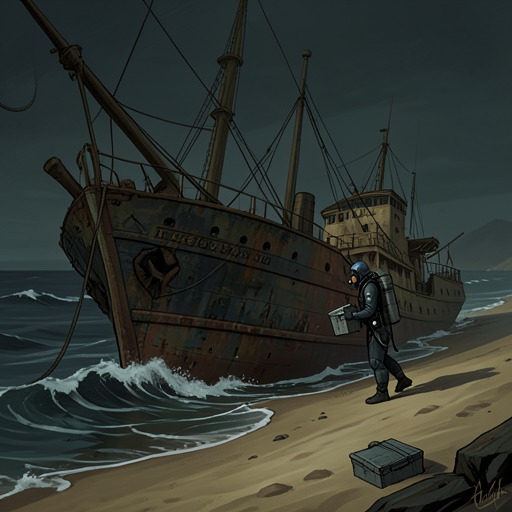
The Exploration of the Wreck
Young Captain Jack · The Son of a SoldierThe Exploration of the Wreck is the expedition by Jack Ruthven and Marion Ruthven to the wreck on Hemlock Bluff, the ruined vessel that carried Jack as a child and became the first tangible scene of his uncertain identity. The visit transforms a half-remembered catastrophe into an investigation. It links Jack’s fragmentary memory, his mother’s ring and lace handkerchief, the later discovery of a heavy black-painted tin box, Colonel Stanton’s feverish recollections, and the final recovery of papers proving that the wreck concealed the material key to the Stanton family’s lost fortune.
Identity Mystery and the Decision to Investigate
The expedition follows Marion’s account of Jack’s earliest known history. Between ten and eleven years earlier, a ship had come ashore near Hemlock Bluff after a signal gun announced that it was in distress. The sea had overwhelmed the vessel; its captain and crew had gone down, and Old Ben, then enslaved on the Ruthven plantation, found an injured woman on the beach with a small child in her arms. The child was Jack. Old Ben carried Jack and his mother to his boathouse, then summoned help from the plantation, where the Ruthvens took them in. Jack retains only a dim impression of the storm and the waves, but the wreck gives that uncertain memory a physical location.
Jack’s need to examine the vessel is therefore more than curiosity. He has learned that Mrs. Ruthven is his adoptive mother rather than his biological mother, yet Marion insists that adoption makes him her parents’ real brother in the eyes of the law and that St. John Ruthven must not disregard that bond. Jack nevertheless wants to know who he really is. The wreck becomes the place where competing versions of his life might be tested against objects and documents rather than against rumor alone. He proposes rowing there, and Marion agrees, recognizing that the abandoned ship will have a new significance for him now.
The investigation also reactivates details preserved at the Ruthven home. Jack’s mother died without an identifiable name or marked clothing; the only possessions retained were an unmarked lace handkerchief and a ring whose worn inscription could not be read, even after two jewelers examined it. Mrs. Ruthven shows Jack the small jewel casket containing both items. The ring looks like a wedding ring, making it a possible sign of a family connection, while the wreck offers the prospect of discovering evidence that the household objects alone cannot provide.
The Expedition to the Hemlock Bluff Wreck
Jack rows the boat roughly a mile across the bay to Hemlock Bluff, brings it into a safe corner, and helps Marion ashore before climbing onto the wreck. The vessel lies with its bow raised on the rocks and its stern projecting over the sea. Reaching the deck is difficult, but Jack’s climbing ability gets him aboard, after which he helps Marion up. The deck has decayed badly, so the pair must move carefully through the unstable remains of the ship.
Marion initially waits on deck while Jack descends through the rotted companionway. Below, the interior is dirty and dark. A cabin door hangs from one rusty hinge, and Jack regrets not bringing a lantern as he enters. The vessel has already been searched and stripped of anything thought valuable: furniture has disappeared, and the pantries and staterooms are bare. Yet emptiness does not make the wreck irrelevant. The absence of obvious possessions encourages a more exact search, because whatever remains may have been overlooked, concealed, or judged worthless by earlier investigators.
Marion eventually joins Jack below, and together they examine the wreck from bow to stern. Their tour lasts longer than expected because the search proves highly interesting. The scene is both dangerous ruin and evidence chamber: the decayed structure preserves the setting of Jack’s rescue while concealing the objects that can connect the shipwreck to the identities and property claims unfolding elsewhere in the story. Their movement through the vessel turns a remembered disaster into a deliberate act of inquiry.
The exploration ends with an immediate practical danger. When Jack and Marion return to the cove, he discovers that the oars are missing. Marion had shifted their position before they left the boat, and contact with the rocks sent them adrift. The lost oars strand the investigators at the wreck and convert their search into an emergency, showing how the vessel’s physical instability continues to govern the action even after its history has begun to yield clues.
The Hidden Tin Box and the Return of the Evidence
The decisive object associated with the exploration is the heavy tin box painted black. In a concealed closet, dirt and water have accumulated through a crack at the top, initially hiding the compartment’s contents beneath a solid cake of grime. Jack digs through it and uncovers the box. A small padlock secures it, but he has a bunch of keys in his pocket and eventually finds one that opens the lock. The discovery changes the wreck from a stripped and seemingly exhausted site into a repository of deliberately protected evidence.
The box’s importance becomes clear only through later developments. The material discovered in it is connected to papers taken from the wreck of the Nautilus, and the box is subsequently found in the outlaws’ camp after a battle between Federal troops and guerrillas kills several of the men who had held Jack prisoner. Pete Gendron is killed in the same contest without revealing what he knew of Dr. Mackey’s past. The camp search recovers goods stolen from a trader during a storm as well as other valuables, including the tin box. It is then turned over to Colonel Stanton.
When Colonel Stanton examines the papers, he tells Jack that they are his precious papers and that nothing now stands between them and their fortune. The exploration therefore has consequences beyond Jack’s private search for a name. The object first found amid mud, water, decay, and darkness becomes documentary proof capable of restoring a family’s property. Its route from the wreck, through criminal possession, into Colonel Stanton’s hands gives the investigation a material chain of custody and makes the final recognition more than an emotional resemblance or a feverish recollection.
Recovered Memory and Narrative Recognition
The wreck also functions as a recurring trigger for damaged memory. Jack’s own recollection of the storm is dreamy and incomplete, consistent with the fact that he was only three or four years old when exposure nearly cost him his life. Much later, Colonel Stanton, feverish and barely recognizing Mrs. Ruthven, cries that the ship is doomed and that they are going to pieces on the rocks. He speaks of saving his wife Laura and his son Jack. The language of the wreck thus returns through a different consciousness, linking the adult officer’s fractured recollection with the child’s rescue.
Colonel Stanton explains that after surviving the wreck he was seen by a passing ship after more than twenty-four hours, taken aboard, and later placed in a hospital. The exposure affected both his body and his mind. He remembers only dimly being carried through a voyage lasting several weeks, remaining in a strange hospital for two months, and then being transferred to an insane asylum, where he was confined for years after a physician recorded him as incurable and subject to violent attacks.
That physician, Dr. Mackey, exploited Stanton’s intermittent lucidity. Stanton says that property in England was coming to him and that an estate in Virginia was coming to Laura; the ocean voyage had been undertaken to obtain Laura’s property. Dr. Mackey extracted the details of the family’s affairs, drugged Stanton, and left the asylum after learning what he needed. Stanton consequently suspects that Mackey is scheming to obtain property rightfully belonging to him and has plotted to take Jack. The wreck investigation, read alongside this confession, exposes how a maritime disaster created the conditions for identity theft, confinement, and an attempted seizure of inheritance.
Consequences and Significance
The exploration is a turning point because it joins three kinds of evidence that had previously remained separate. The physical wreck anchors the rescue story; the ring and handkerchief preserve the unidentified mother’s last trace; and the black tin box supplies documentary evidence concerning the Stanton family. None of these elements alone resolves Jack’s identity. Together, and in combination with Stanton’s recollections of Laura and Jack, they transform suspicion into a coherent explanation.
The event also changes Jack’s relation to his adoptive home. After the investigation he finds it strange to call Mrs. Ruthven “mother,” because he now knows that she is not his blood relative, yet Marion’s defense of his legal and familial place prevents the discovery from becoming a simple expulsion from the Ruthven family. The wreck thus produces a double recognition: Jack’s biological past becomes recoverable, while his adopted belonging remains morally and legally real.
As a narrative device, the wreck is repeatedly reactivated rather than used once and discarded. It first appears as the site of an old catastrophe, then becomes the setting of Jack and Marion’s search, next yields the concealed tin box, later returns in Colonel Stanton’s feverish speech, and finally gives up papers recovered from the outlaws. Each recurrence adds causal force. The shipwreck is not merely atmospheric scenery or a mysterious backdrop; it is the story’s archive, the place where lost family history, criminal manipulation, and recoverable fortune intersect.
The completed recovery gives the exploration its decisive consequence. Jack’s search begins with a young man asking where he came from and ends with evidence that helps unite him with Colonel Stanton and restore the fortune Mackey sought to appropriate. The wreck remains a ruin, but its evidentiary power survives decay: what the sea destroyed, the concealed box and the later chain of recovery make legible again.