The Home Guard Defends the Ruthven Plantation
Young Captain Jack · The Son of a SoldierThe Home Guard Defends the Ruthven Plantation is the episode in which Jack Ruthven converts local alarm into organized resistance. When a Confederate battery passes the plantation and rumors announce the approach of Union forces, Jack gathers nineteen boys, arms them, and places them between the Ruthven home and a band of guerrillas led by Sandy Barnes. The defense matters not merely because it protects a house: the building is also sheltering six wounded Confederate soldiers under a surgeon’s care, so Jack’s stand asserts both the sanctity of private property and the protection owed to the helpless in wartime.
Causes and Wartime Setting
The action grows out of the dangerous military situation around Oldville, the district surrounding the Ruthven Plantation. The Northern army has driven the Southern army steadily backward, and Confederate forces are encamped less than four miles from Jack’s home. Cannon fire has been audible for two days, while the women of the neighborhood fear that invading troops will descend upon their houses and pillage them. The plantation therefore becomes a civilian frontier between retreating armies, local panic, and the lawless opportunism that follows military movement.
The household’s vulnerability is intensified by the sudden transformation of the home into a medical refuge. Several Confederates arrive carrying three badly wounded soldiers, asking Mrs. Ruthven to receive them because they cannot be carried farther. She immediately agrees, servants prepare cots on the lower floor, and the wounded are joined by others until six soldiers occupy the sitting room under the supervision of a young surgeon. The house is consequently more than family property: it is a hospital whose occupants include incapacitated combatants, and any armed intrusion threatens patients as well as residents.
Jack Organizes the Home Guard
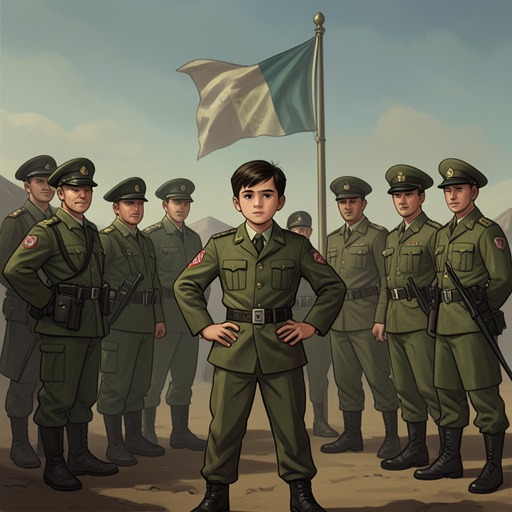
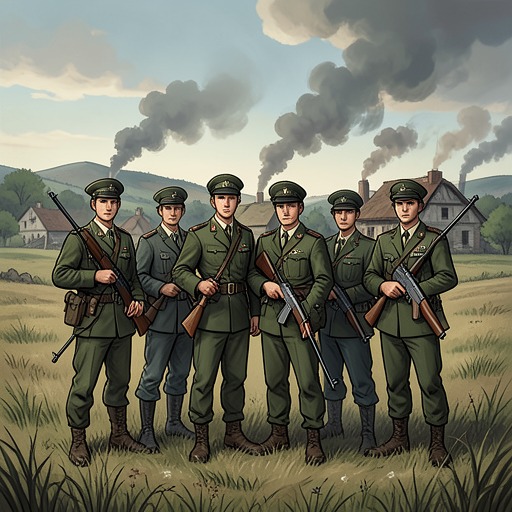
A Confederate battery then rushes past on foam-covered horses, and the cry that the Yankees are coming sends people indoors to hide jewelry and silverware. Jack responds by calling the boys together rather than allowing fear to scatter them. Within half an hour, nineteen members of his company assemble, each carrying a loaded gun or pistol. Their formation is described as imposing despite their youth, and Jack gives the group a military identity by commanding, “Home Guard, attention!”
Jack frames the defense as a moral obligation to the household. He asks whether the boys will stand by him and help keep his mother’s house from being ransacked, and they answer affirmatively, with some acclaiming him as “Captain Jack.” Old Ben also offers support, discreetly displaying a long, old-fashioned pistol and promising to act if anyone tries to shoot Jack. Jack’s gratitude toward Old Ben reveals that the defense is sustained by personal loyalty as well as military display: the plantation’s protection gathers family, servant, and neighborhood boys into a common cause.
The immediate danger comes not from the regular cavalry that passes the homestead, but from a following company of guerrillas. The narrative characterizes these men as followers of every army who fight chiefly in order to loot afterward. Their purpose is thus sharply separated from that of regular troops. They exploit the disorder of battle, treating movement through the countryside as an opportunity for plunder rather than as service to a recognizable military objective.
The Confrontation with Sandy Barnes
Sandy Barnes orders his guerrillas toward the house, and Jack draws the Home Guard across the lawn in front of the homestead. When Barnes demands to know what the boys are doing there, Jack answers that they are the guard of the house. He refuses to retreat when the guerrilla tells them to clear the way, and the boys support him by declaring that they will fight and ordering the intruders to keep back.
Jack’s argument is deliberately concrete. He states that the property is private and must be respected, then adds that the house is functioning as a hospital for six wounded Confederates in the care of a surgeon. This appeal distinguishes his position from simple partisan hostility. Jack is not claiming the house as a battlefield objective; he is insisting that its domestic and humanitarian status imposes limits on armed men who enter it. His defense also exposes the contradiction in the guerrillas’ conduct: men ostensibly moving amid war claim the privileges of force while disregarding the most basic protection for property and the wounded.
The standoff becomes physically immediate when Barnes steps toward a side door. Jack runs in front of him and raises his sword, warning him not to take another step. Barnes responds by raising his own sword, while some of his men lift their guns. Marion watches from a window in fearful silence, understanding that Jack’s resolve may cost him his life. The scene’s tension comes from the imbalance between the boys’ youth and the guerrillas’ weapons, but Jack’s whitened face and continued refusal show that courage here is not the absence of fear; it is action maintained while fear is visible.
Colonel Stanton’s Intervention
The confrontation is broken by a shout from the road and the appearance of a regiment of regular Federal troops. The guerrillas recognize the regiment as Colonel Stanton’s and know that its commander will not tolerate their behavior. Barnes therefore orders an immediate withdrawal, leading his men by a side road toward the distant hills. As they flee, the Federal regiment fires a volley that brings several of them down. The guerrillas are treated as outlaws rather than as an honored military formation, and their hurried escape confirms the precarious legitimacy of their enterprise.
Colonel Stanton then halts his regiment and rides toward Jack and the Home Guard. Jack anxiously asks whether the troops intend to do anything to the plantation, emphasizing again that it is private property and that six wounded men are under a surgeon’s care. Stanton answers that an officer who is a gentleman respects private property and assures Jack that, provided nothing treacherous is done, neither Jack nor the household has anything to fear from his men. His words establish a standard of military restraint that the guerrillas had rejected.
Jack’s immediate judgment of Stanton is shaped by this contrast. He regards the Federal colonel as a gentleman and recognizes the difference between Stanton’s disciplined authority and the guerrilla who threatened him with a sword. The encounter therefore plants a relation between Jack and Colonel Stanton before the later revelations of their family connection. Their first meaningful contact is ethical and public: Stanton earns Jack’s respect by protecting the boundary between military necessity and civilian abuse.
Consequences and Narrative Significance
The defense succeeds without the Home Guard having to fire upon the guerrillas. Jack’s company makes the plantation’s status unmistakable, the hospital’s presence strengthens the claim to protection, and the arrival of regular troops prevents Barnes from turning the threat into an assault. The scene consequently presents local courage and formal authority as complementary when both are directed toward restraint rather than plunder.
Its consequences extend beyond the immediate standoff. Later events connect Colonel Stanton to the wreck that first explains Jack’s mysterious past: while ill, the colonel cries out about a shipwreck and asks that his wife Laura and his son Jack be saved. The plantation defense thus precedes a deeper recognition. Jack has already admired Stanton’s conduct before learning that the wreck, the unidentified mother whose clothing and ring were preserved, and the recovered black tin box are parts of the same buried history. When the tin box is eventually recovered from the outlaws’ camp and returned to Colonel Stanton, its papers remove the final obstacle between the colonel and his fortune. The earlier defense consequently stands at the intersection of two plot lines: it protects the Ruthven household in the present and brings Jack into the orbit of the man whose identity will explain his past.
The episode also provides a sustained contrast between kinds of wartime power. Barnes uses armed presence to threaten property and patients; Jack uses weapons to prevent that abuse; Stanton uses regular military authority to restore order without violating the household’s rights. The plantation, briefly exposed to cavalry, guerrillas, wounded soldiers, and Federal troops, becomes a test of whether force will serve greed, courage, or law. Jack’s answer is the formation of the Home Guard and his refusal to yield the doorway, making this action a defining demonstration of his emerging leadership.