Union Army
Young Captain Jack · The Son of a SoldierThe Union Army is the Federal military force that advances through the Oldville district during the American Civil War and reshapes the meaning of military power around the Ruthven home. Its decisive significance lies not simply in defeating Confederate forces, but in presenting an alternative wartime authority: disciplined, restrained, and capable of recognizing private property and humanitarian obligations even while fighting the South. Its conduct throws the behavior of the guerrillas into sharp relief and gives material form to the novel’s contrast between legitimate military duty and violence pursued for plunder.
Advance into Oldville
The Union Army enters the local story after the army of the North has steadily pressed the army of the South backward. The Confederate encampment comes within less than four miles of Jack Ruthven’s home, and cannon fire can be heard for two days. In Oldville, the approaching Federal advance produces fear of invasion, pillage, and the destruction of homes; the stores close, trade has already been damaged by the war, and the inhabitants gather anxiously as reports of Confederate retreat spread.
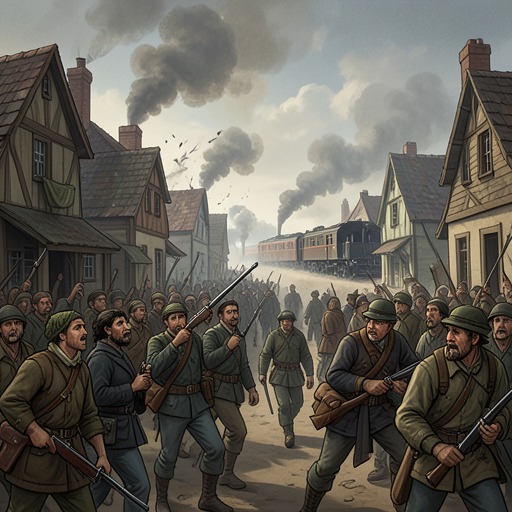
The crisis becomes immediate when cannon fire erupts from the mountain above the town and Federal troops appear. The soldiers have been fighting hard and are nearly exhausted, yet their arrival fills the roads, the green, and the streets before the army begins a systematic retreat northward. This movement makes the Union Army both a battlefield force and a presence that reorganizes civilian space: commercial life stops, roads become military corridors, and the Ruthven plantation becomes exposed to whatever follows the regular troops.
Discipline and the Ruthven Home
The clearest distinction between the Union Army and irregular violence appears when a Federal regiment follows cavalry past the Ruthven homestead. The house contains six wounded Confederates lying on cots in the sitting room, where a young surgeon works while Mrs. Ruthven and Marion Ruthven assist him. The presence of wounded enemy soldiers turns the mansion into a temporary hospital and places the approaching army before an ethical test: it can treat the house as hostile property, or it can recognize the limits imposed by the wounded and the civilian household.
A company of guerrillas comes behind the cavalry, described as men who fight chiefly in order to loot afterward. Their captain, Sandy Barnes, orders his men toward the house despite Jack Ruthven’s warning that the property is private and that the building is functioning as a hospital. Jack draws the nineteen boys of his Home Guard across the lawn; each has a loaded gun or pistol, and the boys prepare to resist the threatened raid. Jack’s defense is explicitly tied to property and medical protection rather than to an attempt to change the battle’s outcome.
The guerrillas raise weapons and threaten Jack until the Union Army appears on the road. Recognizing Colonel Stanton’s regiment, the guerrillas withdraw toward the hills, and the Federal troops fire a volley that brings several of them down. Colonel Stanton then halts his regiment and asks what has happened. Jack explains that the Home Guard has been defending the house from men who intended to ransack it, and he repeats that six wounded Confederates are inside under a surgeon’s care.
Colonel Stanton answers that an officer who is a gentleman respects private property and that Jack and the household have nothing to fear so long as they act without treachery. He does not confiscate the plantation or punish the defenders for protecting it. Jack consequently judges Stanton to be a gentleman and notices the moral distance between the colonel and Barnes, whose sword and threatened raid represent a lawless form of wartime power.
Colonel Stanton’s Regiment and Harry Powell
The Union regiment establishes its camp a short distance up the road from the Ruthven home. Its presence initially alarms the neighborhood, but the inhabitants become calmer when they see that Colonel Stanton is a strict disciplinarian who does not permit pilfering. The Confederate troops depart for an uncertain destination, leaving the Union Army as the organized military authority immediately surrounding the plantation. The narrative therefore defines Federal occupation through restraint as much as through force.
Attached to Stanton’s regiment is Harry Powell, a young surgeon and nephew of Mrs. Ruthven. Powell had moved to Philadelphia years earlier, built a medical practice there, and become thoroughly opposed to slavery. When war begins, he joins the Federal troops without delay. His decision horrifies his aunts and his cousin Marion Ruthven, while St. John Ruthven dismisses it as evidence that Harry has no head on his shoulders. Powell’s service makes the Union Army a family issue as well as a political one: the regiment carries a member of the Ruthven family back into a household that regards the Federal cause as an assault on its section.
Harry tells Old Ben that he is fighting for the old flag and wants all colored people to be free, as Old Ben is. His explanation joins military service to emancipation and gives the Union Army an explicit moral purpose within the novel. Yet the scene also preserves the emotional strain of divided allegiance. Harry does not cease to be Mrs. Ruthven’s nephew or Marion’s relative because he wears a Federal uniform; instead, the uniform makes kinship, regional identity, and political conviction impossible to keep separate.
National Allegiance and Wartime Conduct
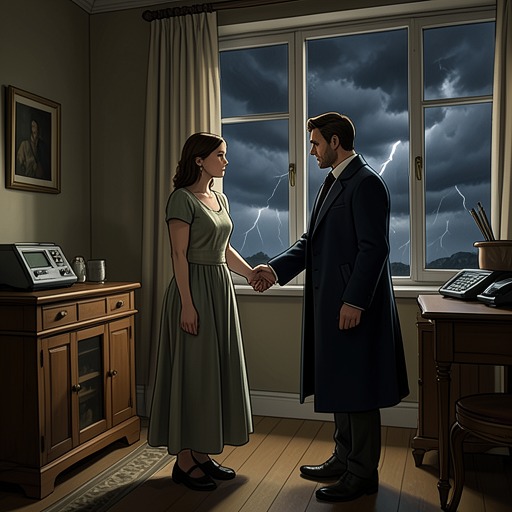
The Union Army’s representative authority is also expressed in Colonel Stanton’s attempt to distinguish opposition to a section from opposition to the country. When Mrs. Ruthven asks whether he is not in arms against her country, Stanton replies that he is against her section but not against the country, fighting under a flag belonging alike to the South and the North. His formulation presents the Federal cause as national rather than merely Northern and anticipates the novel’s larger movement toward national reconciliation.
This claim is tested repeatedly by the conduct of soldiers and irregular forces. The Federal troops protect the Ruthven property from guerrillas, while the guerrillas later fight Old Ben and two Home Guard boys who attempt to stop them from stealing horses from the stable. The contrast is not abstract: it is visible in who guards a house, who treats wounded men, who respects property, and who turns military disorder into opportunity for theft. The Union Army is not portrayed merely as an invading mass; under Stanton, it is an institution whose discipline limits the damage war can inflict on civilians.
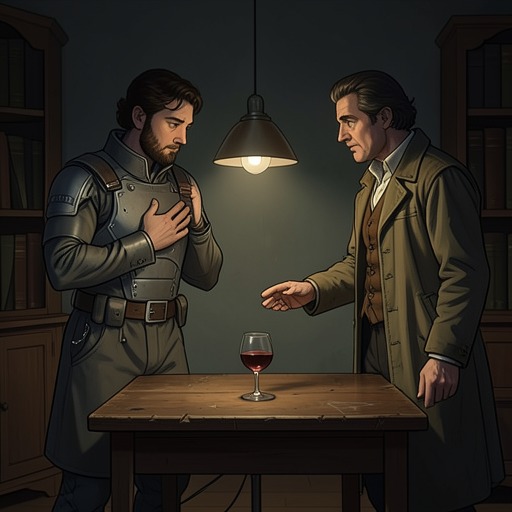
The contrast becomes sharper when Dr. Mackey uses Confederate soldiers to seize Jack Ruthven. After Jack calls the physician a fraud, Mackey threatens to make him suffer, orders soldiers to conduct him to the Confederate camp, and later holds Jack and his companions in a guerrilla cave for two days under brutal conditions and with barely enough food to prevent starvation. These episodes are not actions of the Union Army, but they clarify the standard against which Federal authority is measured. Stanton’s refusal to molest a hospital and Mackey’s use of armed men for coercion belong to opposed systems of wartime conduct.
Narrative Significance
The Union Army functions as a moving institution of judgment within the novel. Its advance creates fear, but its presence also exposes the difference between rumor and conduct: men in Oldville hear that Northern soldiers will loot and burn, while Colonel Stanton demonstrates that his regiment will not tolerate pilfering. The war’s public arguments are thus corrected, or at least complicated, by local encounters involving a plantation, a shop, a hospital, horses, and the testimony of people who must live through the army’s passage.
Its officers and soldiers also broaden the story beyond the private mystery surrounding Jack. Colonel Stanton’s regiment brings Harry Powell into the plot, gives Jack an encounter with a Federal commander whose ethics he can recognize, and turns the Ruthven home into a threshold between Confederate retreat and Federal advance. The Union Army’s most important effect is therefore institutional and moral: it supplies a model of national authority that can fight, occupy, and enforce order without reducing every opposing person to legitimate prey. In the world of the novel, that distinction makes the Federal cause part of the developing argument for freedom, lawful conduct, and eventual reunion rather than only an instrument of military victory.