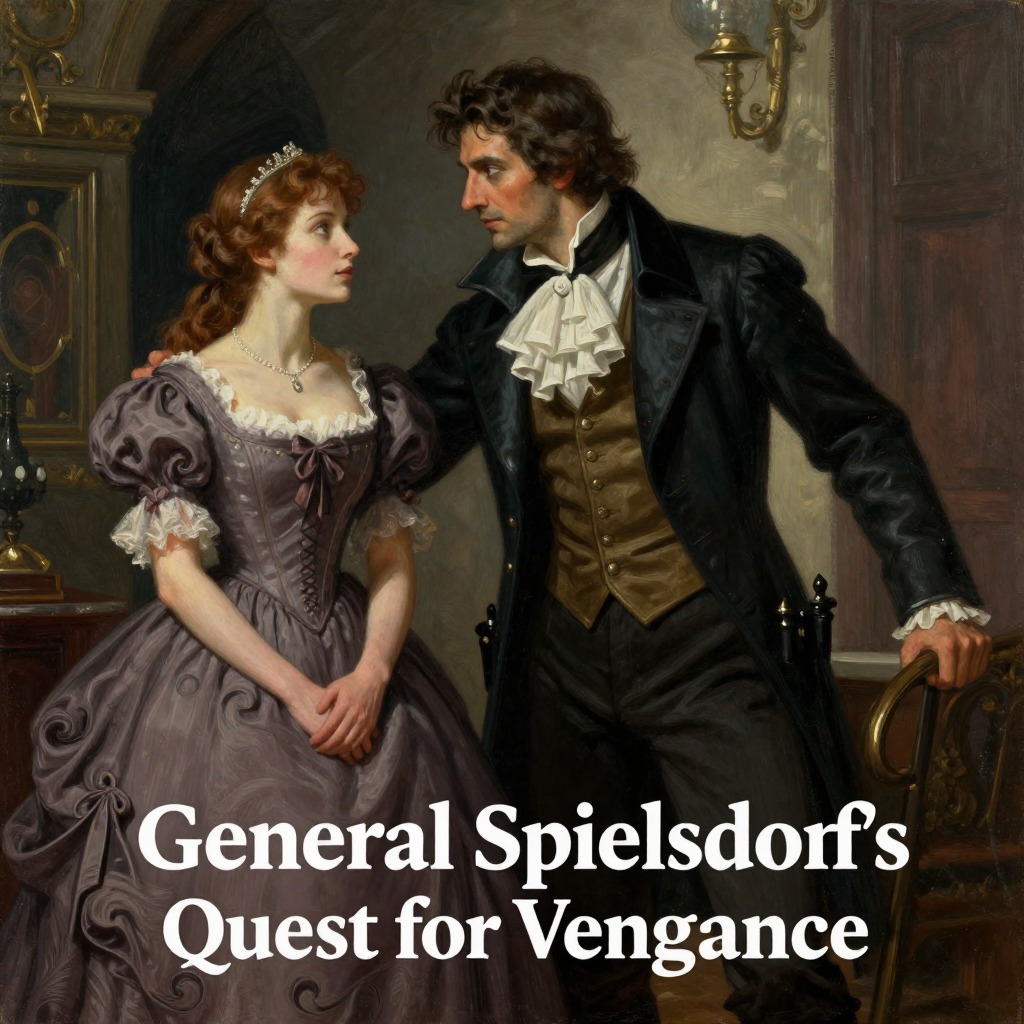
General Spielsdorf's story of the masked ball and Bertha's death
General Spielsdorf's story of the masked ball and Bertha's death is the narrative hinge of Sheridan Le Fanu's Carmilla, the moment when the novel's two parallel plots—Laura's mysterious illness and the General's bereavement—converge into a single horrifying revelation. Delivered during a carriage ride to the ruined village of Karnstein, the General's account transforms the reader's understanding of Carmilla from a beautiful, languid guest into a predatory vampire who has already killed once and is now draining Laura's life. The story is a confession of the General's own blindness, a chronicle of Bertha's decline, and a declaration of vengeance that will culminate in the exhumation and destruction of the vampire.
The Masked Ball and the First Encounter
The General's narrative begins with an invitation to the Count Carlsfeld's schloss, about six leagues beyond Karnstein, for a series of fetes honoring the Grand Duke Charles. The night from which his sorrow dates was devoted to a magnificent masquerade. The grounds were thrown open, the trees hung with colored lamps, and fireworks were displayed such as Paris itself had never witnessed. The finest instrumental band in the world and the finest singers from the great operas of Europe performed ravishing music that stole from the silence of groves or rose from boats upon the lake. The General, carried back into the romance of his early youth, felt himself transported. When the fireworks ended and the ball began, the company returned to the noble suite of rooms thrown open to the dancers. It was a very aristocratic assembly, and the General was almost the only "nobody" present. Bertha, his ward, was looking quite beautiful, her excitement and delight adding an unspeakable charm to her features. She wore no mask. The General remarked a young lady, dressed magnificently but wearing a mask, who appeared to be observing Bertha with extraordinary interest. He had seen her earlier in the evening in the great hall and again walking near them on the terrace under the castle windows. A lady, also masked, richly and gravely dressed with a stately air like a person of rank, accompanied her as a chaperon. Had the young lady not worn a mask, the General could have been much more certain whether she was really watching his poor darling; he is now well assured that she was.
The Seduction of Bertha and the General's Blindness
In one of the salons, while Bertha rested near the door, the two masked ladies approached. The younger took the chair next to Bertha, while her companion stood beside the General and addressed herself in a low tone to her charge. Availing herself of the privilege of her mask, the elder lady turned to the General and, calling him by name, opened a conversation that piqued his curiosity. She referred to many scenes where she had met him—at Court and at distinguished houses—and alluded to little incidents he had long ceased to think of, which instantly started into life at her touch. The General became more and more curious to ascertain who she was, but she parried his attempts to discover adroitly and pleasantly. The knowledge she showed of many passages in his life seemed all but unaccountable. In the meantime, the young lady, whom her mother called by the odd name Millarca, had with the same ease and grace entered into conversation with Bertha. She introduced herself by saying that her mother was a very old acquaintance of the General. She spoke of the agreeable audacity a mask rendered practicable, talked like a friend, admired Bertha's dress, and insinuated very prettily her admiration of Bertha's beauty. She amused Bertha with laughing criticisms upon the people who crowded the ballroom. After a time they had grown very good friends, and the young stranger lowered her mask, displaying a remarkably beautiful face. Though it was new to them, the features were so engaging and lovely that it was impossible not to feel the attraction powerfully. Bertha was taken with her at first sight, and the stranger herself seemed quite to have lost her heart to Bertha. The General, meanwhile, continued his conversation with the elder lady, who refused to remove her mask or reveal her identity. She told him she would pass his schloss in three weeks and renew a friendship she never thought of without a thousand pleasant recollections. Then, with a sudden urgency, she explained that a piece of news had reached her like a thunderbolt and she must set out immediately on a journey of nearly a hundred miles. She made a petition: that the General would take charge of her daughter during her absence. Bertha, at that moment, came to the General's side and besought him to invite her new friend Millarca to pay them a visit. The two ladies assailed him together, and the refined and beautiful face of the young lady, with its elegance and fire of high birth, determined him. He submitted and undertook the care of Millarca. The elder lady whispered a few words to her daughter, kissed her hurriedly twice, and went away accompanied by a pale gentleman in black. The General, reflecting on the folly of his act, felt a moment's regret, but Millarca was so beautiful that he relented and determined to make amends for his unavowed churlishness. She replaced her mask, joined Bertha in persuading him to return to the grounds, and became very intimate with them, amusing them with lively descriptions and stories of the great people they saw. The ball continued until the morning sun had almost reached the horizon; the Grand Duke danced till then, so loyal people could not go away or think of bed. As they passed through a crowded saloon, Bertha asked what had become of Millarca. They had lost her. All efforts to find her were vain. The General now recognized in full force the folly of having undertaken the charge of a young lady without knowing her name, and fettered as he was by promises, he could not even point his inquiries by saying she was the daughter of the Countess who had departed. Morning broke, and it was clear daylight before he gave up his search. Not until near two o'clock the next day did they hear anything of his missing charge. A servant knocked at Bertha's door to say that a young lady in great distress had asked to find the General Baron Spielsdorf and the young lady his daughter, in whose charge she had been left by her mother. Millarca had turned up. "Would to heaven we had lost her!" the General exclaimed. She told Bertha a story to account for her failure to find them: very late, she had got to the housekeeper's bedroom in despair and had fallen into a deep sleep. That day Millarca came home with them. The General was only too happy to have secured so charming a companion for his dear girl.
The Decline and Death of Bertha
Soon, however, drawbacks appeared. Millarca complained of extreme languor, the weakness that remained after her late illness, and she never emerged from her room until the afternoon was far advanced. It was accidentally discovered that she was sometimes absent from her room in the very early morning and at various times later in the day, before she wished it to be understood that she was stirring. She was repeatedly seen from the windows of the schloss, in the first faint grey of the morning, walking through the trees in an easterly direction, looking like a person in a trance. This convinced the General that she walked in her sleep, but the hypothesis did not solve the puzzle of how she passed out from her room leaving the door locked on the inside, or how she escaped from the house without unbarring door or window. In the midst of these perplexities, an anxiety of a far more urgent kind presented itself. Bertha began to lose her looks and health in a manner so mysterious and horrible that the General became thoroughly frightened. She was at first visited by appalling dreams; then, as she fancied, by a specter, sometimes resembling Millarca, sometimes in the shape of a beast, indistinctly seen, walking round the foot of her bed from side to side. Lastly came sensations: one, not unpleasant but very peculiar, resembled the flow of an icy stream against her breast. At a later time, she felt something like a pair of large needles pierce her a little below the throat with a very sharp pain. A few nights after followed a gradual and convulsive sense of strangulation, then unconsciousness. The physician who attended her failed to produce the slightest impression on her disease. The General called in an abler physician from Gratz. Several days elapsed before he arrived. Having seen Bertha together, the two doctors withdrew to the library to confer. The General, from the adjoining room, heard their voices raised in something sharper than a strictly philosophical discussion. He entered and found the old physician from Gratz maintaining his theory while his rival combated it with undisguised ridicule and bursts of laughter. The first physician told the General, "My learned brother seems to think that you want a conjuror, and not a doctor." The physician from Gratz, looking displeased, said he would state his own view of the case in his own way another time and that he could be of no use. He seemed thoughtful, sat down at a table, and began to write. The other doctor, as the General turned to go, pointed over his shoulder to his companion and, with a shrug, significantly touched his forehead. The consultation left the General precisely where he was, all but distracted. The physician from Gratz overtook him in the grounds and apologized for following him, but said he could not conscientiously take his leave without a few words more. He told the General that he could not be mistaken; no natural disease exhibited the same symptoms, and death was already very near. There remained, however, a day or possibly two of life. If the fatal seizure were at once arrested, with great care and skill her strength might possibly return, but all hung now upon the confines of the irrevocable. He placed a note in the General's hands upon the distinct condition that he send for the nearest clergyman and open the letter in his presence, and on no account read it till he was with him. The ecclesiastic was absent, and the General read the letter by himself. The learned man's letter stated that the patient was suffering from the visits of a vampire. The punctures she described near the throat were, he insisted, the insertion of those two long, thin, and sharp teeth peculiar to vampires, and there could be no doubt as to the well-defined presence of the small livid mark which all concurred in describing as that induced by the demon's lips. Every symptom was in exact conformity with those recorded in every case of a similar visitation. The General, wholly skeptical as to the existence of any such portent as the vampire, considered the supernatural theory but another instance of learning and intelligence oddly associated with some one hallucination. Yet, rather than try nothing, he acted upon the instructions of the letter. He concealed himself in the dark dressing room that opened upon Bertha's room, in which a candle was burning, and watched there until she was fast asleep. He stood at the door, peeping through a small crevice, his sword laid on the table beside him. A little after one, he saw a large black object, very ill-defined, crawl over the foot of the bed and swiftly spread itself up to the poor girl's throat, where it swelled in a moment into a great, palpitating mass. Petrified for a few moments, he sprang forward with his sword in hand. The black creature suddenly contracted toward the foot of the bed, glided over it, and, standing on the floor about a yard below the foot of the bed with a glare of skulking ferocity and horror fixed on him, he saw Millarca. He struck at her instantly with his sword, but she stood near the door unscathed. Horrified, he pursued and struck again. She was gone, and his sword flew to shivers against the door. The whole house was up and stirring. The specter Millarca was gone, but her victim was sinking fast, and before the morning dawned, Bertha died.
The Revelation and the Hunt
The General's story, delivered as the carriage approaches the ruins of Karnstein, is punctuated by his bitter self-recrimination. He curses his conceited incredulity, his despicable affectation of superiority, his blindness, his obstinacy—all too late. He now knows that the creature who called herself Millarca is the same being who, under the name Carmilla, is Laura's guest. The narrative establishes the vampire's method: a seductive courtship, a gradual draining of life through nightly visitations, and a complete indifference to the suffering of her victims. The General's purpose in telling the story is not merely to warn but to enlist Laura's father in his mission of vengeance. He has come to Karnstein to find the tomb of Mircalla, Countess Karnstein, and to decapitate the monster. "To strike her head off," he declares, with a fierce flush and a stamp that echoes through the hollow ruin. The story thus serves as both a confession of failure and a declaration of war, setting the stage for the confrontation that will follow in the chapel.