I live in you; and you would die for me
In Sheridan Le Fanu's Carmilla, the vampire Carmilla speaks the line "I live in you; and you would die for me, I love you so" to Laura during a moonlit walk, encapsulating the predatory, possessive, and erotic nature of her attachment. This utterance, delivered in a moment of intense intimacy, reveals the vampire's core strategy: to bind her victim through a declaration of love that is simultaneously a threat, a promise, and a demand for total self-surrender. The phrase functions as a key expression of the story's central dynamic, where the language of romantic devotion is weaponized to mask a lethal, parasitic consumption.
Context and Delivery
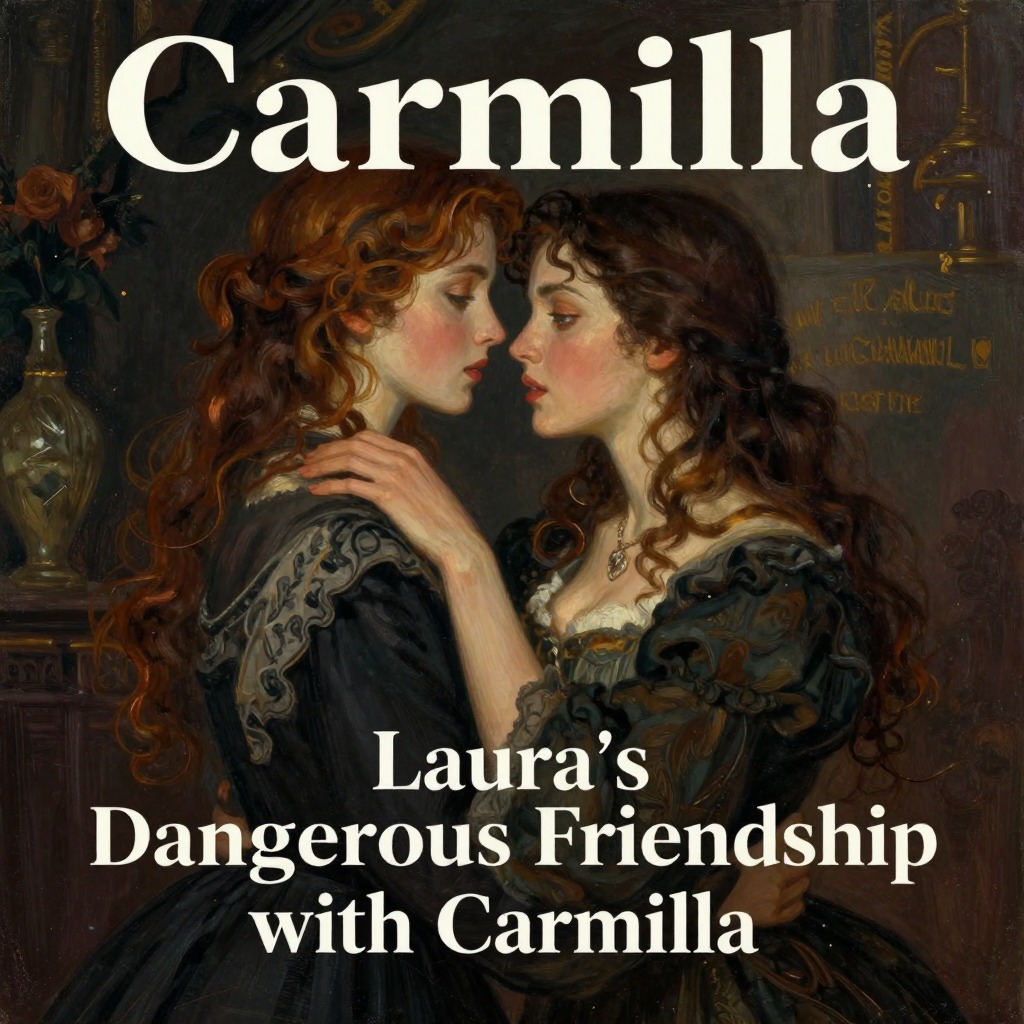
The line is spoken on the night of the discovery of the portrait of Mircalla, Countess Karnstein, a painting that bears an uncanny resemblance to Carmilla. Laura has just asked her father if she may hang the picture in her room, and the two young women have stepped outside to walk in the moonlight. As they stand on the drawbridge, with the beautiful landscape opening before them, Carmilla draws Laura closer, lets her head sink upon Laura's shoulder, and murmurs with tumultuous sighs that seem almost to sob. When Laura playfully suggests that Carmilla must have been in love, Carmilla whispers that she has never been in love with anyone and never shall be, "unless it should be with you." Then, pressing a trembling hand in Laura's, she delivers the line: "Darling, darling, I live in you; and you would die for me, I love you so." The moment is charged with a strange, shy intensity; Laura immediately starts back, and Carmilla's face becomes colorless and apathetic, as if she had been dreaming.
Thematic Significance
The phrase operates on multiple levels. On its surface, it mimics the hyperbolic language of romantic love, a declaration of mutual belonging and devotion. But the vampire's words invert the conventional meaning: Carmilla does not say she would die for Laura, but that Laura would die for her. The "living in you" is not a metaphor for emotional closeness but a literal description of the vampire's parasitic existence, sustained by draining the life of her victim. The line thus collapses the distinction between love and predation, presenting the act of consumption as the ultimate form of intimacy. This inversion is central to the novel's exploration of the vampire as a figure who exploits the very structures of affection and hospitality—the trust of a guest, the warmth of a friend—to gain access to her prey. Carmilla's language throughout the story is filled with such paradoxes: she speaks of "the rapture of that cruelty, which yet is love," and tells Laura that "love will have its sacrifices. No sacrifice without blood." The phrase "I live in you; and you would die for me" is the most concentrated expression of this logic, a seductive promise that is also a death sentence.
Narrative Role and Evaluation
The line marks a turning point in Laura's perception of Carmilla. Immediately after hearing it, Laura starts away, and the spell is momentarily broken. She later reflects that Carmilla's "strange paroxysms of languid adoration" shocked her "like a momentary glare of insanity." Yet the phrase also exerts a powerful, ambiguous hold on Laura's memory. Even years after the events, she writes that the image of Carmilla returns "with ambiguous alternations—sometimes the playful, languid, beautiful girl; sometimes the writhing fiend." The line itself embodies this ambiguity: it is both a declaration of love and a prophecy of death, and Laura can never fully separate the two. In the broader context of the vampire narrative, the phrase serves as a key piece of evidence for the reader, revealing the true nature of Carmilla's interest in Laura long before the characters themselves fully understand it. It is a moment of dramatic irony, where the reader is invited to see the horror beneath the romance, and to recognize that the most dangerous predator is the one who speaks the language of love.