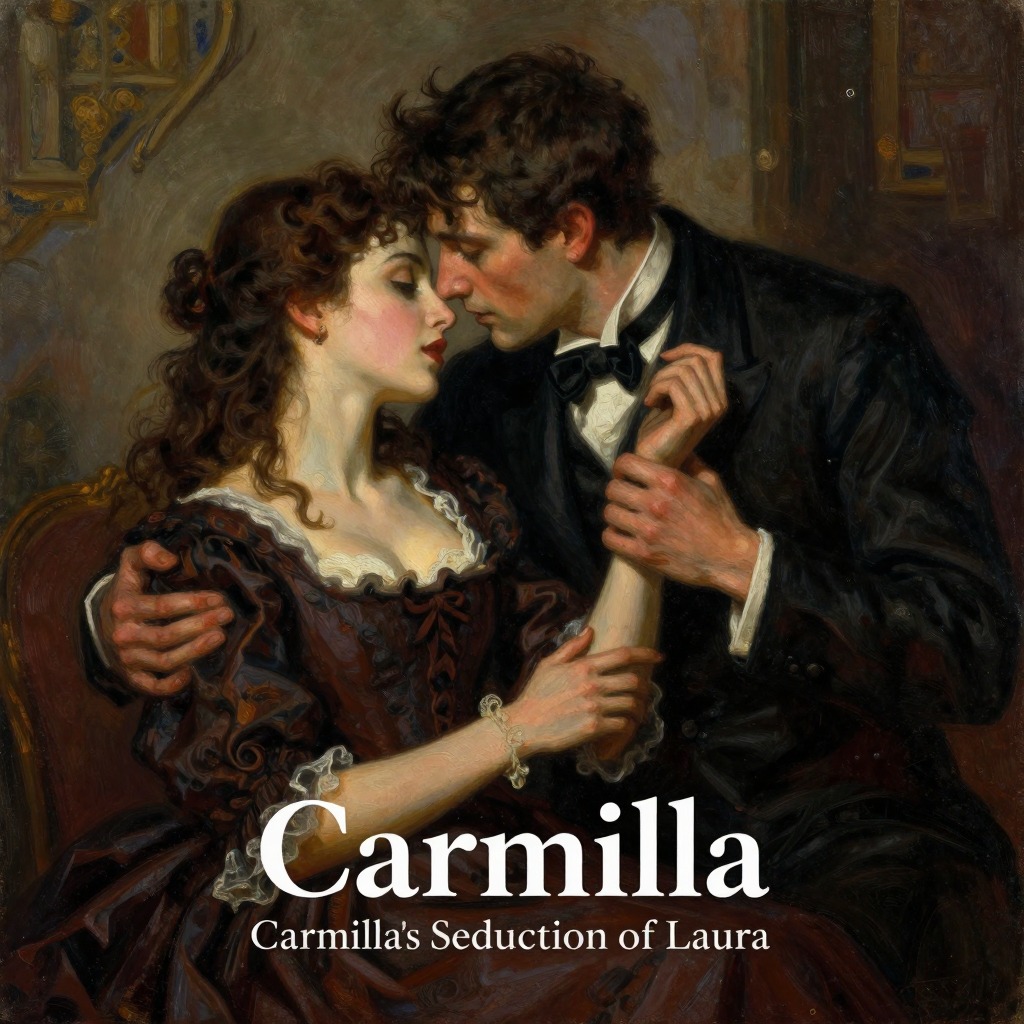
Your mother warns you to beware of the assassin
The phrase "Your mother warns you to beware of the assassin" appears in Laura's narrative as the spoken content of a dream that marks a critical turning point in her ordeal. It is the first time an external voice—one she identifies as her dead mother's—intervenes in her consciousness, and the warning is immediately followed by a horrifying visual revelation that shatters any remaining ambiguity about the nature of her suffering.
The Dream and Its Vision
One night, instead of the voice Laura had grown accustomed to hearing in the dark—a deep, female voice speaking slowly from a distance—she heard one that was "sweet and tender, and at the same time terrible." This voice said, "Your mother warns you to beware of the assassin." At the same moment, a light unexpectedly sprang up, and Laura saw Carmilla standing near the foot of her bed, in her white nightdress, "bathed, from her chin to her feet, in one great stain of blood." The dream thus combines an auditory warning from a maternal source with a stark, blood-drenched image of the very person who has become the object of Laura's intense, ambivalent attachment.
Immediate Aftermath and Discovery
Laura wakened with a shriek, possessed by the single idea that Carmilla was being murdered. She sprang from her bed and found herself on the lobby, crying for help. Madame Perrodon and Mademoiselle De Lafontaine came running out in alarm, and Laura insisted they knock at Carmilla's door. Their knocking was unanswered, and it soon became a pounding and an uproar. They shrieked Carmilla's name, but all was vain. The door was locked. In panic, they hurried back to Laura's room and rang the bell long and furiously. Servants soon came running up the stairs, and Laura ordered the men to force the lock. When they did, the party stood in the doorway, holding their lights aloft, and stared into the room. Everything was undisturbed—exactly in the state Laura had left it on bidding Carmilla good night—but Carmilla was gone. The dream's warning had not prevented the disappearance; it had instead framed it as a consequence of an unseen, predatory presence.
Narrative and Thematic Significance
The dream functions as a moment of anagnorisis, or recognition, within the Gothic structure of the tale. Laura's mother, who died in Laura's infancy and whom she does not even remember, speaks from beyond the grave, lending the warning an authority that transcends ordinary knowledge. The phrase "beware of the assassin" is ambiguous: it could refer to a literal murderer, but in the context of the story's developing revelation, it points to the vampire who drains life under the guise of love. The blood-soaked figure of Carmilla literalizes the parasitic nature of their relationship—Carmilla has been drawing Laura's life from her, and the dream exposes this truth in a single, indelible image. The warning also echoes the earlier letter from General Spielsdorf, who wrote of "the fiend who betrayed our infatuated hospitality," and it anticipates the final confrontation at the Chapel of Karnstein, where Carmilla is revealed as the vampire Mircalla, Countess Karnstein. The dream thus condenses the story's central horror: that the beloved companion is the assassin, and that the mother's love, though silent for years, breaks through the barrier of death to issue a desperate caution.