Last Night to Stay
Last Night to Stay is the precarious, informal rule that governs the narrator's shelter in Knut Hamsun's Hunger: a penniless lodger may be granted one final night's accommodation before being turned out, a reprieve that is never guaranteed and must be renegotiated at every crisis. The rule is not written into any statute but is enforced by the practical discretion of landlords and the tacit knowledge of the police, who know that a man without a roof cannot simply be abandoned in the street at night. It recurs as a structural rhythm in the narrator's homelessness, each time pushing him closer to the absolute destitution that defines his existence in Christiania.
The Rule in Practice: The Landlady's Ultimatum
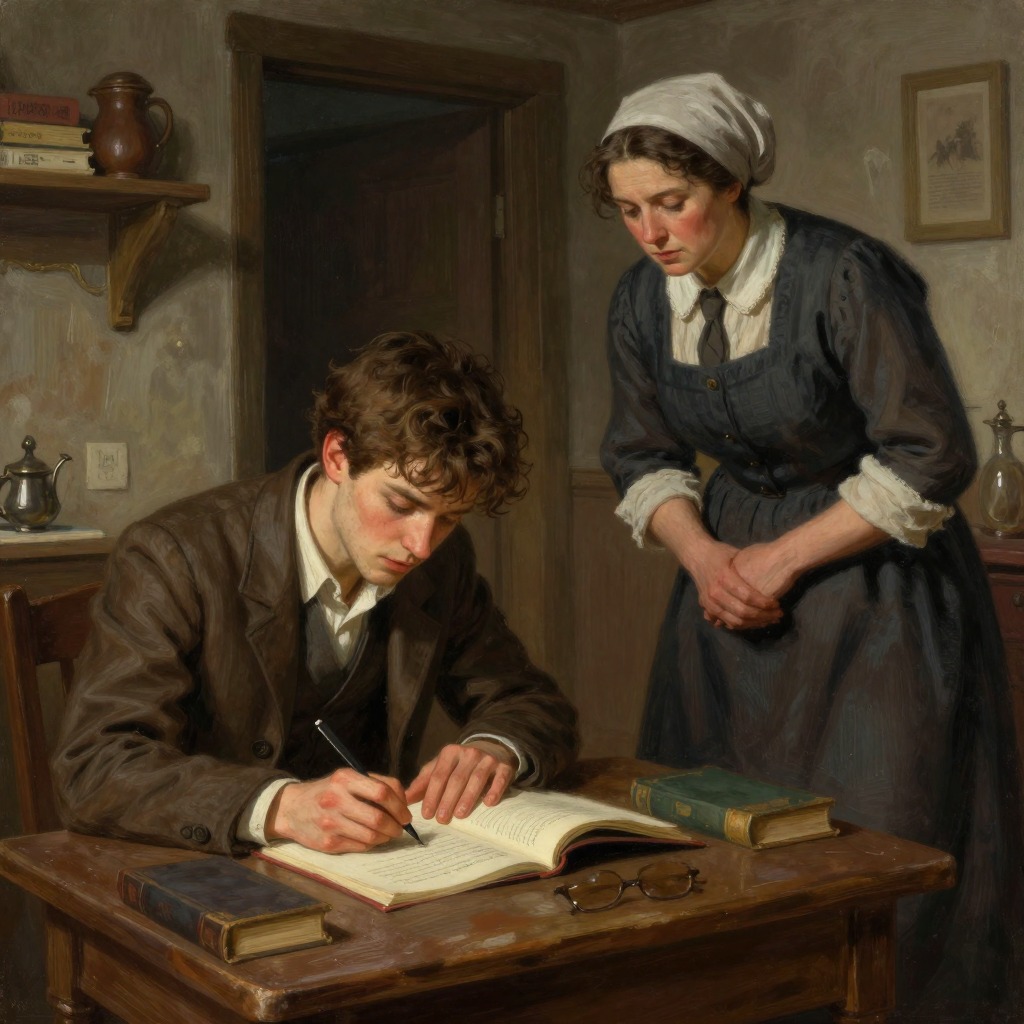
The most explicit articulation of the rule comes from the landlady of the lodging house in Vaterland, where the narrator has stayed for three weeks without paying. She confronts him directly: "But this is the last night you sleep here, so now you know it" . The phrase is a formal declaration, not a threat—it acknowledges that even a debtor cannot be thrown into the street immediately, but that the grace period has a hard limit. The narrator accepts this without protest, replying simply "Yes, yes" , and he sleeps that night in the anteroom on the floor, knowing that by morning he must be gone. The rule thus functions as a minimal social safety net: it prevents instantaneous eviction but does nothing to solve the underlying crisis.
The Police as Enforcers of the Rule
The police, too, operate by a version of the same principle. When the narrator is found sleeping on a bench near the railway bridge, a policeman wakes him and says, "So, that's right, get up now" , but does not arrest him. Later, when he is homeless and reports himself at the guard-house, the officer on duty gives him a ticket for breakfast and a bed for the night . The police do not offer permanent shelter; they enforce the rule that a man cannot be left to freeze or starve in plain sight, but they also ensure he moves on. When the narrator creates a disturbance in the street, a constable tells him, "No disturbance in the street; so, march" , and when he tries to pawn his glasses, the pawnbroker dismisses him with "Oh, God help you, go your way" . The rule is not kindness; it is a minimal, grudging tolerance that keeps the destitute from dying in public view.
The Landlord's Intervention: A Legal Exception
A rare exception to the rule's harshness occurs when the landlady tries to evict the narrator on the spot. Her husband intervenes, saying, "No, it won't do to turn folk out at night; do you know one can be punished for doing that?" . This is the only moment in the novel where a character explicitly cites a legal prohibition against night eviction. The landlady backs down, and the narrator is allowed to stay one more night. The rule, in this instance, is not merely a custom but a recognized legal boundary that even a hostile landlord must respect. Yet the reprieve is temporary: the next morning, the landlady finds the narrator sitting in his former room and shrieks, "If you don't go out, now, may God blast me, but I'll fetch the police!" , and he is forced to leave immediately.
The Rule as a Recurring Pattern
The "last night" rule is not a single event but a repeating structure in the narrator's life. It first appears in the opening pages, when he lies awake in his attic room, aware that his rent is overdue and that he must avoid his landlady . The room itself is a "gasping, sinister coffin" , and he steals out each morning to avoid detection. Later, after sleeping in Bogstad's Wood, he returns to the city and is told by a policeman that he must report himself as homeless . The rule governs his movements: he knows that the churchyard gates close at eight , that the park keeper will not let him sleep on a bench , and that the guard-house cell's gas will burn for only ten minutes . Each of these is a variant of the same principle: the city offers temporary, conditional shelter, but never permanent refuge.
The Rule's Thematic Significance
The "last night" rule encapsulates the novel's central tension between the narrator's desperate need for stability and the city's relentless refusal to provide it. Christiania is a "singular city, from which no man departs without carrying away the traces of his sojourn there" , and the rule is one of those traces: a constant reminder that the narrator belongs nowhere, that every shelter is provisional, and that his existence is a series of deferrals rather than solutions. The rule is not a law but a practice, enforced by landlords, police, and pawnbrokers alike, and it reveals the thin line between social inclusion and absolute exclusion. The narrator's final departure on the Copégoro is the ultimate expression of this rule: he leaves Christiania because the city has no more "last nights" to offer him.